


doi: 10.1021/acs.jctc.3c01230.
Epub 2024 Feb 14.
Low-Scaling GW Algorithm Applied to Twisted Transition-Metal Dichalcogenide Heterobilayers
Affiliations
- PMID: 38353944
- PMCID: PMC10938508
- DOI: 10.1021/acs.jctc.3c01230
Item in Clipboard
Low-Scaling GW Algorithm Applied to Twisted Transition-Metal Dichalcogenide Heterobilayers
J Chem Theory Comput.
.
Abstract
The GW method is widely used for calculating the electronic band structure of materials. The high computational cost of GW algorithms prohibits their application to many systems of interest. We present a periodic, low-scaling, and highly efficient GW algorithm that benefits from the locality of the Gaussian basis and the polarizability. The algorithm enables G0W0 calculations on a MoSe2/WS2 bilayer with 984 atoms per unit cell, in 42 h using 1536 cores. This is 4 orders of magnitude faster than a plane-wave G0W0 algorithm, allowing for unprecedented computational studies of electronic excitations at the nanoscale.
Conflict of interest statement
The authors declare no competing financial interest.
Figures

G0W0 band
gap of monolayer WS2, MoS2, WSe2,
and MoSe2 calculated from eq 23 as a function of the supercell size (TZVP-MOLOPT
basis set, without spin–orbit
coupling (SOC)).
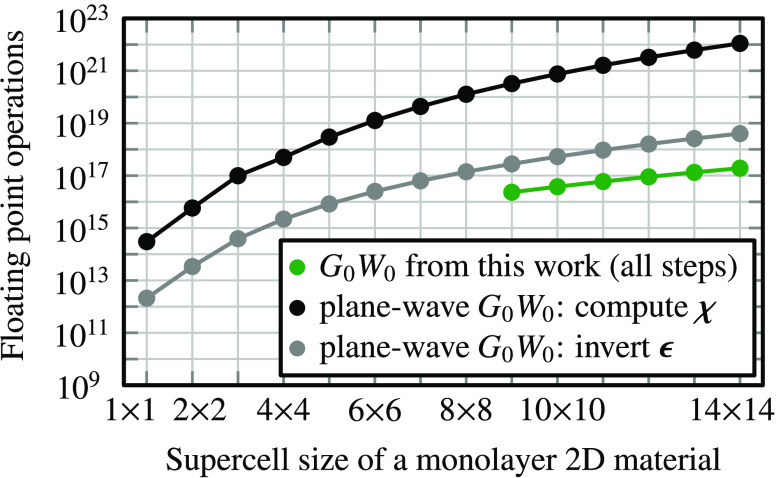
Number of floating point operations (real double precision)
needed
for executing G0W0 algorithms. Green: low-scaling G0W0 algorithm from this work using a TZVP-MOLOPT
basis set. Black: computing the irreducible
polarizability χ in a plane-wave basis. Gray: inverting
the dielectric matrix ϵ in a plane-wave basis.
Underlying computational parameters are typical for monolayers MoS2, MoSe2, WS2, and WSe2; see
the detailed raw data and discussion available in the SI .

Execution time of a G0W0 calculation for MoSe2 9 ×
9–14
× 14 supercells (TZVP-MOLOPT basis set) on Supermuc-NG (Intel
Skylake Xeon Platinum 8174). Magenta points show the computational
cost to diagonalize the polarizability χ(k), which
allows us to remove all spurious negative eigenvalues of χ(k) to ensure numerical stability. Dashed lines show a fit
of αNatβ to the execution time, where α
and β are fit parameters. Raw data are available in the SI .

Band gap of a MoSe2/WS2 heterostructure as
a function of the twist angle. Inset: The unit cell (black rhomboid)
for a 19.4° twist angle contains 984 atoms.
References
-
- Shabani S.; Halbertal D.; Wu W.; Chen M.; Liu S.; Hone J.; Yao W.; Basov D. N.; Zhu X.; Pasupathy A. N. Deep moiré potentials in twisted transition metal dichalcogenide bilayers. Nat. Phys. 2021, 17, 720–725. 10.1038/s41567-021-01174-7. - DOI
LinkOut - more resources
Full Text Sources