


"Make yourself un-NIMBY-able": stakeholder perspectives on strategies to mobilize public and political support for overdose prevention centers in the United States of America
- PMID: 38355641
- PMCID: PMC10868085
- DOI: 10.1186/s12954-024-00955-6
"Make yourself un-NIMBY-able": stakeholder perspectives on strategies to mobilize public and political support for overdose prevention centers in the United States of America
Abstract
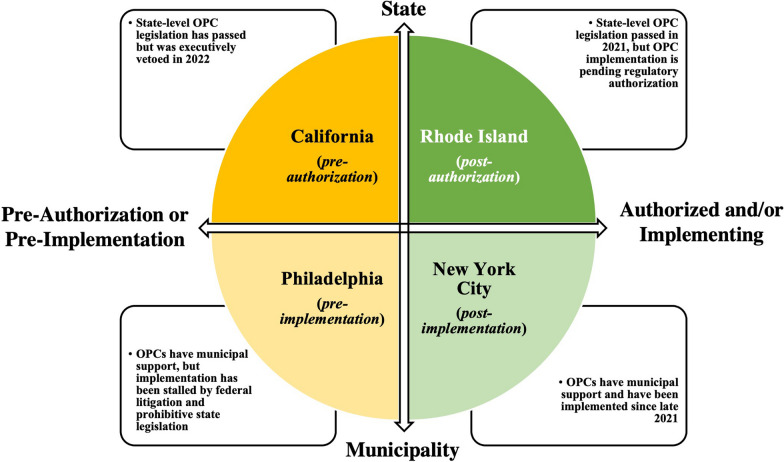
Background: Overdose prevention centers (OPCs), also known as supervised injection facilities and safe consumption sites, are evidenced-based interventions for preventing overdose deaths and drug-related morbidities. The pathways to legalizing OPCs in the USA have confronted multiple social, political, and legal obstacles. We conducted a multi-site, qualitative study to explore heterogeneities in these pathways in four jurisdictions, as well as to understand stakeholder perspectives on valuable strategies for galvanizing political and public support for OPCs.
Methods: From July 2022 to February 2023, we conducted 17 semi-structured, in-depth interviews with OPC policymakers, service providers, advocates, and researchers from California, New York City, Philadelphia, and Rhode Island, where efforts have been undertaken to authorize OPCs. Using inductive thematic analysis, we identified and compared contextually relevant, salient approaches for increasing support for OPCs.
Results: Participants described several strategies clustering around five distinct domains: (1) embedding OPC advocacy into broader overdose prevention coalitions to shape policy dialogs; (2) building rapport with a plurality of powerbrokers (e.g., lawmakers, health departments, law enforcement) who could amplify the impact of OPC advocacy; (3) emphasizing specific benefits of OPCs to different audiences in different contexts; (4) leveraging relationships with frontline workers (e.g., emergency medicine and substance use treatment providers) to challenge OPC opposition, including 'NIMBY-ism,' and misinformation; and (5) prioritizing transparency in OPC decision-making to foster public trust.
Conclusion: While tailored to the specific socio-political context of each locality, multiple OPC advocacy strategies have been deployed to cultivate support for OPCs in the USA. Advocacy strategies that are multi-pronged, leverage partnerships with stakeholders at multiple levels, and tailor communications to different audiences and settings could yield the greatest impact in increasing support for, and diffusing opposition to, future OPC implementation.
Keywords: Harm reduction; Injection drug use; Opioids; People who use drugs; Qualitative research; Supervised consumption sites.
© 2024. The Author(s).
Conflict of interest statement
JNP serves as a technical consultant on a grant funded by the U.S. Food and Drug Administration (U01FD00745501). The remaining authors have no competing interests to declare.
Figures
References
-
- Spencer MR, Miniño AM, Warner M. Drug Overdose Deaths in the United States, 2001–2021. Atlanta, GA: Centers for Disease Control and Prevention; 2022 Dec. (National Center for Health Statistics Data Briefs).
-
- Gladden RM, O’Donnell J, Mattson CL, Seth P. Changes in opioid-involved overdose deaths by opioid type and presence of benzodiazepines, cocaine, and methamphetamine: 25 states, July-December 2017 to January-June 2018. MMWR Morb Mortal Wkly Rep. 2019;68(34):737–744. doi: 10.15585/mmwr.mm6834a2. - DOI - PMC - PubMed
Publication types
MeSH terms
Grants and funding
LinkOut - more resources
Full Text Sources
Medical
