


Prevalence of pulmonary hypertension in children with obstructive sleep apnea living at high altitude
- PMID: 38356659
- PMCID: PMC10864626
- DOI: 10.1016/j.sleepx.2024.100106
Prevalence of pulmonary hypertension in children with obstructive sleep apnea living at high altitude
Abstract
Introduction: The prevalence of obstructive sleep apnea (OSA) is 1-4 %. Some reports describe its association with pulmonary hypertension (PH), but its prevalence is unknown. No studies at high altitude have determined the relationship between OSA and PH. The aim of this study was to establish the prevalence of PH in children diagnosed with OSA living in a high-altitude city at 2640 m above sea level.
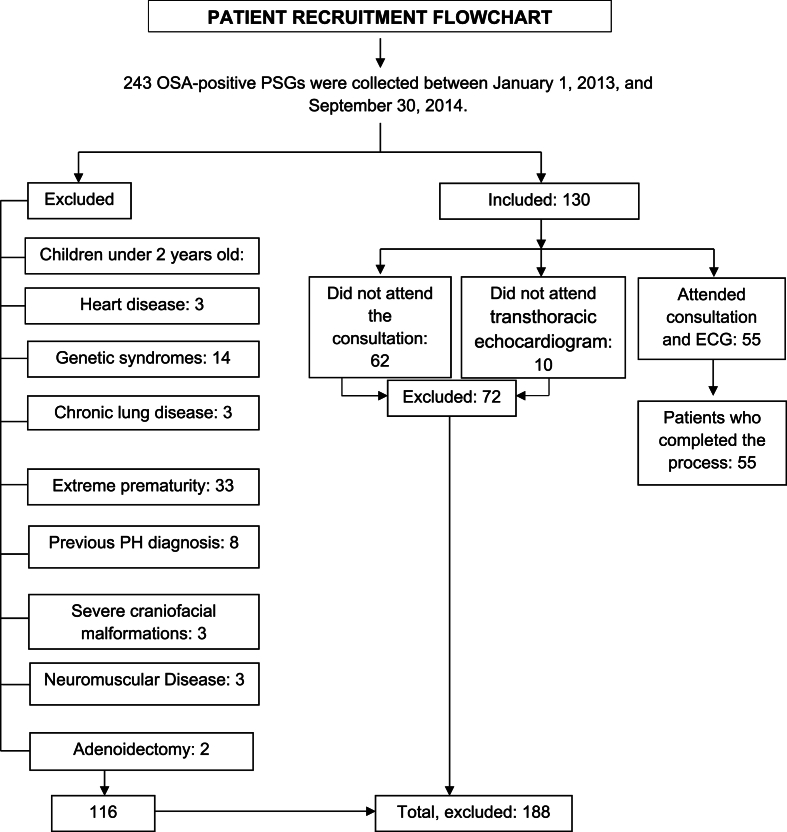
Methods: Children between 2 and 16 years of age referred to the Sleep Laboratory of the Fundación Neumológica Colombiana in Bogotá with a positive polysomnogram for OSA were included, and a two-dimensional transthoracic echocardiogram (TTE) was performed to evaluate PH. Statistical analysis was performed using median, interquartile range, chi-squared test, and Kruskall-Wallis test.
Results: Of the 55 patients (n: 55), 63.6 % were male, with a median age of 6 years, 14 children (25.5 %) were overweight; 12 children (21.8 %) had mild OSA, 12 (21.8 %) had moderate OSA and 31 (56.4 %) severe OSA. In patients with severe OSA, the minimum saturation during events was 78 % with a desaturation index (DI) of 33.8/hour (p < 0.01). T90 and T85 increased proportionally with OSA severity (p < 0.05). Of the 55 patients with OSA, none had PH according to echocardiography; 4 patients (7.2 %) had pulmonary artery systolic pressure (PASP) at the upper limit of normal (ULN), and it was not related to a higher body mass index (BMI).
Conclusions: We found no association between OSA and PH in children with OSA at high altitude.
Keywords: Children; High altitude; Obstructive sleep apnea; Prevalence; Pulmonary hypertension.
© 2024 The Authors.
Conflict of interest statement
The authors declare that they have no known competing financial interests or personal relationships that could have appeared to influence the work reported in this paper.
References
-
- Marcus C.L., Brooks L.J., Draper K.A., Gozal D., Halbower A.C., Jones J., et al. Diagnosis and management of childhood obstructive sleep apnea syndrome. Pediatrics. 2012;130(3):e714–e755. - PubMed
-
- Blechner M., Williamson A.A. Consequences of obstructive sleep apnea in children. Curr Probl Pediatr Adolesc Health Care. 2016;46(1):19–26. - PubMed
-
- Parish J.M., Somers V.K. Obstructive sleep apnea and cardiovascular disease. Mayo Clin Proc. 2004;79(8):1036–1046. - PubMed
-
- Dyugovskaya L., Lavie P., Hirsh M., Lavie L. Activated CD8+ T-lymphocytes in obstructive sleep apnoea. Eur Respir J. 2005;25(5):820–828. - PubMed
-
- Phillips B.G., Narkiewicz K., Pesek C.A., Haynes W.G., Dyken M.E., Somers V.K. Effects of obstructive sleep apnea on endothelin-1 and blood pressure. J Hypertens. 1999;17(1):61–66. - PubMed
LinkOut - more resources
Full Text Sources
