


Ultra-processed food consumption and metabolic disease risk: an umbrella review of systematic reviews with meta-analyses of observational studies
- PMID: 38356860
- PMCID: PMC10864658
- DOI: 10.3389/fnut.2024.1306310
Ultra-processed food consumption and metabolic disease risk: an umbrella review of systematic reviews with meta-analyses of observational studies
Abstract
Background and aims: There is an ongoing debate on whether to advocate reducing ultra-processed food (UPF) in dietary guidelines to control metabolic disease (such as obesity and type 2 diabetes mellitus [T2DM]). We aimed to summarize the evidence from systematic reviews with meta-analyses between UPF consumption and metabolic diseases risk, assess the credibility, and verify the robustness of these associations.
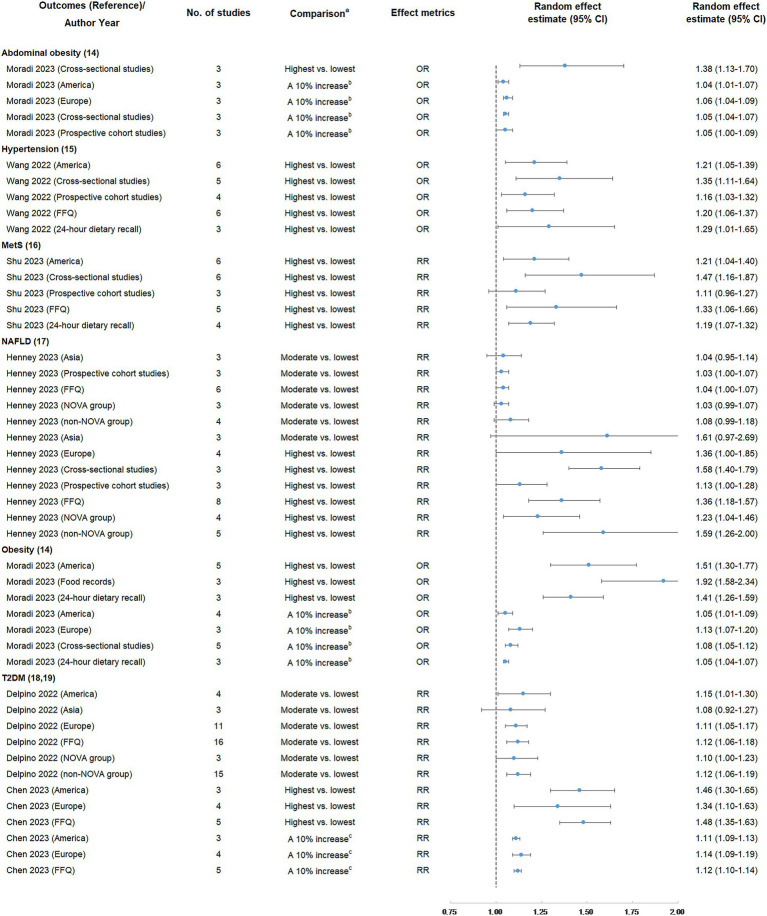
Methods: We systematically searched PubMed, Web of Science, Embase, and Cochrane Library databases from their inception to July 15, 2023, to identify relevant systematic reviews with meta-analyses. We used the random-effects model to evaluate the summary effect size, along with 95% confidence interval and prediction interval. We also assessed heterogeneity, evidence of small-study effects and excess significance bias, and categorized the credibility of each association based on quantitative umbrella review criteria. Additionally, we conducted subgroup and sensitivity analyses to assess the robustness of associations based on continents, study design, dietary assessment methods, definition methods of UPF, population, and units of UPF consumption.
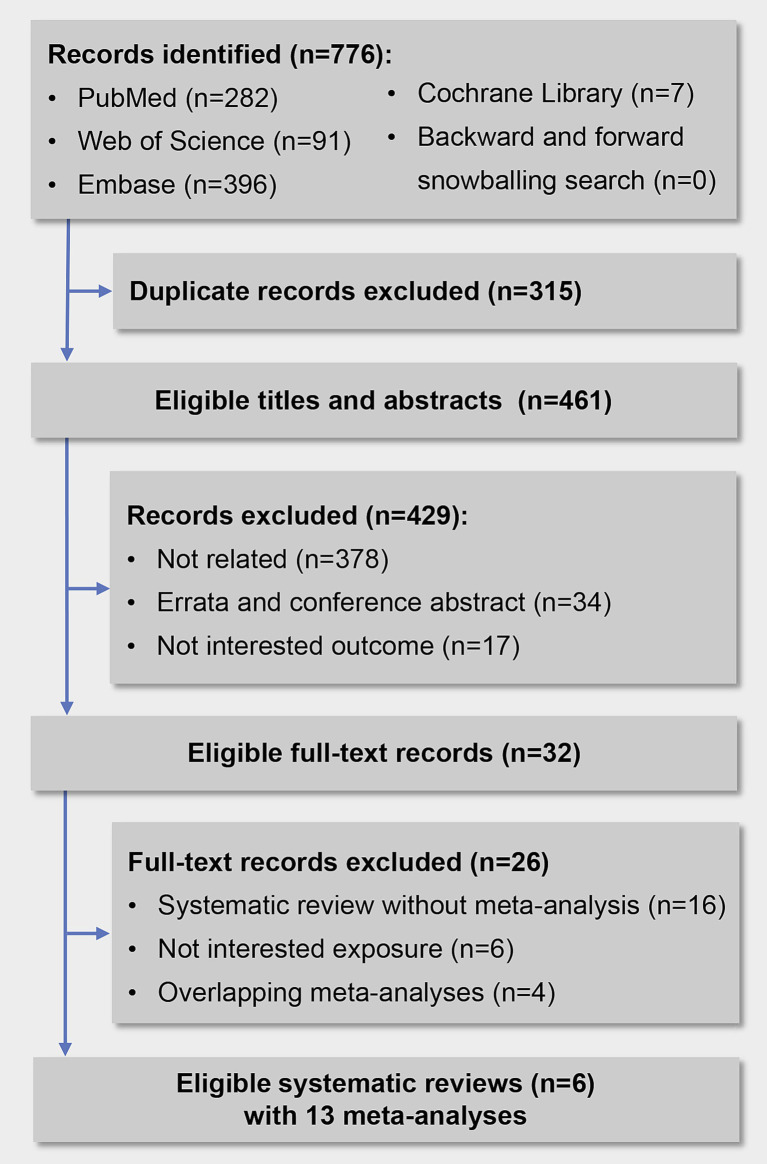
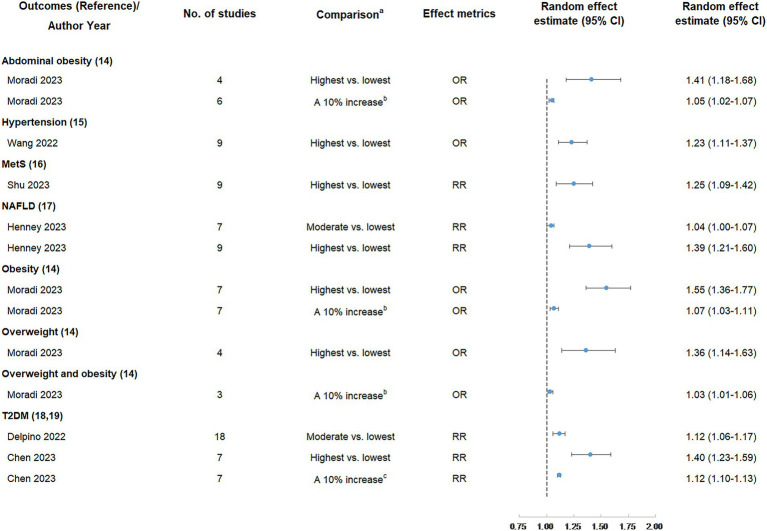
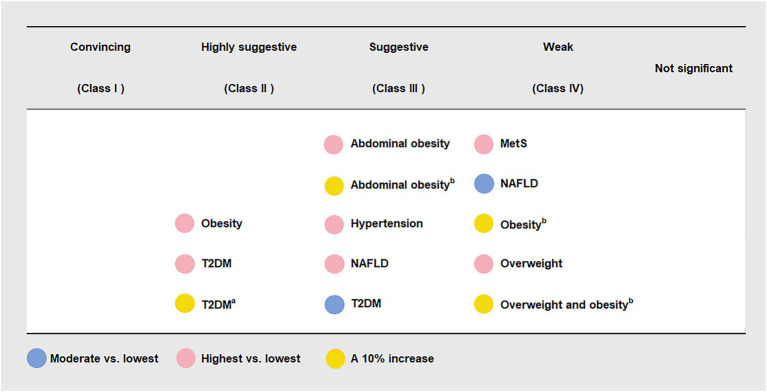
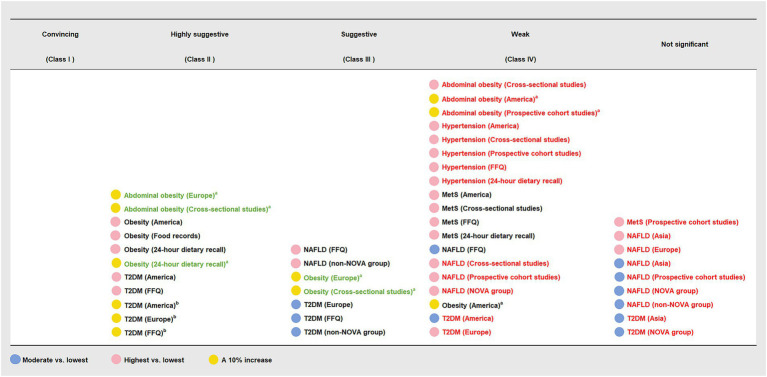
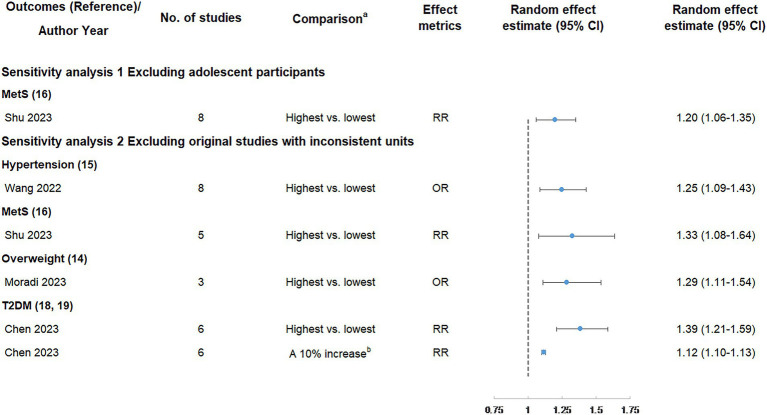
Results: Overall, 6 systematic reviews with 13 meta-analyses were included. Three (23.08%) meta-analyses were classified as highly suggestive evidence for meeting the criteria that associations were significant at p < 10-6, had more than 1,000 cases, and presented the largest study with significance at p < 0.05. Among them, the highest UPF consumption quantile was associated with an increased risk of obesity (OR = 1.55, 95% CI: 1.36-1.77) when compared with the lowest UPF consumption quantile. The highest UPF consumption quantile was associated with an increased risk of T2DM (RR = 1.40, 95% CI: 1.23-1.59) when compared with the lowest UPF consumption quantile, and a 10% increase in UPF consumption (% g/d) was associated with an increased risk of T2DM (RR = 1.12, 95% CI: 1.10-1.13). Meanwhile, the robustness of these associations was verified by a series of subgroup and sensitivity analyses.
Conclusion: UPF consumption may be a risk factor for several metabolic diseases. However, well-designed studies are still needed to verify our findings in the future.
Keywords: meta-analysis; metabolic diseases; observational study; ultra-processed food; umbrella review.
Copyright © 2024 Lv, Wei, Sun, Shi, Liu, Sun, Chang, Wu and Zhao.
Conflict of interest statement
The authors declare that the research was conducted in the absence of any commercial or financial relationships that could be construed as a potential conflict of interest.
Figures
Similar articles
-
Ultra-processed food consumption and increased risk of metabolic syndrome: a systematic review and meta-analysis of observational studies.Front Nutr. 2023 Jun 9;10:1211797. doi: 10.3389/fnut.2023.1211797. eCollection 2023. Front Nutr. 2023. PMID: 37360294 Free PMC article.
-
Association between ultra-processed foods consumption and the risk of hypertension: An umbrella review of systematic reviews.Hellenic J Cardiol. 2024 Mar-Apr;76:99-109. doi: 10.1016/j.hjc.2023.07.010. Epub 2023 Aug 3. Hellenic J Cardiol. 2024. PMID: 37543089
-
Ultra-processed food consumption and non-alcoholic fatty liver disease, metabolic syndrome and insulin resistance: A systematic review.JHEP Rep. 2023 Nov 17;6(1):100964. doi: 10.1016/j.jhepr.2023.100964. eCollection 2024 Jan. JHEP Rep. 2023. PMID: 38234408 Free PMC article.
-
Association between ultra-processed food consumption and risk of breast cancer: a systematic review and dose-response meta-analysis of observational studies.Front Nutr. 2023 Sep 4;10:1250361. doi: 10.3389/fnut.2023.1250361. eCollection 2023. Front Nutr. 2023. PMID: 37731393 Free PMC article.
-
Ultra-Processed Food Consumption and Adult Diabetes Risk: A Systematic Review and Dose-Response Meta-Analysis.Nutrients. 2021 Dec 9;13(12):4410. doi: 10.3390/nu13124410. Nutrients. 2021. PMID: 34959961 Free PMC article.
Cited by
-
Allura Red AC is a xenobiotic. Is it also a carcinogen?Carcinogenesis. 2024 Oct 10;45(10):711-720. doi: 10.1093/carcin/bgae057. Carcinogenesis. 2024. PMID: 39129647 Free PMC article. Review.
-
Ultra-Processed Food Consumption and Metabolic-Dysfunction-Associated Steatotic Liver Disease (MASLD): A Longitudinal and Sustainable Analysis.Nutrients. 2025 Jan 28;17(3):472. doi: 10.3390/nu17030472. Nutrients. 2025. PMID: 39940330 Free PMC article.
-
Ultra-processed foods consumption and health-related outcomes: a systematic review of randomized controlled trials.Front Nutr. 2024 Jun 26;11:1421728. doi: 10.3389/fnut.2024.1421728. eCollection 2024. Front Nutr. 2024. PMID: 38988861 Free PMC article.
-
The neglected PCK1/glucagon (inter)action in nutrient homeostasis beyond gluconeogenesis: Disease pathogenesis and treatment.Mol Metab. 2025 Apr;94:102112. doi: 10.1016/j.molmet.2025.102112. Epub 2025 Feb 13. Mol Metab. 2025. PMID: 39954782 Free PMC article. Review.
-
Dietary Relationships between Obesity and Inflammatory Bowel Diseases: A Narrative Review of Diets Which May Promote Both Diseases.Curr Gastroenterol Rep. 2025 Apr 30;27(1):29. doi: 10.1007/s11894-025-00980-w. Curr Gastroenterol Rep. 2025. PMID: 40304971 Free PMC article. Review.
References
Publication types
LinkOut - more resources
Full Text Sources
