. 2024 May;60(5):858-877.
doi: 10.1037/dev0001684. Epub 2024 Feb 15.

Comparing the multivariate relationships of conceptual adversity models and structural brain development in adolescent girls: A registered report

Affiliations

Comparing the multivariate relationships of conceptual adversity models and structural brain development in adolescent girls: A registered report

Ann-Marie Y Barrett et al. Dev Psychol. 2024 May.

Abstract

Adverse experiences throughout development confer risk for a multitude of negative long-term outcomes, but the processes via which these experiences are neurobiologically embedded are still unclear. Adolescence provides an opportunity to understand how these experiences impact the brain's rapidly changing structure. Two models are central to current adversity conceptualizations: a cumulative risk model, where all types of experiences are combined to represent accumulating stress, and a dimensional model, where certain features of experience (e.g., threat or deprivation) exert unique neurophysiological influence. In this registered report, we extended upon previous research by using a form of representational similarity analysis to examine whether the dimensional and cumulative risk models of adversity predict cortical thinning in frontoparietal and frontotemporal networks and volumetric changes in subcortical regions throughout adolescence. Drawing from a longitudinal sample of 179 adolescent girls (ages 10-13 years at the first wave) from Lane County, Oregon, United States, and up to four waves of follow-up data, we found that operationalizing adversity by similarity in threat and deprivation provided better prediction of brain development than similarity in overall adversity. However, these dimensions do not exhibit unique associations with developmental changes in the hypothesized brain changes. These results underscore the significance of carefully defining adversity and considering its impact on the entire brain. (PsycInfo Database Record (c) 2024 APA, all rights reserved).


Figures

Figure 1
Figure 1. Participation Across Study Timepoints
Note. Each line represents each participant’s age at the second session (the MRI session) across all time points. MRI = magnetic resonance imaging; SOS = social stress.
Figure 2
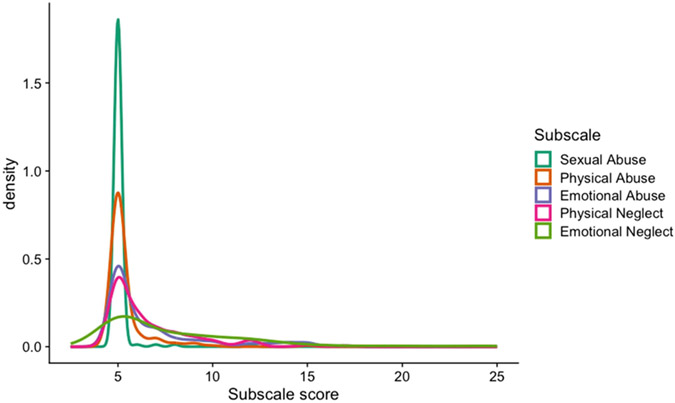
Figure 2. CTQ Subscale Score Distributions
Note. CTQ = Childhood Trauma Questionnaire.
Figure 3
Figure 3. Adversity Intersubject Representational Dissimilarity Matrices
Note. Intersubject dissimilarities (in Euclidean distance) across (a) all adversity, (b) threat, and (c) deprivation are displayed. Higher values indicate further distance between participants in their responses to adversity items.
Figure 4
Figure 4. Distributions of Annualized Percent Change Scores
Note. Annualized percent change scores for each region of interest in both the right and left hemispheres.
Figure 5
Figure 5. Intersubject Dissimilarity Matrix for Annualized Percent Change Across Regions of Interest
Figure 6
Figure 6. Dissimilarity in Overall Adversity Versus Dissimilarity in Brain Development
Note. The regression line demonstrates a small, positive relationship between dissimilarity in overall adversity and dissimilarity in brain development. The x- and y-axis each represent intersubject Euclidean distance.
Figure 7
Figure 7. Interaction Between Threat and Deprivation
Note. At higher dissimilarity in deprivation, higher dissimilarity in threat predicts more dissimilarity in brain development.
Figure 8
Figure 8. Correlations Between Intersubject Dissimilarity Matrices
Note. Adversity and ROI RDMs are all positively correlated. Threat IS-RDM is most associated with each ROI RDM. IS-RDMs = intersubject representational dissimilarity matrices; ROI = regions of interest.
Figure 9
Figure 9. Distributions of Randomly Selected Parcellations
Note. Annualized percent change scores for randomly selected parcellations from the whole brain were used to create 10,000 new structural brain development IS-RDMs. These were regressed along each adversity IS-RDM. The unstandardized regression coefficients from the models with the “observed ROIs” are marked by the solid lines. IS-RDMs = intersubject representational dissimilarity matrices; ROI = regions of interest.

References

    1. Backhausen LL, Herting MM, Buse J, Roessner V, Smolka MN, & Vetter NC (2016). Quality control of structural MRI images applied using FreeSurfer—A hands-on workflow to rate motion artifacts. Frontiers in Neuroscience, 10, Article 558. 10.3389/fnins.2016.00558 - DOI - PMC - PubMed
    1. Barendse MEA, Vijayakumar N, Byrne ML, Flannery JE, Cheng TW, Flournoy JC, Nelson BW, Cosme D, Mobasser A, Chavez SJ, Hval L, Brady B, Nadel H, Helzer A, Shirtcliff EA, Allen NB, & Pfeifer JH (2020). Study protocol: Transitions in adolescent girls (TAG). Frontiers in Psychiatry, 10, Article 1018. 10.3389/fpsyt.2019.01018 - DOI - PMC - PubMed
    1. Barrett A-M, Cheng TW, Flannery JE, Mills KL, Fisher P, McCann CF, & Pfeifer JH (2023, November 10). Comparing the multivariate relationships of conceptual adversity models and structural brain development in adolescent girls: A registered report. 10.17605/OSF.IO/BPZJU - DOI - PMC - PubMed
    1. Bath KG (2020). Synthesizing views to understand sex differences in response to early life adversity. Trends in Neurosciences, 43(5), 300–310. 10.1016/j.tins.2020.02.004 - DOI - PMC - PubMed
    1. Berens AE, Jensen SKG, & Nelson CA (2017). Biological embedding of childhood adversity: From physiological mechanisms to clinical implications. BMC Medicine, 15(1), Article 135. 10.1186/s12916-017-0895-4 - DOI - PMC - PubMed