


Surveillance for Lyme Disease After Implementation of a Revised Case Definition - United States, 2022
- PMID: 38358952
- PMCID: PMC10899080
- DOI: 10.15585/mmwr.mm7306a1
Surveillance for Lyme Disease After Implementation of a Revised Case Definition - United States, 2022
Abstract
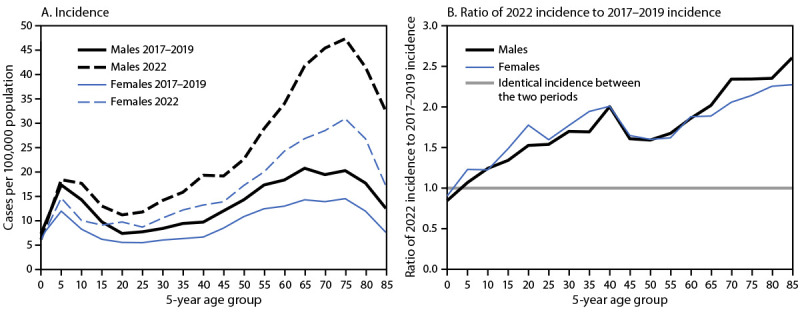
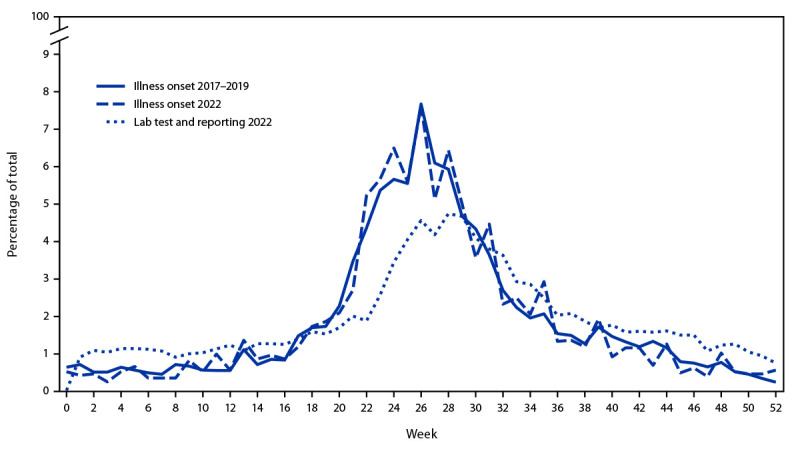
Lyme disease, a tickborne zoonosis caused by certain species of Borrelia spirochetes, is the most common vectorborne disease in the United States. Approximately 90% of all cases are reported from 15 high-incidence jurisdictions in the Northeast, mid-Atlantic, and upper-Midwest regions. After the implementation of a revised surveillance case definition in 2022, high-incidence jurisdictions report cases based on laboratory evidence alone, without need for additional clinical information. In 2022, 62,551 Lyme disease cases were reported to CDC, 1.7 times the annual average of 37,118 cases reported during 2017-2019. Annual incidence increased most in older age groups, with incidence among adults aged ≥65 years approximately double that during 2017-2019. The sharp increase in reported Lyme disease cases in 2022 likely reflects changes in surveillance methods rather than change in disease risk. Although these changes improve standardization of surveillance across jurisdictions, they preclude detailed comparison with historical data.
Conflict of interest statement
All authors have completed and submitted the International Committee of Medical Journal Editors form for disclosure of potential conflicts of interest. No potential conflicts of interest were disclosed.
Figures
References
-
- Steere A. Lyme disease (Lyme borreliosis) due to Borrelia burgdorferi [Chapter 241]. In: Bennett JE, Dolin R, Blaser M, eds. Mandell, Douglas, and Bennett's principles and practice of infectious diseases. 9th ed. Philadelphia, PA: Elsevier; 2020:2911–22.
MeSH terms
LinkOut - more resources
Full Text Sources
Medical
