


Refining the clinical diagnosis of Parkinson's disease
- PMID: 38360507
- PMCID: PMC11069446
- DOI: 10.1016/j.parkreldis.2024.106041
Refining the clinical diagnosis of Parkinson's disease
Abstract
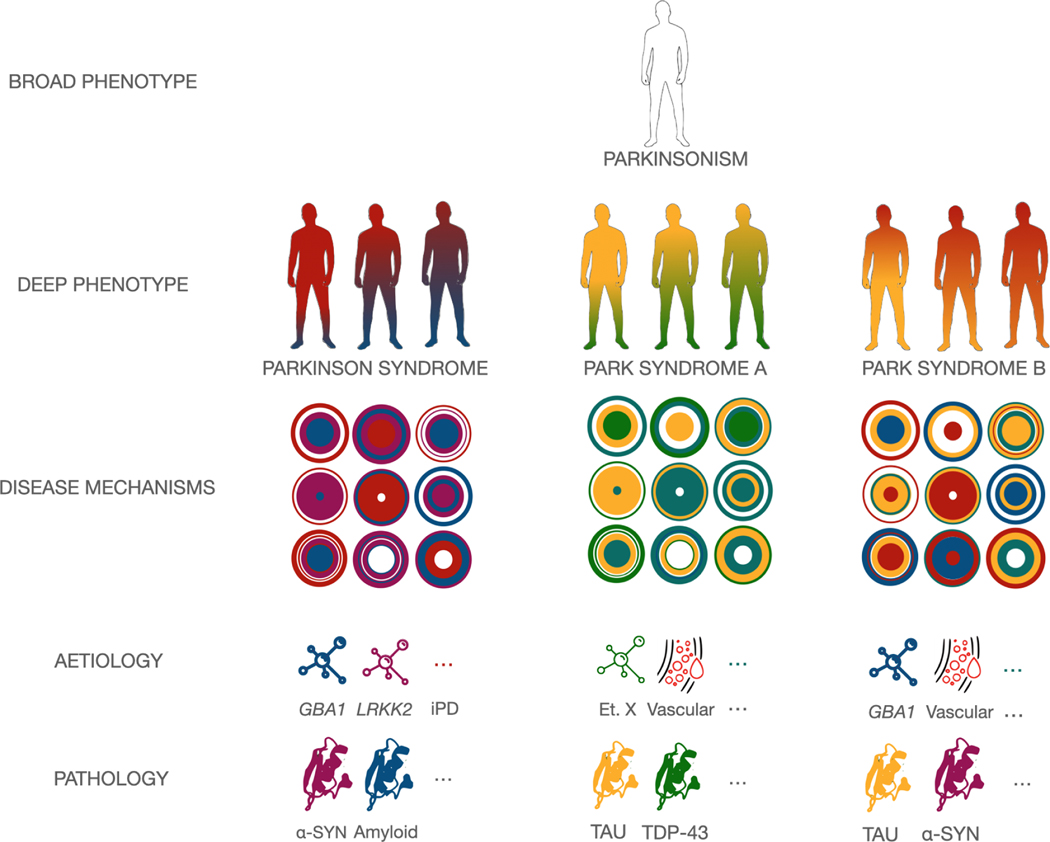
Our ability to define, understand, and classify Parkinson's disease (PD) has undergone significant changes since the disorder was first described in 1817. Clinical features and neuropathologic signatures can now be supplemented by in-vivo interrogation of genetic and biological substrates of disease, offering great opportunity for further refining the diagnosis of PD. In this mini-review, we discuss the historical perspectives which shaped our thinking surrounding the definition and diagnosis of PD. We highlight the clinical, genetic, pathologic and biologic diversity which underpins the condition, and proceed to discuss how recent developments in our ability to define biologic and pathologic substrates of disease might impact PD definition, diagnosis, individualised prognostication, and personalised clinical care. We argue that Parkinson's 'disease', as currently diagnosed in the clinic, is actually a syndrome. It is the outward manifestation of any array of potential dysfunctional biologic processes, neuropathological changes, and disease aetiologies, which culminate in common outward clinical features which we term PD; each person has their own unique disease, which we can now define with increasing precision. This is an exciting time in PD research and clinical care. Our ability to refine the clinical diagnosis of PD, incorporating in-vivo assessments of disease biology, neuropathology, and neurogenetics may well herald the era of biologically-based, precision medicine approaches PD management. With this however comes a number of challenges, including how to integrate these technologies into clinical practice in a way which is acceptable to patients, promotes meaningful changes to care, and minimises health economic impact.
Keywords: Alpha-synuclein; Lewy bodies; Parkinson disease; Precision medicine.
Published by Elsevier Ltd.
Conflict of interest statement
Declaration of competing interest EM declares no competing interests. RE receives royalties from publication of Case Studies in Movement Disorders—Common and Uncommon Presentations (Cambridge University Press, 2017) and of Paroxysmal Movement Disorders (Springer, 2020). He has received consultancies from Ipsen and honoraria for speaking from the International Parkinson's Disease and Movement Disorders Society. KPB has received grant support from Wellcome/MRC, National Institute for Health and CareResearch (NIHR), Parkinsons's UK and EUHorizon 2020. He receives royalties from publication of the Oxford Specialist Handbook Parkinson's Disease and Other Movement Disorders (Oxford University Press, 2008), of Marsden's Book of Movement Disorders (Oxford University Press, 2012), and of Case Studies in Movement Disorders–Common and uncommon presentations (Cambridge University Press, 2017). He has received honoraria/personal compensation for participating as consultant/scientific board member from Ipsen, Allergan, Merz; and honoraria for speaking at meetings and from Allergan, Ipsen, Merz, Sun Pharma, Teva, UCB Pharmaceuticals, and from the American Academy of Neurology and the International Parkinson's Disease and Movement Disorders Society. The University College London Queen Square Movement Disorders Centre acknowledges the NIHR University College London Hospitals Biomedical Research Centre. MH is an inventor of a patent held by NIH for the H-coil for magnetic stimulation for which he receives license fee payments from the NIH (from Brainsway). He is on the Medical Advisory Boards of Brainsway, QuantalX, and VoxNeuro and has consulted for Janssen Pharmaceuticals.
Figures
References
-
- Parkinson J, An essay on the shaking palsy. 1817, J Neuropsychiatry Clin Neurosci 14(2) (2002) 223–36; discussion 222. - PubMed
-
- Spillantini MG, Schmidt ML, Lee VM, Trojanowski JQ, Jakes R, Goedert M, Alpha-synuclein in Lewy bodies, Nature 388(6645) (1997) 839–40. - PubMed
-
- Hughes AJ, Daniel SE, Blankson S, Lees AJ, A clinicopathologic study of 100 cases of Parkinson’s disease, Arch Neurol 50(2) (1993) 140–8. - PubMed
Publication types
MeSH terms
Grants and funding
LinkOut - more resources
Full Text Sources
Medical
