Review
. 2024 Feb 1:37:100797.
doi: 10.1016/j.lanepe.2023.100797. eCollection 2024 Feb.

Atrial fibrillation: stroke prevention

Affiliations
Review

Atrial fibrillation: stroke prevention

Tze-Fan Chao et al. Lancet Reg Health Eur. .

Abstract

Stroke prevention is central to the management of patients with atrial fibrillation (AF) which has moved towards a more holistic or integrative care approach. The published evidence suggests that management of AF patients following such a holistic approach based on the Atrial fibrillation Better Care (ABC) pathway is associated with a lower risk of stroke and adverse events. Risk assessment, re-assessment and use of direct oral anticoagulants (DOACs) are important for stroke prevention in AF. The stroke and bleeding risks of AF patients are not static and should be re-assessed regularly. Bleeding risk assessment is to address and mitigate modifiable bleeding risk factors, and to identify high bleeding risk patients for early review and follow-up. Well-controlled comorbidities and healthy lifestyles also play an important role to achieve a better clinical outcome. Digital health solutions are increasingly relevant in the diagnosis and management of patients with AF, with the potential to improve stroke prevention. In this review, we provide an update on stroke prevention in AF, including importance of holistic management, risk assessment/re-assessment, and stroke prevention for special AF populations. Evidence-based and structured management of AF patients would reduce the risk of stroke and other adverse events.

Keywords: ABC pathway; Atrial fibrillation; Bleeding risk; Oral anticoagulants; Stroke risk.


Conflict of interest statement

All authors declare that they have no conflicts of interest.

Figures
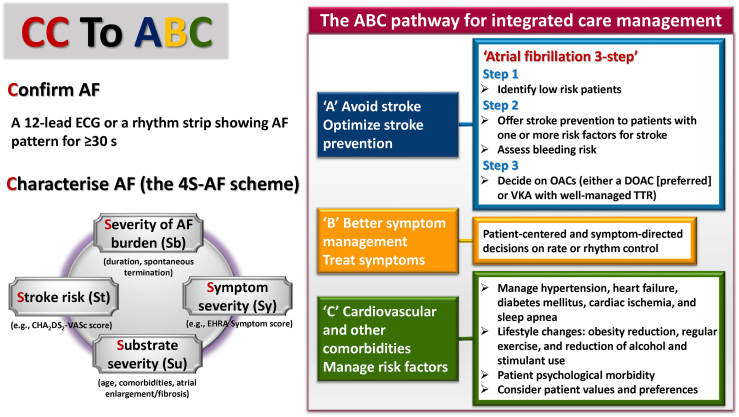
Fig. 1
Fig. 1
CC to ABC—the standard of diagnosis, evaluation and integrated care management of AF. AF = atrial fibrillation; DOACs = direct oral anticoagulants; ECG = electrocardiogram; VKA = vitamin-K antagonist; OACs = oral anticoagulants; TTR = time in therapeutic range. The figure was redrawn and modified from 2020 ESC AF guidelines and 2021 focused update consensus guidelines of the APHRS on stroke prevention in atrial fibrillation.,
Fig. 2
Fig. 2
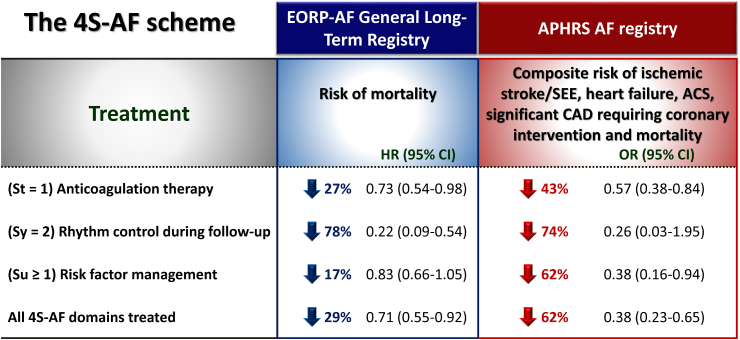
Effects of treatments according to 4S-AF scheme. Data in this figure were adapted from the papers by Ding et al. and Chao et al.
Fig. 3
Fig. 3
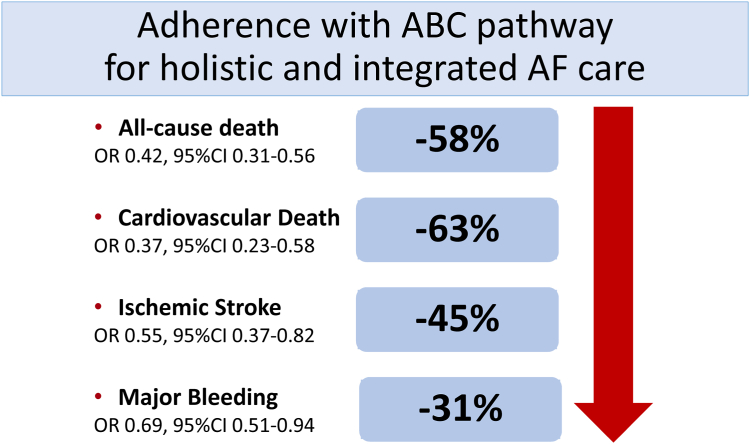
Impacts of adherence to the ABC pathway on clinical outcomes in AF patients. The figure was redraw and modified from the paper by Romiti et al.
Fig. 4
Fig. 4
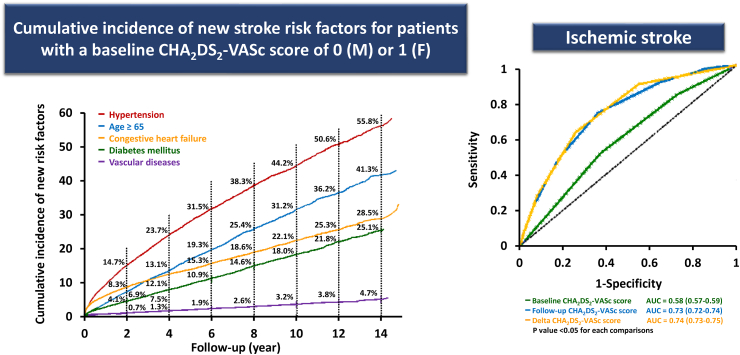
Incident stroke risk factors and the predictive accuracies of baseline, follow-up and delta CHA2DS2-VASc scores. AUC = area under the curve; F = female; M = male. The figure was redrawn, and data were adapted from the papers by Chao et al.,
Fig. 5
Fig. 5
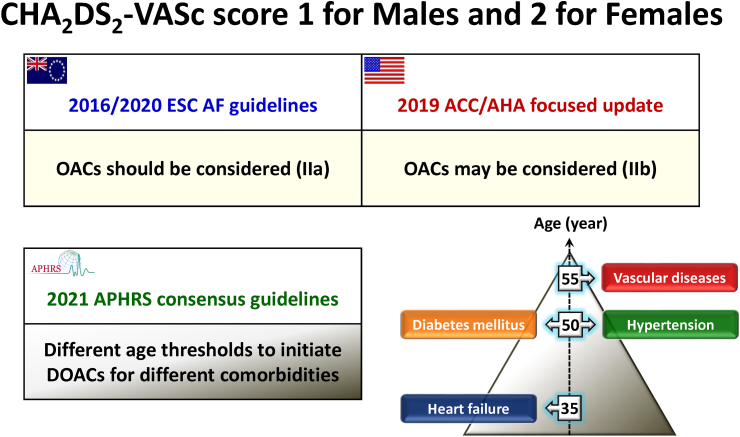
Recommendations about stroke prevention in ESC, ACC/AHA and APHRS guidelines. ACC/AHA = American College of Cardiology/American Heart Association; APHRS = Asia Pacific Heart Rhythm Society; ESC = European Society of Cardiology; DOACs = direct oral anticoagulants; OACs = oral anticoagulants.
Fig. 6
Fig. 6
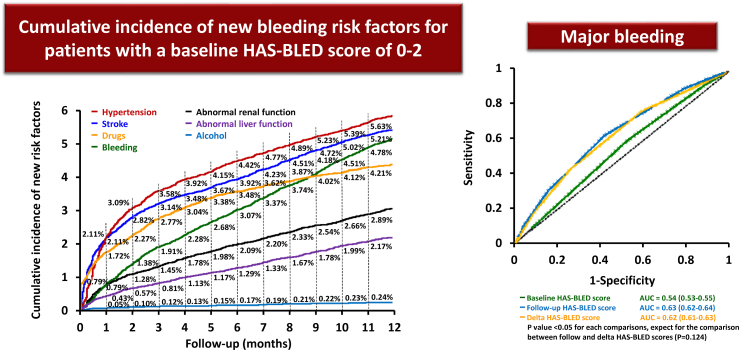
Incident bleeding risk factors and the predictive accuracies of baseline, follow-up and delta HAS-BLED scores. AUC = area under the curve. The figure was redrawn, and data were adapted from the papers by Chao et al.,
Fig. 7
Fig. 7
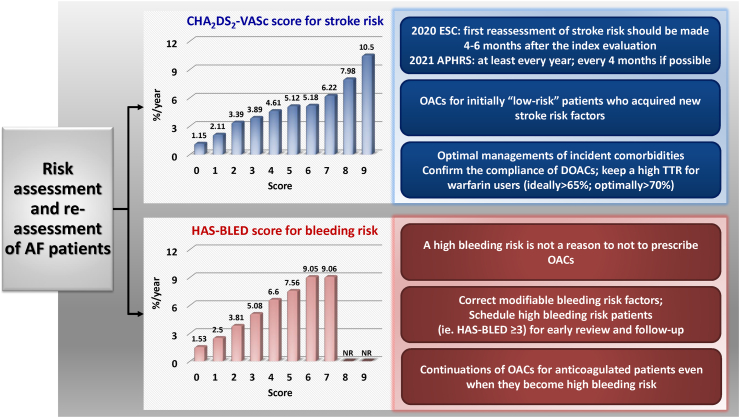
Risk assessment and re-assessment in AF. AF = atrial fibrillation; DOACs = direct oral anticoagulants; NR = not reported; OACs = oral anticoagulants; TTR = time in therapeutic range. The figure was redrawn, and data were adapted from the papers by Chao et al.,,
Fig. 8
Fig. 8
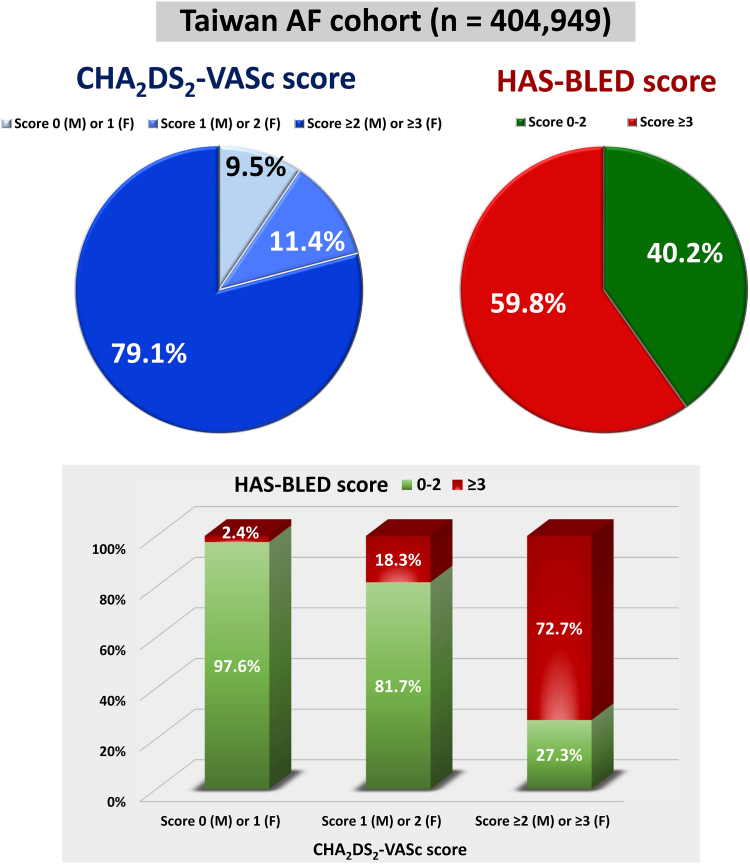
Distribution and co-distribution of CHA2DS2-VASc and HAS-BLED score. AF = atrial fibrillation; F = female; M = male. Data in this figure were adapted from the paper by Chao et al.

References

    1. Chiang C.E., Chao T.F., Choi E.K., et al. Stroke prevention in atrial fibrillation: a scientific statement of JACC: Asia (Part 1) JACC Asia. 2022;2(4):395–411. - PMC - PubMed
    1. Chiang C.E., Chao T.F., Choi E.K., et al. Stroke prevention in atrial fibrillation: a scientific statement of JACC: Asia (Part 2) JACC Asia. 2022;2(5):519–537. - PMC - PubMed
    1. Lane D.A., Lip G.Y.H. Stroke and bleeding risk stratification in atrial fibrillation: a critical appraisal. Eur Heart J Suppl. 2020;22(Suppl O):O14–O27. - PMC - PubMed
    1. Proietti M., Esteve-Pastor M.A., Rivera-Caravaca J.M., et al. Relationship between multimorbidity and outcomes in atrial fibrillation. Exp Gerontol. 2021;153 - PubMed
    1. Proietti M., Marzona I., Vannini T., et al. Long-term relationship between atrial fibrillation, multimorbidity and oral anticoagulant drug use. Mayo Clin Proc. 2019;94(12):2427–2436. - PubMed

LinkOut - more resources