. 2024 Jan 8;18(1):wrad010.
doi: 10.1093/ismejo/wrad010.

Direct observations of microbial community succession on sinking marine particles

Affiliations

Direct observations of microbial community succession on sinking marine particles

Brandon M Stephens et al. ISME J. .

Erratum in

Abstract

Microbial community dynamics on sinking particles control the amount of carbon that reaches the deep ocean and the length of time that carbon is stored, with potentially profound impacts on Earth's climate. A mechanistic understanding of the controls on sinking particle distributions has been hindered by limited depth- and time-resolved sampling and methods that cannot distinguish individual particles. Here, we analyze microbial communities on nearly 400 individual sinking particles in conjunction with more conventional composite particle samples to determine how particle colonization and community assembly might control carbon sequestration in the deep ocean. We observed community succession with corresponding changes in microbial metabolic potential on the larger sinking particles transporting a significant fraction of carbon to the deep sea. Microbial community richness decreased as particles aged and sank; however, richness increased with particle size and the attenuation of carbon export. This suggests that the theory of island biogeography applies to sinking marine particles. Changes in POC flux attenuation with time and microbial community composition with depth were reproduced in a mechanistic ecosystem model that reflected a range of POC labilities and microbial growth rates. Our results highlight microbial community dynamics and processes on individual sinking particles, the isolation of which is necessary to improve mechanistic models of ocean carbon uptake.

Keywords: 16S rRNA; bacterial community diversity; carbon export; community succession; individual particles; island biogeography; metagenomes; particle lability; sinking particles.


Conflict of interest statement

None declared.

Figures
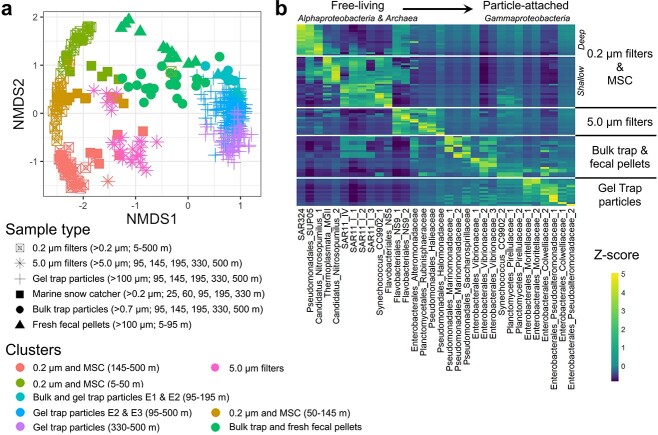
Figure 1
Figure 1
Sample collection type influences associated microbial communities; (A) Bray–Curtis dissimilarity-based nonparametric multidimensional scaling ordination of 16S rRNA ASVs separate by sample collection type and Ward.D2 clusters (see Supplementary Fig. 5 for clustering); (B) heatmap of indicator ASVs by sample collection type, represented as z-score normalized values based on relative abundances for all samples; noted in the x-axis of (B) are the order and family names for indicator ASVs that progress from Alphaproteobacteria to Gammaproteobacteria; fecal pellets = freshly collected; “E” = Epoch.
Figure 2
Figure 2
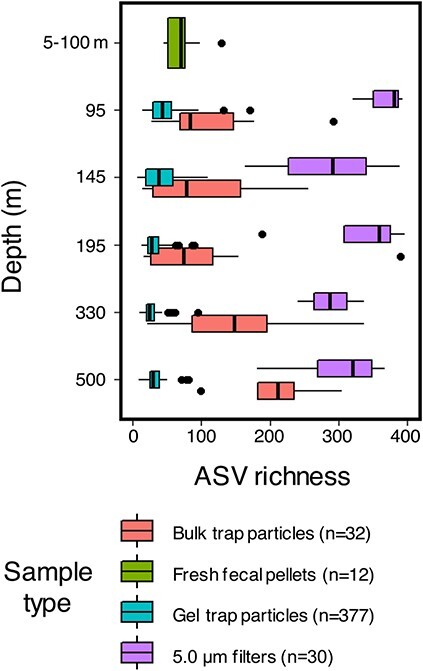
Communities on individual particles differ by collection method; ASV richness differs by particle collection type (i.e. 5.0 μm filters, individual particles from gel traps, bulk particles from sediment traps, fresh zooplankton fecal pellets); the line inside the box plots represents the median ASV richness, and the whiskers represent the minimum and maximum values excluding outliers (1.5 times the interquartile range, black dots).
Figure 3
Figure 3
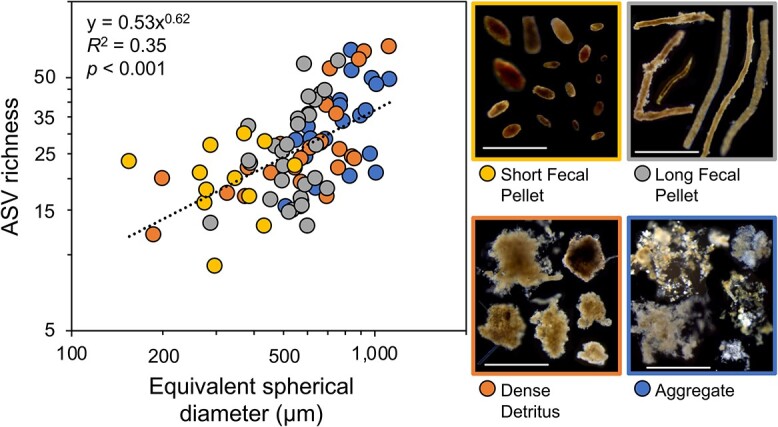
Communities on individual particles differ by particle size; ASV richness was significantly correlated (P < 0 .001) with the ESD of individual particles; scale bars in images: 1000 μm.
Figure 4
Figure 4
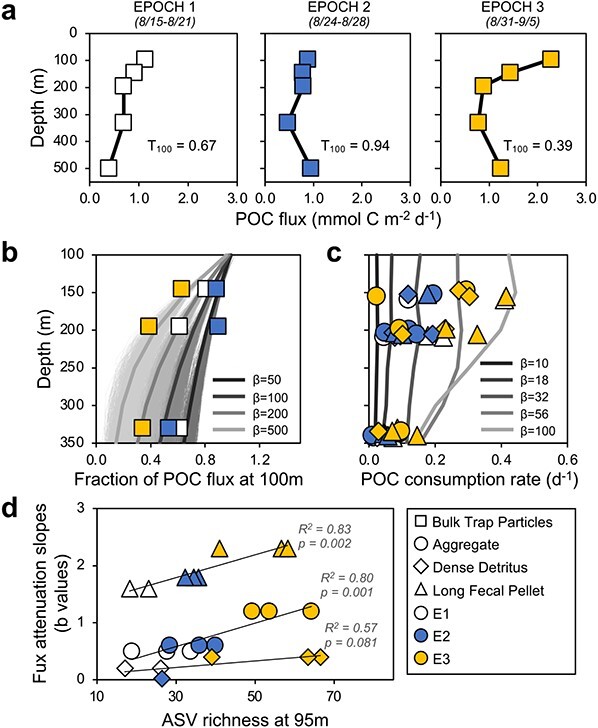
Dominant taxa on individual particles change with temporal changes in sinking flux attenuation; (A) particle flux and mean transfer efficiencies at 100 m (T100) as previously presented [33]; T100 = fraction of sinking carbon export transferred 100 m below the base of the euphotic zone; (B) temporal shifts in T100 are predicted by particle lability (ß = average particle lability (mmol CPOC mmol Ccell−1 day−1) of all particles at formation depth of 100 m) in a mechanistic model of particle decomposition [8]; these modeled average temporal shifts are represented as lines from least to most labile for ß = 50, 100, 200, and 500 mmol CPOC mmol Ccell−1 day−1; bold lines represent the average flux from each simulation (shaded lines represent n = 69 000 particles), and squares represent observed POC fluxes for E1, E2, and E3; (C) POC consumption rate (day−1) on individual particles is also predicted by modeled shifts in POC lability; model average POC consumption rates of individual particles are calculated for six discrete lability classes from 10 to 100 mmol CPOC mmol Ccell−1 day−1; observational data of POC consumption rates of individual particles for each Epoch; (D) ASV richness of the microbial community associated with aggregates and long fecal pellets collected at 95 m was significantly and positively correlated (P <  .01) with flux attenuation slopes for those particle types; flux attenuation slope values were determined and previously reported in Durkin et al. [36]; “E” = Epoch.
Figure 5
Figure 5
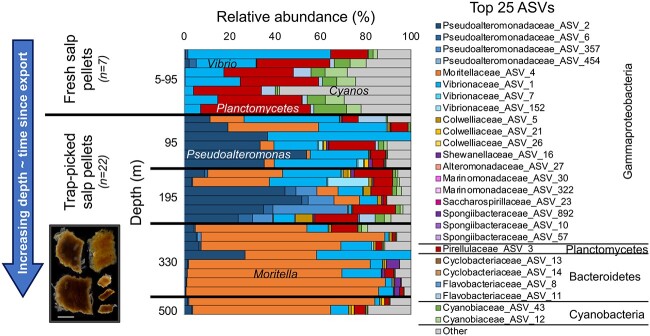
Microbial community succession patterns on sinking particles identified in situ on salp fecal pellets; relative abundances of the top 25 recurring ASVs shift as a function of depth moving from fresh salp pellets to individual sinking salp pellets from gel traps deployed at four depths, suggestive of community succession on particles as they sink through the water column; scale bar in image: 1000 μm.
Figure 6
Figure 6
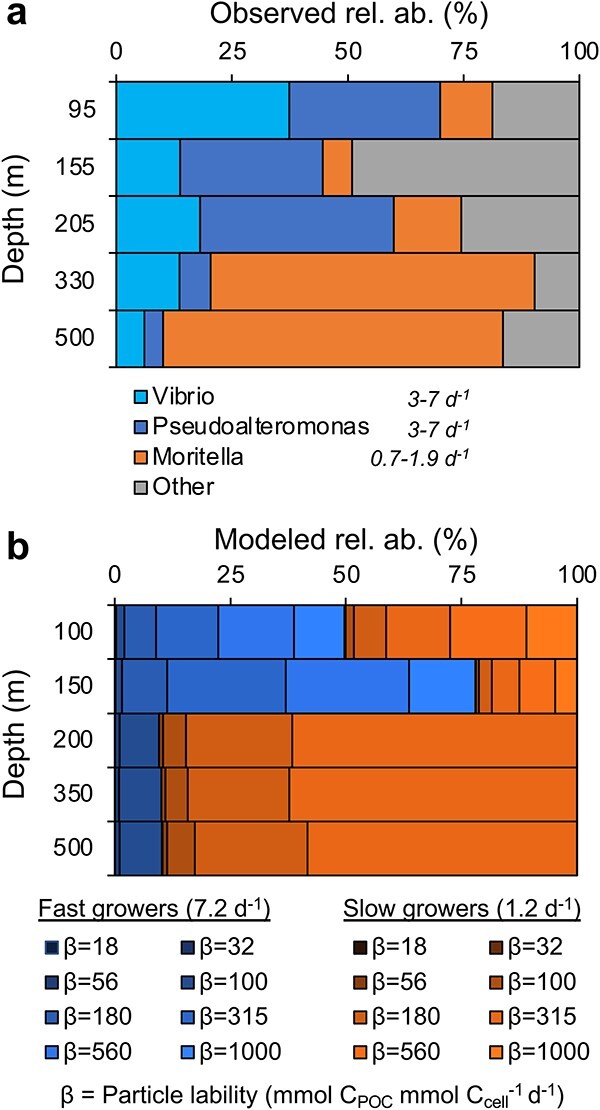
Microbial community succession on salp fecal pellets was similar to modeled community changes based on growth rates; (A) observed depth-based changes in dominant taxa on salp fecal pellets were similar to (B) the modeled changes in community growth rates, from taxa with faster growth rates (7.2 day−1) to slower growth rates (1.2 day−1); the different ß values in (B) refer to different particle labilities in units of mmol CPOC mmol Ccell−1 day−1, where larger ß values refer to particles with higher lability; representing the particle labilities for fast and slow growers; the model community results are summarized from 1000 simulations of high average particle lability (ß = 500 mmol CPOC mmol Ccell−1 day−1); in each simulation, we extract 161 particles belonging to particle size classes of 2000 and 4000 μm in diameter for this analysis to make it comparable to the size of salp pellet particles.
Figure 7
Figure 7
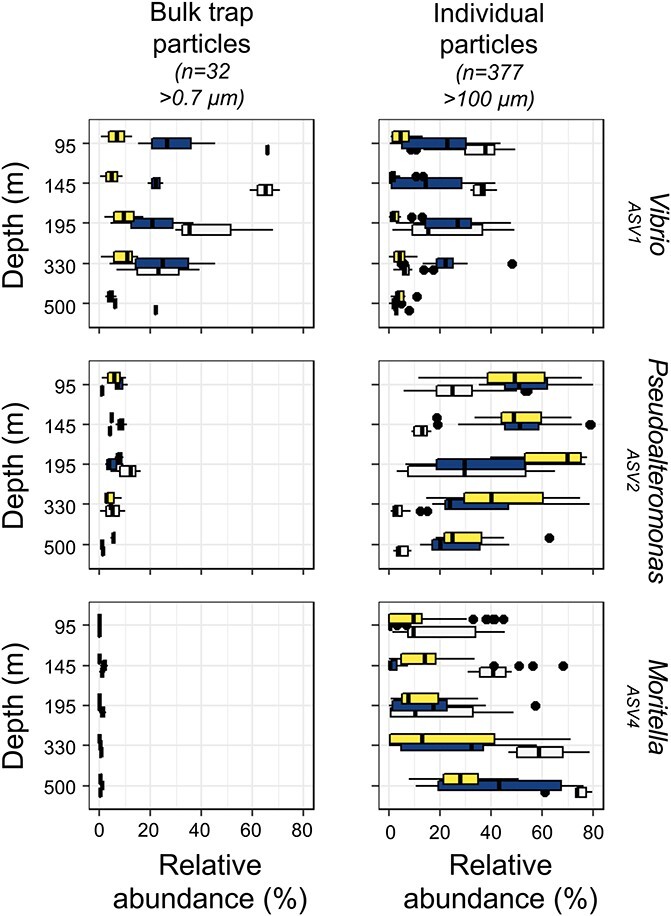
Dominant particle-associated taxa differ across sample type, depth, and time; ASV richness and relative abundances for the top three recurring ASVs for the individual particles differ by particle collection type (i.e. bulk particles from sediment traps vs. individual particles from gel traps), depth and time (i.e. “E” = Epoch); the line inside the box plots represents the median ASV richness, whiskers represent the minimum and maximum values excluding outliers, and the dots represent outliers (1.5 times the interquartile range).

References

    1. Volk T, Hoffert MI. Ocean carbon pumps: analysis of relative strengths and efficiencies in ocean-driven atmospheric CO2 changes. In Sundquist ET, Broecker WS (Eds.): The Carbon Cycle and Atmospheric CO2: Natural Variations Archean to Present. American Geophysical Union (AGU), United States of America, 1985, 99–110.
    1. Sarmiento JL, Bender M. Carbon biogeochemistry and climate change. Photosynth Res 1994;39:209–34. - PubMed
    1. Martin JH, Knauer GA, Karl DM et al. VERTEX: carbon cycling in the northeast Pacific. Deep Sea Res I 1987;34:267–85.
    1. Smith DC, Simon M, Alldredge AL et al. Intense hydrolytic enzyme activity on marine aggregates and implications for rapid particle dissolution. Nature 1992;359:139–42.
    1. Simon M, Welschmeyer NA, Kirchman DL. Bacterial production and the sinking flux of particulate organic matter in the subarctic Pacific. Deep Sea Res I 1992;39:1997–2008.