


Mortality risk in patients with autosomal dominant polycystic kidney disease
- PMID: 38365638
- PMCID: PMC10870477
- DOI: 10.1186/s12882-024-03484-3
Mortality risk in patients with autosomal dominant polycystic kidney disease
Abstract
Background: Autosomal dominant polycystic kidney disease (ADPKD) is the leading inheritable cause of end-stage renal disease (ESRD). Mortality data specific to patients with ADPKD is currently lacking; thus, the aim of this study was to estimate mortality in patients with ADPKD.
Methods: We analyzed data from the United States Renal Data System (USRDS) for patients with ADPKD available during the study period of 01/01/2014-12/31/2016, which included a cohort of patients with non-ESRD chronic kidney disease (CKD) and a cohort of patients with ESRD. Mortality rates with 95% confidence intervals (CIs) were calculated overall and by age group, sex, and race for the full dataset and for a subset of patients aged ≥ 65 years. Adjusted mortality hazard ratios (HRs) were calculated using Cox regression modeling by age group, sex, race, and CKD stage (i.e., non-ESRD CKD stages 1-5) or ESRD treatment (i.e., dialysis and transplant).
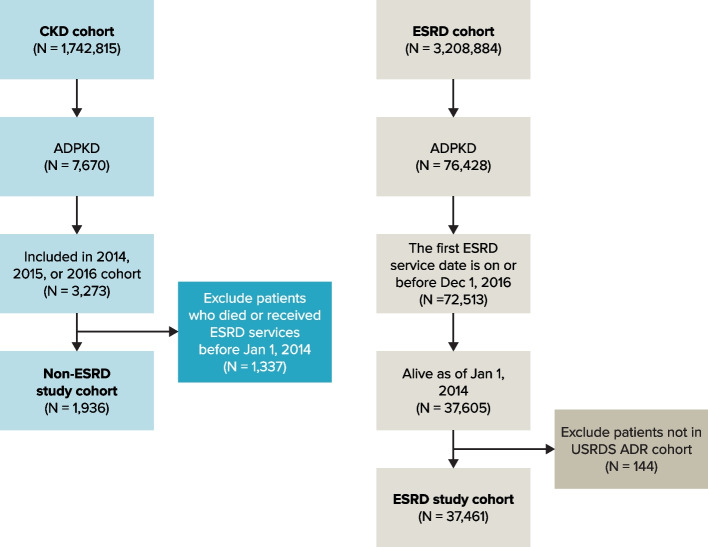
Results: A total of 1,936 patients with ADPKD and non-ESRD CKD and 37,461 patients with ADPKD and ESRD were included in the analysis. Age-adjusted mortality was 18.4 deaths per 1,000 patient-years in the non-ESRD CKD cohort and 37.4 deaths per 1,000 patient-years in the ESRD cohort. As expected, among the non-ESRD CKD cohort, patients in CKD stages 4 and 5 had a higher risk of death than patients in stage 3 (HR = 1.59 for stage 4 and HR = 2.71 for stage 5). Among the ESRD cohort, patients receiving dialysis were more likely to experience death than patients who received transplant (HR = 2.36). Age-adjusted mortality among patients aged ≥ 65 years in the non-ESRD CKD cohort was highest for Black patients (82.7 deaths per 1,000 patient-years), whereas age-adjusted mortality among patients aged ≥ 65 years in the ESRD cohort was highest for White patients (136.1 deaths per 1,000 patient-years).
Conclusions: Mortality rates specific to patients aged ≥ 65 years suggest racial differences in mortality among these patients in both non-ESRD CKD and ESRD cohorts. These data fill an important knowledge gap in mortality estimates for patients with ADPKD in the United States.
Keywords: Autosomal dominant polycystic kidney disease; End-stage renal disease; Mortality.
© 2024. The Author(s).
Conflict of interest statement
Competing interests. DM, XZ, JW, and CB are full time employees of RTI Health Solutions, an independent nonprofit research organization, which was retained by Otsuka to conduct the research that is the subject of this manuscript. Their compensation is unconnected to the studies on which they work. GM was an employee of RTI Health Solutions at the time the research was conducted. MS was an employee of Otsuka at the time the research was conducted. CW has served as an epidemiologic consultant to Otsuka Pharmaceuticals, Inc. SS is an employee of the University of Maryland School of Medicine.
Figures


References
-
- Benjamin O, Lappin SL. End-stage renal disease. 2022. Available at: https://www.ncbi.nlm.nih.gov/books/NBK499861/. Accessed 28 Feb 2022
Publication types
MeSH terms
LinkOut - more resources
Full Text Sources
Medical
Research Materials
Miscellaneous
