. 2024 Feb 16;14(1):3874.
doi: 10.1038/s41598-024-53945-w.

Prolyl hydroxylase domain inhibitor is an effective pre-hospital pharmaceutical intervention for trauma and hemorrhagic shock

Affiliations

Prolyl hydroxylase domain inhibitor is an effective pre-hospital pharmaceutical intervention for trauma and hemorrhagic shock

Xiaowu Wu et al. Sci Rep. .

Abstract

Pre-hospital potentially preventable trauma related deaths are mainly due to hypoperfusion-induced tissue hypoxia leading to irreversible organ dysfunction at or near the point of injury or during transportation prior to receiving definitive therapy. The prolyl hydroxylase domain (PHD) is an oxygen sensor that regulates tissue adaptation to hypoxia by stabilizing hypoxia inducible factor (HIF). The benefit of PHD inhibitors (PHDi) in the treatment of anemia and lactatemia arises from HIF stabilization, which stimulates endogenous production of erythropoietin and activates lactate recycling through gluconeogenesis. The results of this study provide insight into the therapeutic roles of MK-8617, a pan-inhibitor of PHD-1, 2, and 3, in the mitigation of lactatemia in anesthetized rats with polytrauma and hemorrhagic shock. Additionally, in an anesthetized rat model of lethal decompensated hemorrhagic shock, acute administration of MK-8617 significantly improves one-hour survival and maintains survival at least until 4 h following limited resuscitation with whole blood (20% EBV) at one hour after hemorrhage. This study suggests that pharmaceutical interventions to inhibit prolyl hydroxylase activity can be used as a potential pre-hospital countermeasure for trauma and hemorrhage at or near the point of injury.


Conflict of interest statement

A patent was filed: ISR 22-04-US01-PRI: 63/379,518 filed 14 Oct 2022, “Prolyl Hydroxylase Domain Inhibitor Treatment to Improve Survivability of Hemorrhagic Shock” by Andrew P. Cap, James A. Bynum, and Xiaowu Wu from U.S. Army Institute of Surgical Research. The authors declare no competing interests.

Figures
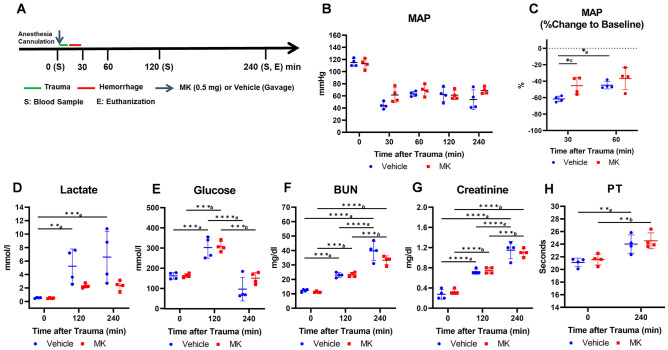
Figure 1
Figure 1
A pilot study of administration of MK-8617 (MK) prior to polytrauma/hemorrhage by gavage mitigated lactate increase. (A) Study schematic timeline; (B) sustained decline in MAP at 30, 60, 120, and 240 min after trauma followed by 40% hemorrhage. (C) A significant difference in MAP percent change versus baseline was observed between vehicle and MK 30 min after trauma. (D) Lactate levels were significantly elevated in vehicle-treated rats, but not in MK-treated rats at 120 and 240 min after trauma. (E) Glucose was significantly elevated at 120 min versus baseline after trauma and declined at 240 min compared to that at 120 min in both groups of the vehicle and MK. (F) BUN and (G) Creatinine were significantly and progressively elevated at 120 min and 240 min versus baseline after trauma in both groups; (H) PT significantly elevated at 240 min after trauma in both groups of the vehicle and MK versus baseline, and there was no significant difference between groups. Solid dot (blue): vehicle; solid square (red): MK; a: comparison among the groups of the vehicle; b: comparison among the groups of the MK; c: comparison between the groups of the vehicle and MK; *p < 0.05; **p < 0.01; ***p < 0.001; ****p < 0.0001. MK MK-8617; MAP mean arterial pressure; PT prothrombin time; BUN blood urea nitrogen.
Figure 2
Figure 2
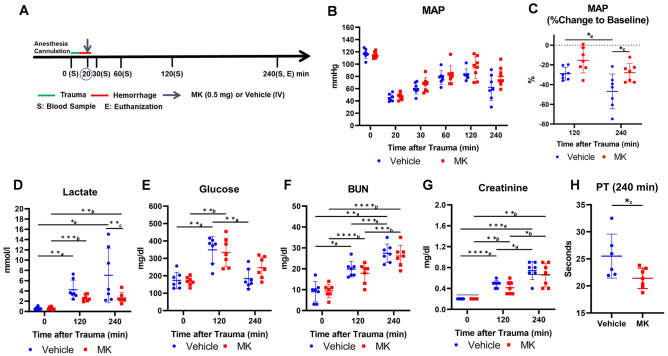
Intravenous administration of MK-8617 (MK) 20 min after polytrauma/hemorrhage significantly mitigated the rise of lactate. (A) Study schematic timeline; (B) sustained decline in MAP at 30, 60, 120, and 240 min after trauma followed by 40% hemorrhage. (C) A significant difference in MAP percent change versus baseline was observed between vehicle and MK 240 min after trauma; (D) lactate levels were significantly elevated versus baseline in both vehicle and MK-treated rats at 120 and 240 min after trauma; the lactate at 240 min was significantly lower in the rats of MK compared to the rats of vehicle. (E) Glucose was significantly elevated at 120 min compared to baseline and declined by 240 min compared to that at 120 min in both groups; no significant difference was found between the groups. (F) BUN and (G) Creatinine were significantly and progressively elevated at 120 min and 240 min after trauma in both groups; no significant difference was found between the groups. (H) PT was significantly reduced in rats treated with MK at 240 min after trauma compared to vehicle-treated rats. Solid dot (blue): vehicle; solid square (red): MK; a: comparison among the groups of the vehicle; b: comparison among the groups of the MK; c: comparison between the groups of the vehicle and MK; *p < 0.05; **p < 0.01; ***p < 0.001; ****p < 0.0001. MK MK-8617, MAP mean arterial pressure, PT prothrombin time, BUN blood urea nitrogen.
Figure 3
Figure 3
HIF-1α mRNA/protein and targeted downstream gene expression in the tissues (liver, kidney and lung) collected at 240 min after polytrauma/hemorrhage. (A) Gene expression and (B) protein expression of HIF-1α in liver, kidney, and lung at 240 min after polytrauma/hemorrhage; HIF-1α targeted downstream gene expression: (C) GLUT1, (D) VEGFa, and (E) hexokinase, in the liver, kidney, and lung among the groups of sham control, vehicle, and MK; (F) significant elevation of EPO gene expression in the kidney of both vehicle and MK-treated groups compared to sham control. EPO gene expression trended higher in MK-treated rats compared to vehicle (p = 0.06); (G) significant elevation of Hepcidin gene expression in the liver of both vehicle and MK-treated groups compared sham control. Solid triangle (black): control; Solid dot (blue): vehicle; solid square (red): MK; *p < 0.05; **p < 0.01; ***p < 0.001. HIF-1α hypoxia-inducible factor-1 alpha, GLUT1 glucose transporter protein type 1, VEGFa vascular endothelial growth factor A, EPO erythropoietin.
Figure 4
Figure 4
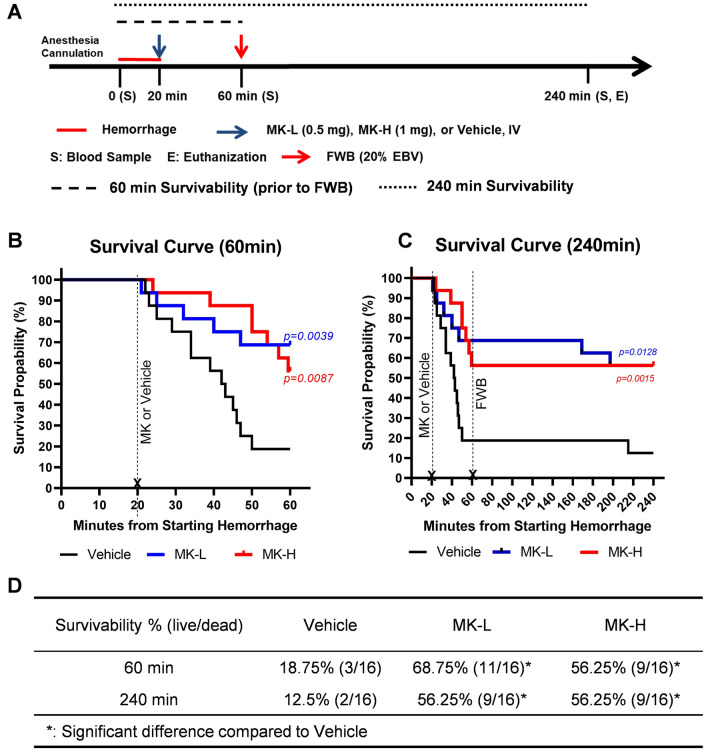
Administration of MK-8617 (MK) improves survivability in lethal decompensated hemorrhagic shock. (A) Study schematic timeline; (B) Kaplan–Meier analysis of rats treated with vehicle (black), MK-L (blue), or MK-H (red) 60 min after initiating hemorrhage and prior to FWB resuscitation, and (C) for 240 min or 180 min after FWB resuscitation. The survivability (Log-rank test) was significantly higher in rats treated with MK-L or MK-H compared to rats treated with vehicle at 60 and 240 min after hemorrhage; no significant difference was found between MK-L and MK-H. (D) The survivability rate for vehicle, MK-L, and MK-H treatments at 60 min and 240 min after hemorrhage showed significant differences comparing MK-L or MK-H to vehicle (Chi-square or Fisher’s exact test); no significant difference was found between MK-L and MK-H. *p < 0.05. MK-L MK-8617 lose dose, MK-H MK-8617 high dose.
Figure 5
Figure 5
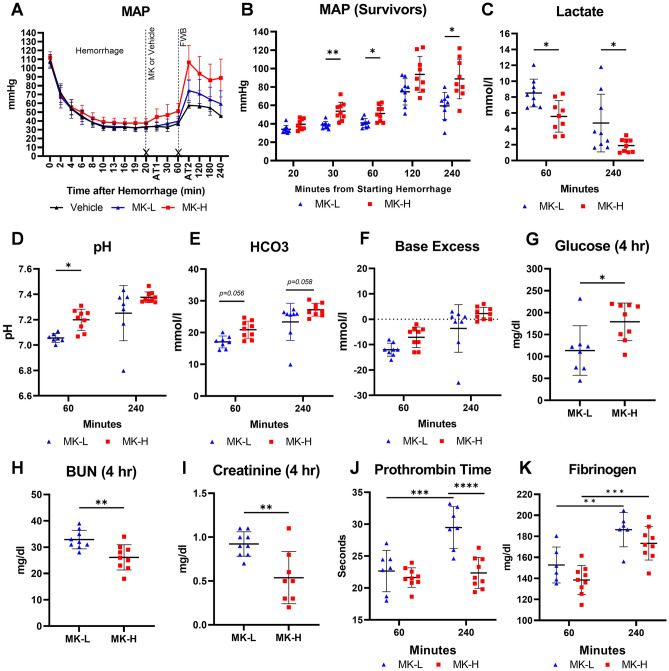
Administration of MK-8617 (MK) results in a dose-dependent improvement of outcomes in lethal decompensated hemorrhagic shock. (A) There was a sustained decline in MAP in response to hemorrhage prior to FWB resuscitation at 60 min, and FWB resuscitation partially restored MAP at least for 3 h after resuscitation in surviving animals; the MAP in rats of MK-H showed better compensation prior to FWB resuscitation and was maintained at the highest level of MAP compared to that in rats of MK-L and the vehicle. (B) MAP was significantly higher in rats of MK-H compared to rats of MK-L at 30, 60, and 240 min after hemorrhage. (C) Lactate was significantly lower in rats of MK-H compared to rats of MK-L at 60 and 240 min after hemorrhage. (D) pH was significantly higher in rats of MK-H compared to rats of MK-L at 60 min after hemorrhage. (E) HCO3 was trending higher in MK-H compared to rats of MK-L at 60 and 240 min after trauma. (F) There was no significant difference in base excess between the groups of MK-H and MK-L. (G) Glucose was significantly higher in rats of MK-H compared to rats of MK-L at 240 min after hemorrhage. (H) BUN and (I) Creatinine were significantly lower in rats of MK-H compared to rats of MK-L at 240 min after hemorrhage. (J) Improvement in coagulopathy with MK-H treatment compared to MK-L was observed by a significant reduction of PT at 180 min after FWB resuscitation. (K) FWB resuscitation improved the levels of fibrinogen in both groups of MK, but there was no significant difference between the groups. Solid dot (blue): MK-L; solid square (red): MK-H; *p < 0.05; **p < 0.01; ***p < 0.001; ****p < 0.0001. MK-L MK-8617 lose dose, MK-H MK-8617 high dose.

References

    1. Rhee P, Joseph B, Pandit V, et al. Increasing trauma deaths in the United States. Ann. Surg. 2014;260(1):13–21. doi: 10.1097/SLA.0000000000000600. - DOI - PubMed
    1. Drake SA, Wolf DA, Meininger JC, et al. Methodology to reliably measure preventable trauma death rate. Trauma Surg. Acute Care Open. 2017;2(1):e000106. doi: 10.1136/tsaco-2017-000106. - DOI - PMC - PubMed
    1. Eastridge BJ, Mabry RL, Seguin P, et al. Death on the battlefield (2001–2011): Implications for the future of combat casualty care. J. Trauma Acute Care. 2012;73:S431–S437. doi: 10.1097/TA.0b013e3182755dcc. - DOI - PubMed
    1. Eastridge BJ, Hardin M, Cantrell J, et al. Died of wounds on the battlefield: Causation and implications for improving combat casualty care. J. Trauma. 2011;71:S4–S8. - PubMed
    1. Kotwal RS, Howard JT, Orman JA, et al. The effect of a golden hour policy on the morbidity and mortality of combat casualties. JAMA Surg. 2016;151(1):15–24. doi: 10.1001/jamasurg.2015.3104. - DOI - PubMed

MeSH terms

Substances