. 2024 Feb 16;7(1):192.
doi: 10.1038/s42003-024-05867-6.

Akkermansia muciniphila-induced trained immune phenotype increases bacterial intracellular survival and attenuates inflammation

Affiliations

Akkermansia muciniphila-induced trained immune phenotype increases bacterial intracellular survival and attenuates inflammation

Ainize Peña-Cearra et al. Commun Biol. .

Abstract

The initial exposure to pathogens and commensals confers innate immune cells the capacity to respond distinctively upon a second stimulus. This training capacity might play key functions in developing an adequate innate immune response to the continuous exposure to bacteria. However, the mechanisms involved in induction of trained immunity by commensals remain mostly unexplored. A. muciniphila represents an attractive candidate to study the promotion of these long-term responses. Here, we show that priming of macrophages with live A. muciniphila enhances bacterial intracellular survival and decreases the release of pro- and anti-inflammatory signals, lowering the production of TNF and IL-10. Global transcriptional analysis of macrophages after a secondary exposure to the bacteria showed the transcriptional rearrangement underpinning the phenotype observed compared to acutely exposed cells, with the increased expression of genes related to phagocytic capacity and those involved in the metabolic adjustment conducing to innate immune training. Accordingly, key genes related to bacterial killing and pro-inflammatory pathways were downregulated. These data demonstrate the importance of specific bacterial members in the modulation of local long-term innate immune responses, broadening our knowledge of the association between gut microbiome commensals and trained immunity as well as the anti-inflammatory probiotic potential of A. muciniphila.


Conflict of interest statement

The authors declare no competing interests.

Figures
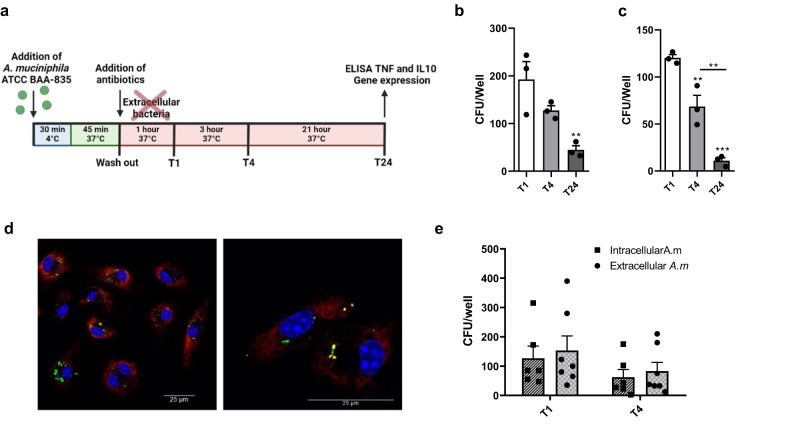
Fig. 1
Fig. 1. Akkermansia muciniphila colonizes and survives within bone marrow macrophages (BMMs) and human monocytes (hmon).
a Antibiotic-protection assay set up. Gene expression analysis and cytokine release quantification were carried out 24 h after stopping A. muciniphila phagocytosis by BMMs or hmon. A. muciniphila intracellular survival in b BMMs and c hmon measured at T1, T4, and T24, expressed as CFU/well (n = 3). d Detection of live A. muciniphila inside BMMs by Live/Dead staining at T4. Live A. muciniphila is shown in green, and heat-killed A. muciniphila in yellow (Scale bar: 25 μm) (n = 6 for intracellular, n = 7 for extracellular). e Intracellular and extracellular A. muciniphila (CFU/Well) after BMMs colonization. Data are shown as mean ± SEM. Statistical analysis: b, c Ordinary one-way ANOVA (Tukey post hoc), d two-way ANOVA (Sidak post hoc).
Fig. 2
Fig. 2. A. muciniphila modulates the response of murine macrophages and human monocytes.
a TNF and IL-10 measurements in BMMs stimulated for 24 h with live (A.m) or heat-killed (HkA.m) A. muciniphila by ELISA (n = 5 for TNF, n = 4 for IL-10). b, c Gene expression levels in stimulated BMMs expressed relatively to the mean of unstimulated BMMs (U), analyzed by Real-Time PCR (n ≥ 3). d TNF quantification by ELISA in human monocyte stimulated supernatants (n = 3). e Heatmap of gene expression for several differentially expressed genes between live A.m-stimulated and unstimulated BMMs, analyzed by RNAseq (n = 3). Normalized expression values are z score normalized for each gene. f Bubble plot displaying significantly enriched KEGG pathways of upregulated genes in acutely stimulated BMMs. Only relevant pathways related to immune processes are selected and represented here, extracted from the Supplementary data set 1. Rich factor is calculated as the number of DEGs associated with each pathway by the total number of genes belonging to that pathway in KEGG database. Data are shown as mean ± SEM. Statistical analysis: Ordinary one-way ANOVA (Tukey post hoc).
Fig. 3
Fig. 3. Stimulation of murine-inflamed colons with live Akkermansia muciniphila promoted an anti-inflammatory response.
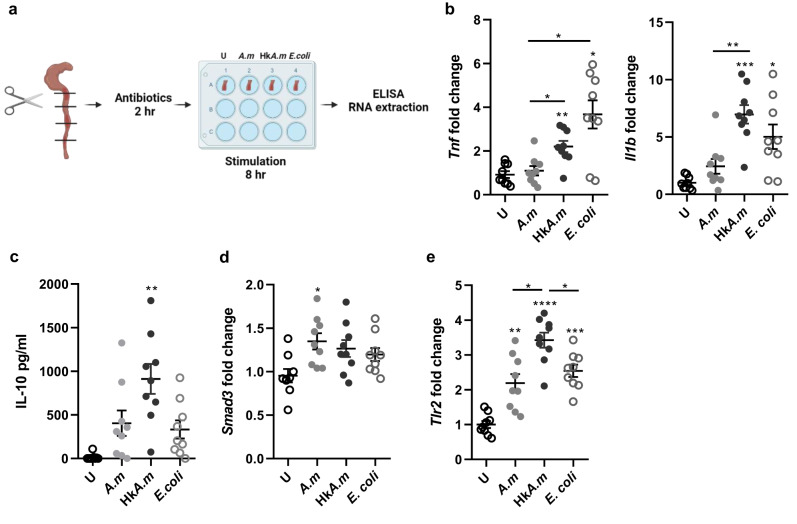
a Diagram of the steps to prepare murine colon tissues and stimulate ex vivo with live A.m, heat-killed A.m, and E. coli. Gene expression levels in all conditions of b Tnf and Il1b, and d Smad3 and e Tlr2 shown as fold change relative to the mean of unstimulated colon tissue (U) (n = 9). c IL-10 quantification in medium supernatants by ELISA (n = 9). Data are represented as mean ± SEM. Statistical analysis: One-way ANOVA (Tukey post hoc) and mixed-effects analysis for paired samples (Tukey post hoc). a Created with BioRender.com.
Fig. 4
Fig. 4. BMMs and human monocyte training with live Akkermansia muciniphila enhances its intracellular survival capacity and reduces the pro-inflammatory response.
a Experimental workflow of in vitro trained innate immunity assay. b Intracellular survival of A. muciniphila in acute (U-A.m) or trained (A.m-A.m, HkA.m-A.m) BMMs at T1 and T4 represented as CFU/Well (n = 3). c TNF and IL-10 quantification in BMMs supernatants (n = 3). Gene expression levels in BMMs of d Tnf and Il-10 and e Il-1b, Il-6, and Cxcl3 (n ≥ 4). f A. muciniphila intracellular survival within acute and trained monocytes at T1 and T4 after internalization (n = 3). g TNF and IL-6 quantification by ELISA in human monocytes supernatants (n ≥ 10). h IL10 expression of human monocytes (n ≥ 8). qPCR results are normalized to the unstimulated control (U-U), not shown in the graphs. Data are shown as mean ± SEM, n = 3–6. Statistical analysis: ordinary one-way ANOVA (Tukey post hoc).
Fig. 5
Fig. 5. Transcriptional response of live Akkermansia muciniphila-trained BMMs.
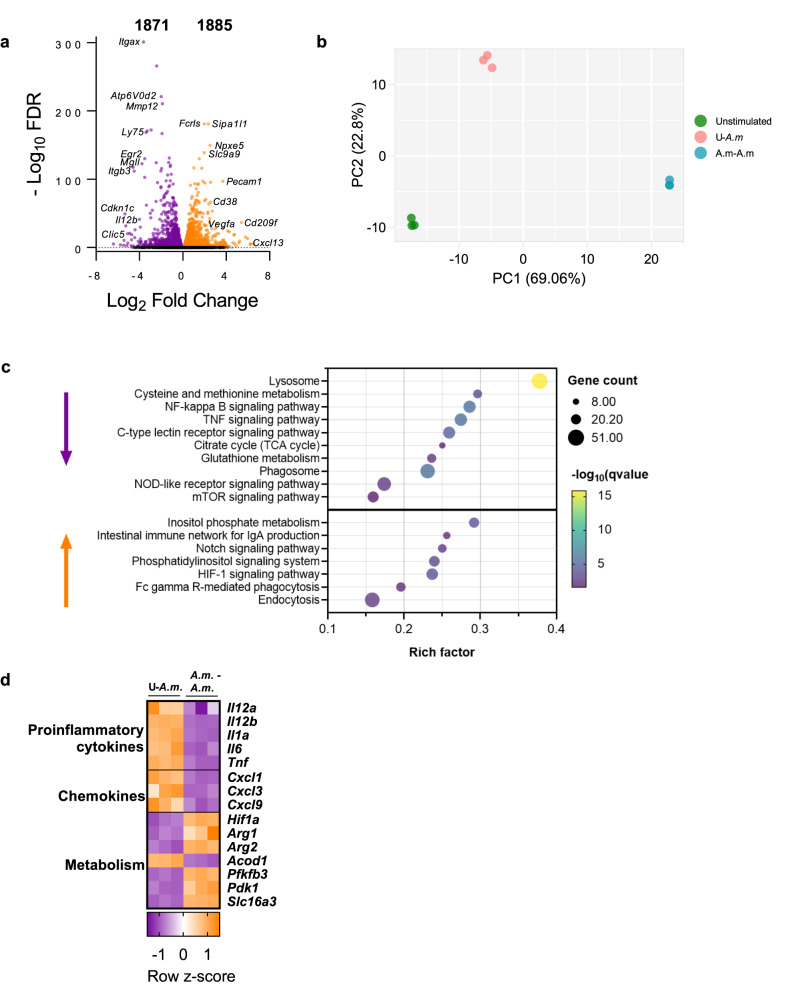
a Volcano plot representing differentially expressed genes of trained and restimulated macrophages compared to acutely stimulated cells. b Principal component analysis (PCA) of the transcriptome of trained, acute, and unstimulated macrophages (n = 3). c Bubble plot of significantly enriched KEGG pathways of upregulated and downregulated genes in trained macrophages. Only relevant pathways related to immune and metabolic processes are selected and displayed here, extracted from the Supplementary data set 2. d Heatmap of gene expression for several differentially expressed genes between live A. muciniphila acutely stimulated and trained BMMs. Normalized expression values are z score normalized for each gene.
Fig. 6
Fig. 6. A. muciniphila-training of BMMs promotes a profound metabolic rewiring towards glycolysis and mitochondrial respiration.
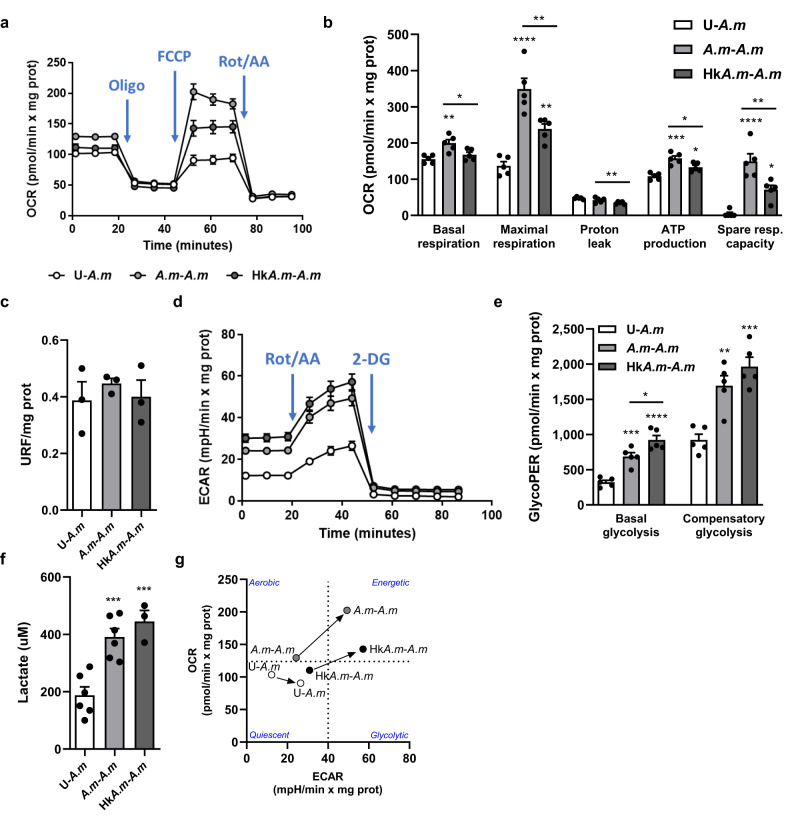
a, b Seahorse Extracellular Flux Analyzer was used to determine oxygen consumption rate (OCR) coupled to mitochondrial respiration (n = 5). c Intracellular ROS superoxide production in the mitochondrial matrix of BMMs (n = 3, independent experiment). d, e Extracellular acidification rate (ECAR) and glycolytic parameters measured by Seahorse (n = 5). f Lactate concentration (μM) in BMM supernatants (n = 4–6). g Metabolic phenogram showing OCR/ECAR ratio in basal and stressed conditions. Data are shown as mean ± SEM. Statistical analysis: ordinary one-way ANOVA (Tukey post hoc).

References

    1. Scott NA, Mann ER. Regulation of mononuclear phagocyte function by the microbiota at mucosal sites. Immunology. 2020;159:26–38. doi: 10.1111/imm.13155. - DOI - PMC - PubMed
    1. Bain CC, Schridde A. Origin, differentiation, and function of intestinal macrophages. Front. Immunol. 2018;9:2733. doi: 10.3389/fimmu.2018.02733. - DOI - PMC - PubMed
    1. Danne C, et al. A large polysaccharide produced by helicobacter hepaticus induces an anti-inflammatory gene signature in macrophages. Cell Host Microbe. 2017;22:733–745.e735. doi: 10.1016/j.chom.2017.11.002. - DOI - PMC - PubMed
    1. Hayashi A, et al. A single strain of Clostridium butyricum induces intestinal IL-10-producing macrophages to suppress acute experimental colitis in mice. Cell Host Microbe. 2013;13:711–722. doi: 10.1016/j.chom.2013.05.013. - DOI - PubMed
    1. Correa-Oliveira R, Fachi JL, Vieira A, Sato FT, Vinolo MA. Regulation of immune cell function by short-chain fatty acids. Clin. Transl. Immunol. 2016;5:e73. doi: 10.1038/cti.2016.17. - DOI - PMC - PubMed

Publication types

Substances

Supplementary concepts