. 2024 Feb 16;14(1):3888.
doi: 10.1038/s41598-024-54372-7.

Prevalence of mental health symptoms and potential risk factors among Austrian psychotherapists

Affiliations

Prevalence of mental health symptoms and potential risk factors among Austrian psychotherapists

Yvonne Schaffler et al. Sci Rep. .

Abstract

This research focused on the intricacies of mental health within the psychotherapist community, a domain currently understudied. A recent study suggests a better overall mental health profile for Austrian psychotherapists compared to the general population. However, a substantial proportion of psychotherapists still exhibited scores beyond the cut-off for clinically significant mental disorders, potentially undermining the efficacy of patient outcomes. A cross-sectional study was conducted between April to June 2023, enrolling a cohort of 502 Austrian psychotherapists (79.7% female; mean age: 53.4 ± 9.26 years). The analysis leveraged indicators for symptoms of depression (PHQ-2), anxiety (GAD-2), insomnia (ISI-2), stress (PSS-4), and overall well-being (WHO-5). Key correlations were revealed using multivariable logistic regressions incorporating sociodemographic, work-related, and health behavior variables. Mental health symptoms in psychotherapists were associated with lower income, lesser physical activity, employment in outpatient facilities, less experience in the field, and a smaller patient load. Notably, physical activity emerged as a significant protective component, underscoring regular exercise as a vital self-care routine for psychotherapists. Adequate income also presented as a crucial contributor to mental health stability. These findings augment our understanding of the complex dynamics influencing psychotherapists' mental health, potentially enhancing their well-being and optimizing professional output.

Keywords: Anxiety; Depression; Income; Insomnia; Mental health; Physical activity; Psychotherapist; Stress.


Conflict of interest statement

The authors declare no competing interests.

Figures
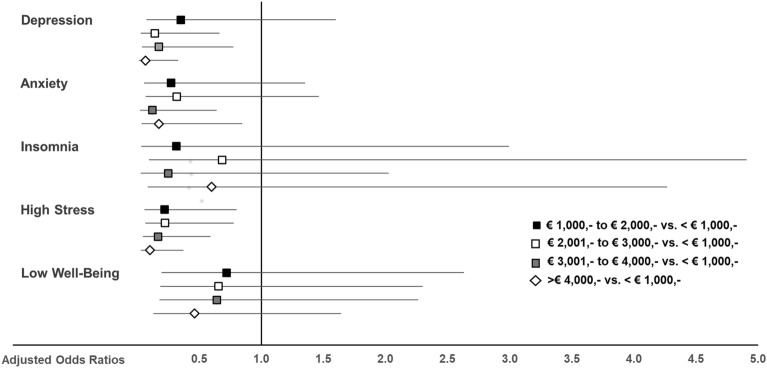
Figure 1
Figure 1
Adjusted odds ratios for clinically relevant symptoms of depression, anxiety, insomnia, high stress, and poor well-being in psychotherapists concerning net household income. An adjusted odds ratio of 1 indicates no difference. Adjusted odds ratios < 1 indicate lower relative risk in the respective income group compared to < € 1000,- net household income. 95% confidence intervals (horizontal lines) crossing 1 (vertical line) indicate no significant difference between the respective income group and < € 1000,- net household income. The multivariable logistic regression model was adjusted for gender, age, region, income, physical activity, smartphone usage, number of patients treated per week, years in the profession, patient group, therapeutic setting, facility, theoretical orientation, income dependency on psychotherapy, working in another job next to psychotherapy.
Figure 2
Figure 2
Adjusted odds ratios for clinically relevant symptoms of depression, anxiety, insomnia, high stress, and poor well-being in psychotherapists meeting WHO recommendations for physical activity vs. those not. An adjusted odds ratio of 1 indicates no difference. Adjusted odds ratios < 1 indicate lower relative risk in psychotherapists meeting WHO recommendations for physical activity vs. those not. 95% confidence intervals (horizontal lines) crossing 1 (vertical line) indicate no significant difference between psychotherapists meeting WHO recommendations for physical activity vs. those not. The multivariable logistic regression model was adjusted for gender, age, region, income, physical activity, smartphone usage, number of patients treated per week, years in the profession, patient group, therapeutic setting, facility, theoretical orientation, income dependency on psychotherapy, working in another job next to psychotherapy.

References

    1. Simionato GK, Simpson S. Personal risk factors associated with burnout among psychotherapists: A systematic review of the literature. J. Clin. Psychol. 2018;74:1431–1456. doi: 10.1002/jclp.22615. - DOI - PubMed
    1. Jimenez RR, Andersen S, Song H, Townsend C. Vicarious trauma in mental health care providers. J. Interprof. Educ. Pract. 2021;24:100451.
    1. Van Hoy A, Rzeszutek M. Burnout and psychological wellbeing among psychotherapists: A systematic review. Front. Psychol. 2022;13:928191. doi: 10.3389/fpsyg.2022.928191. - DOI - PMC - PubMed
    1. Joshi G, Sharma G. Burnout: A risk factor amongst mental health professionals during COVID-19. Asian J. Psychiatry. 2020;54:102300. doi: 10.1016/j.ajp.2020.102300. - DOI - PMC - PubMed
    1. Rosen CS, et al. Implementation context and burnout among department of veterans affairs psychotherapists prior to and during the COVID-19 pandemic. J. Affect. Disord. 2023;320:517–524. doi: 10.1016/j.jad.2022.09.141. - DOI - PMC - PubMed
