


Impact of mechanical power and positive end expiratory pressure on central vs. mixed oxygen and carbon dioxide related variables in a population of female piglets
- PMID: 38366303
- PMCID: PMC10873162
- DOI: 10.14814/phy2.15954
Impact of mechanical power and positive end expiratory pressure on central vs. mixed oxygen and carbon dioxide related variables in a population of female piglets
Abstract
Introduction: The use of the pulmonary artery catheter has decreased overtime; central venous blood gases are generally used in place of mixed venous samples. We want to evaluate the accuracy of oxygen and carbon dioxide related parameters from a central versus a mixed venous sample, and whether this difference is influenced by mechanical ventilation.
Materials and methods: We analyzed 78 healthy female piglets ventilated with different mechanical power.
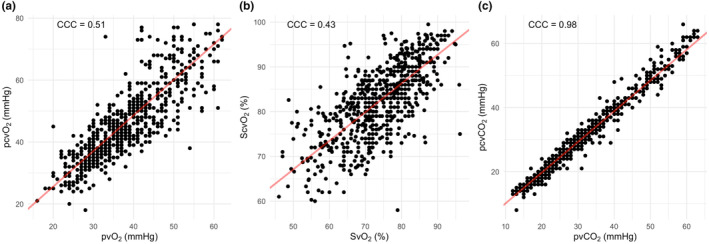
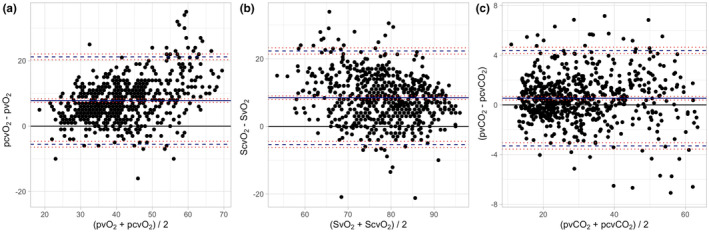
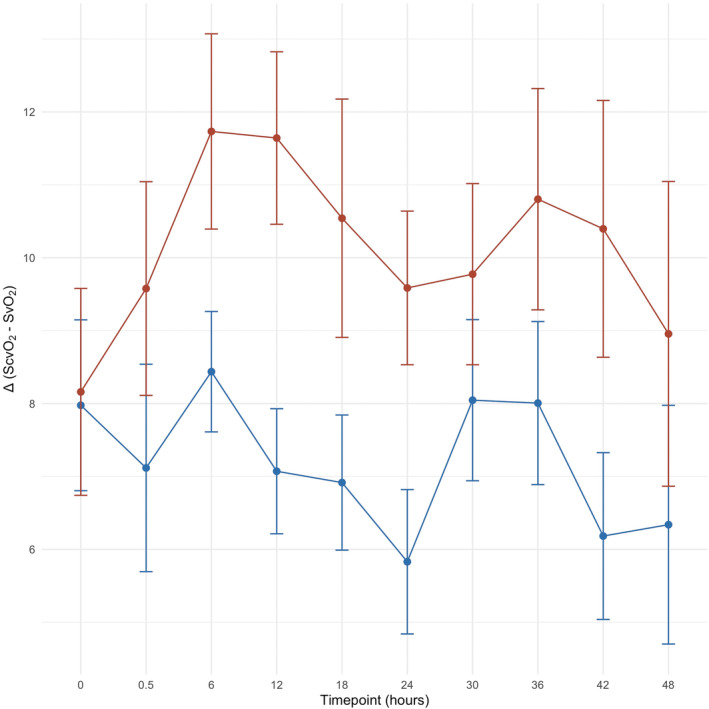
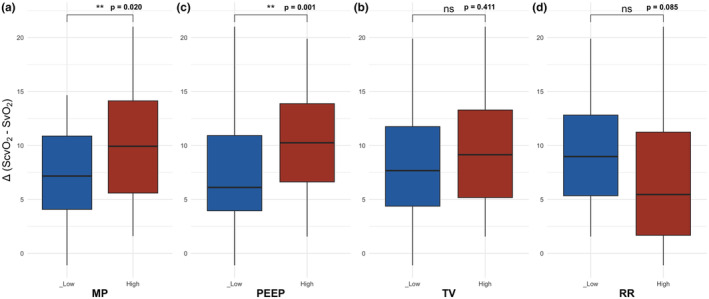
Results: There was a significant difference in oxygen-derived parameters between samples taken from the central venous and mixed venous blood (S O2 = 74.6%, ScvO2 = 83%, p < 0.0001). Conversely, CO2-related parameters were similar, with strong correlation. Ventilation with higher mechanical power and PEEP increased the difference between oxygen saturations, (Δ[ScvO2-S O2 ] = 7.22% vs. 10.0% respectively in the low and high MP groups, p = 0.020); carbon dioxide-related parameters remained unchanged (p = 0.344).
Conclusions: The venous oxygen saturation (central or mixed) may be influenced by the effects of mechanical ventilation. Therefore, central venous data should be interpreted with more caution when using higher mechanical power. On the contrary, carbon dioxide-derived parameters are more stable and similar between the two sampling sites, independently of mechanical power or positive end expiratory pressures.
Keywords: ARDS; ScvO2; SvO2; carbon dioxide; central versus mixed gap; intrathoracic pressures; mechanical power; oxygen saturation; septic shock.
© 2024 The Authors. Physiological Reports published by Wiley Periodicals LLC on behalf of The Physiological Society and the American Physiological Society.
Conflict of interest statement
The Authors declare no conflicts of interest.
Figures
References
-
- Andrew, L. (2000a). Carbon dioxide. In Nunn J. F. (Ed.),Nunn's Apllied Respiratory Physiology (pp. 222–232).
-
- Andrew, L. (2000b). Diffusion of respiratory gases. In In Nunn J. F. (Ed.), Nunn's Applied Respiratory Physiology (pp. 208–209).
MeSH terms
Substances
LinkOut - more resources
Full Text Sources
Miscellaneous
