


Advancing burn wound treatment: exploring hydrogel as a transdermal drug delivery system
- PMID: 38366562
- PMCID: PMC10878343
- DOI: 10.1080/10717544.2023.2300945
Advancing burn wound treatment: exploring hydrogel as a transdermal drug delivery system
Abstract
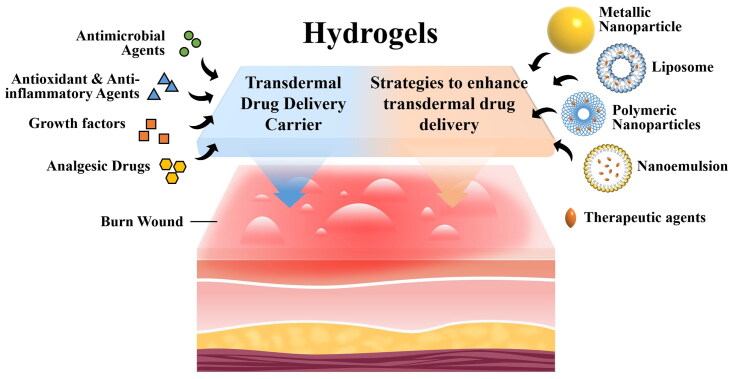
Burn injuries are prevalent and life-threatening forms that contribute significantly to mortality rates due to associated wound infections. The management of burn wounds presents substantial challenges. Hydrogel exhibits tremendous potential as an ideal alternative to traditional wound dressings such as gauze. This is primarily attributed to its three-dimensional (3D) crosslinked polymer network, which possesses a high water content, fostering a moist environment that supports effective burn wound healing. Additionally, hydrogel facilitates the penetration of loaded therapeutic agents throughout the wound surface, combating burn wound pathogens through the hydration effect and thereby enhancing the healing process. However, the presence of eschar formation on burn wounds obstructs the passive diffusion of therapeutics, impairing the efficacy of hydrogel as a wound dressing, particularly in cases of severe burns involving deeper tissue damage. This review focuses on exploring the potential of hydrogel as a carrier for transdermal drug delivery in burn wound treatment. Furthermore, strategies aimed at enhancing the transdermal delivery of therapeutic agents from hydrogel to optimize burn wound healing are also discussed.
Keywords: Hydrogel; burn wound; therapeutic carrier; tissue regeneration; transdermal drug delivery.
Conflict of interest statement
No potential conflict of interest was reported by the authors.
Figures
References
-
- Alyoussef A, El-Gogary RI, Ahmed RF, et al. (2021). The beneficial activity of curcumin and resveratrol loaded in nanoemulgel for healing of burn-induced wounds. J Drug Deliv Sci Technol 62:102360. Available at doi: 10.1016/j.jddst.2021.102360. - DOI
Publication types
MeSH terms
Substances
LinkOut - more resources
Full Text Sources
Medical
