


Efficacy and Safety of Trifluridine/Tipiracil-Containing Combinations in Colorectal Cancer and Other Advanced Solid Tumors: A Systematic Review
- PMID: 38366864
- PMCID: PMC11067808
- DOI: 10.1093/oncolo/oyae007
Efficacy and Safety of Trifluridine/Tipiracil-Containing Combinations in Colorectal Cancer and Other Advanced Solid Tumors: A Systematic Review
Abstract
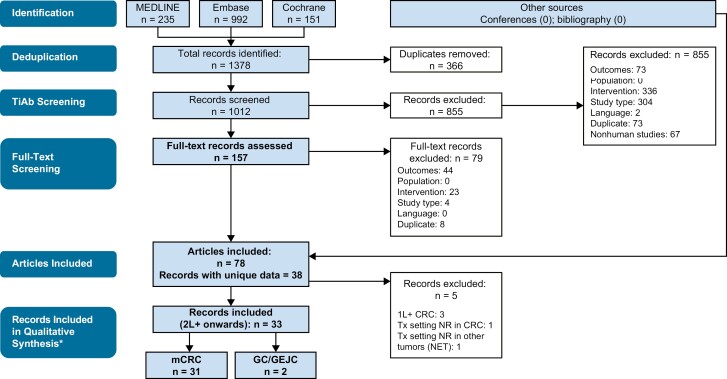
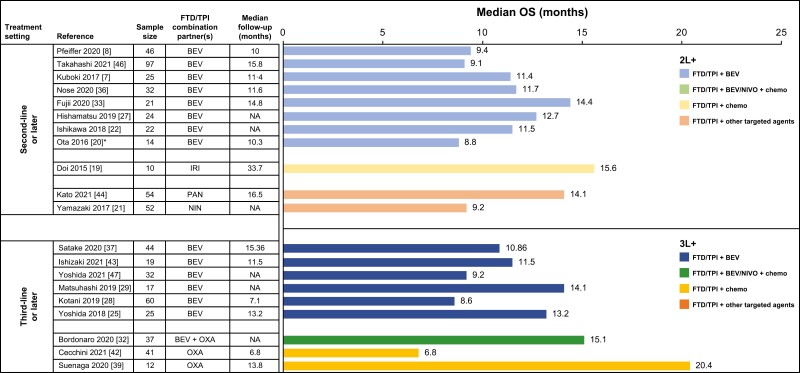
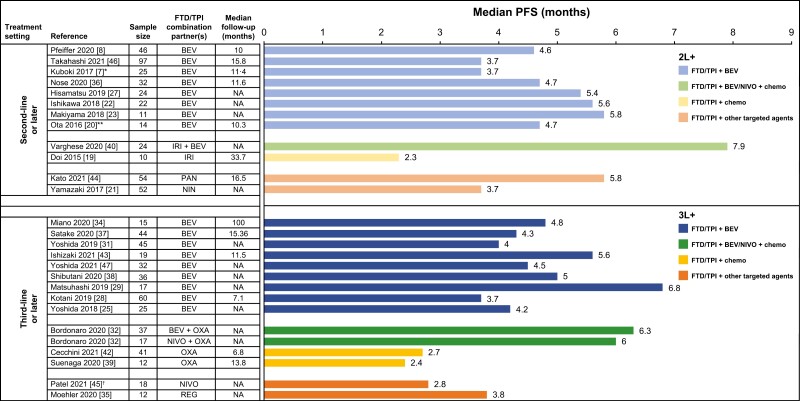
We performed a systematic literature review to identify and summarize data from studies reporting clinical efficacy and safety outcomes for trifluridine/tipiracil (FTD/TPI) combined with other antineoplastic agents in advanced cancers, including metastatic colorectal cancer (mCRC). We conducted a systematic search on May 29, 2021, for studies reporting one or more efficacy or safety outcome with FTD/TPI-containing combinations. Our search yielded 1378 publications, with 38 records meeting selection criteria: 35 studies of FTD/TPI-containing combinations in mCRC (31 studies second line or later) and 3 studies in other tumor types. FTD/TPI plus bevacizumab was extensively studied, including 19 studies in chemorefractory mCRC. Median overall survival ranged 8.6-14.4 months and median progression-free survival 3.7-6.8 months with FTD/TPI plus bevacizumab in refractory mCRC. Based on one randomized and several retrospective studies, FTD/TPI plus bevacizumab was associated with improved outcomes compared with FTD/TPI monotherapy. FTD/TPI combinations with chemotherapy or other targeted agents were reported in small early-phase studies; preliminary data indicated higher antitumor activity for certain combinations. Overall, no safety concerns existed with FTD/TPI combinations; most common grade ≥ 3 adverse event was neutropenia, ranging 5%-100% across all studies. In studies comparing FTD/TPI combinations with monotherapy, grade ≥ 3 neutropenia appeared more frequently with combinations (29%-67%) vs. monotherapy (5%-41%). Discontinuation rates due to adverse events ranged 0%-11% for FTD/TPI plus bevacizumab and 0%-17% with other combinations. This systematic review supports feasibility and safety of FTD/TPI plus bevacizumab in refractory mCRC. Data on non-bevacizumab FTD/TPI combinations remain preliminary and need further validation.
Keywords: antineoplastic agents; antineoplastic drugs; colorectal neoplasms; review literature; tipiracil; trifluridine.
© The Author(s) 2024. Published by Oxford University Press.
Conflict of interest statement
Kohei Shitara reported research funding from Amgen, Astellas Pharma, Chugai Pharmaceuticals, Daiichi Sankyo, Eisai, MSD, Ono Pharmaceuticals, and Taiho Pharmaceuticals; consulting/advisory relationships with AbbVie Inc., Amgen, Astellas Pharma, Boehringer Ingelheim, Bristol-Myers Squibb, Daiichi Sankyo, Eli Lilly and Company, GlaxoSmithKline, Guardant Health Japan, Janssen, MSD, Novartis, Pfizer, Inc, Ono Pharmaceuticals, Takeda Pharmaceuticals, and Taiho Pharmaceuticals; and honoraria from Bristol-Myers Squibb, Janssen, and Takeda Pharmaceuticals. Alfred Falcone reported research funding from AstraZeneca, Bayer, Bristol, Lilly, Merck, MSD, Novartis, Roche, Sanofi, and Servier; consulting/advisory relationships with Amgen, Bayer, Bristol, Daiichi Sankyo, Incyte, Lilly, Merck, MSD, Pierre-Fabre, Roche, and Servier; and travel expenses from Roche and Servier. Marwan G. Fakih reported research funding from Amgen, Inc., Bristol-Myers Squibb, Genentech, Novartis Oncology, and Verastem; consulting/advisory relationships with AstraZeneca, Bristol-Myers Squibb, Incyte Corporation, Pfizer, PsiOxus, Taiho Oncology, and Zhuhai Yufan Biotech; honoraria from Guardant 360; and scientific advisory board for Amgen, Inc., Array BioPharm, Bayer Corporation, Eisai, GlaxoSmithKline, Merck, Mirati Therapeutics, Inc., Nouscom, Roche/Genentech, and Xenthera. Ben George reported research funding from Boehringer Ingelheim, CARSgen, Glyconex, Helix, Hoffman La-Roche, Hutchison Medipharma, Mirati Therapeutics, NGM Biopharma, Pfizer, Roche/Genentech, Taiho Oncology, and Toray; consulting/advisory relationships with BMS, Boston Scientific, Exelixis, Foundation Medicine, Ipsen, Taiho Oncology, and Roche/Genentech; honoraria from Ipsen and Taiho Oncology; scientific advisory board for Roche/Genentech; and stock options with XBiotech. Raghav Sundar reported research funding from MSD, Natera, and Paxman Collers; scientific advisory board for Bayer, Bristol Myers Squibb, DKSH, Eisai, GSK, Merck, MSD, Novartis, and Taiho Oncology; honoraria from AstraZeneca, BMS, DKSH, Eli Lilly, Ipsen, MSD, Roche, and Taiho Oncology; and travel expenses from AstraZeneca, DKSH, Eisai, Roche, and Taiho Oncology. Sandip Ranjan reported employment with SmartAnalyst India, Pvt. Ltd.; and consulting/advisory relationships with BMS, Janssen, Pfizer, and Taiho Oncology. Eric Van Cutsem reported institutional research funding/grants from Amgen, Bayer, Boehringer Ingelheim, Bristol-Myers Squibb, Ipsen, Lilly, Merck Sharp & Dohme, Merck KGaA, Novartis, Roche, and Servier; and consulting/advisory relationships with Abbvie, ALX, Amgen, Array, Astellas, AstraZeneca, Bayer, Beigene, Boehringer Ingelheim, Bristol-Myers Squibb, Daiichi, GSK, Incyte, Ipsen, Lilly, Merck Sharp & Dohme, Merck KGaA, Mirati, Novartis, Nordic, Pierre Fabre, Pfizer, Roche, Seattle Genetics, Servier, Takeda, Terumo, Taiho, and Zymeworks. All authors report medical writing support for the submitted work, which was funded by Taiho Oncology, Inc.
Figures
References
-
- Emura T, Suzuki N, Yamaguchi M, Ohshimo H, Fukushima M.. A novel combination antimetabolite, TAS-102, exhibits antitumor activity in FU-resistant human cancer cells through a mechanism involving FTD incorporation in DNA. Int J Oncol. 2004;25(3):571-578. - PubMed
Publication types
MeSH terms
Substances
Grants and funding
LinkOut - more resources
Full Text Sources
Medical
Miscellaneous
