


Time-integrated BMP signaling determines fate in a stem cell model for early human development
- PMID: 38368368
- PMCID: PMC10874454
- DOI: 10.1038/s41467-024-45719-9
Time-integrated BMP signaling determines fate in a stem cell model for early human development
Abstract
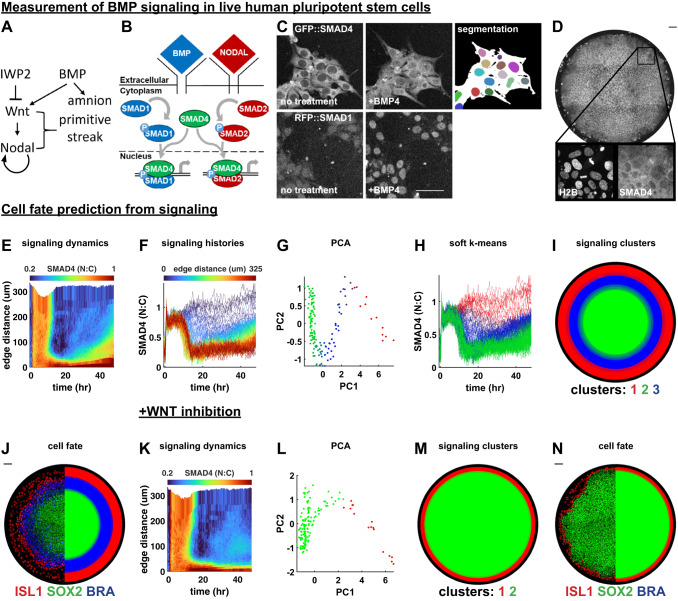
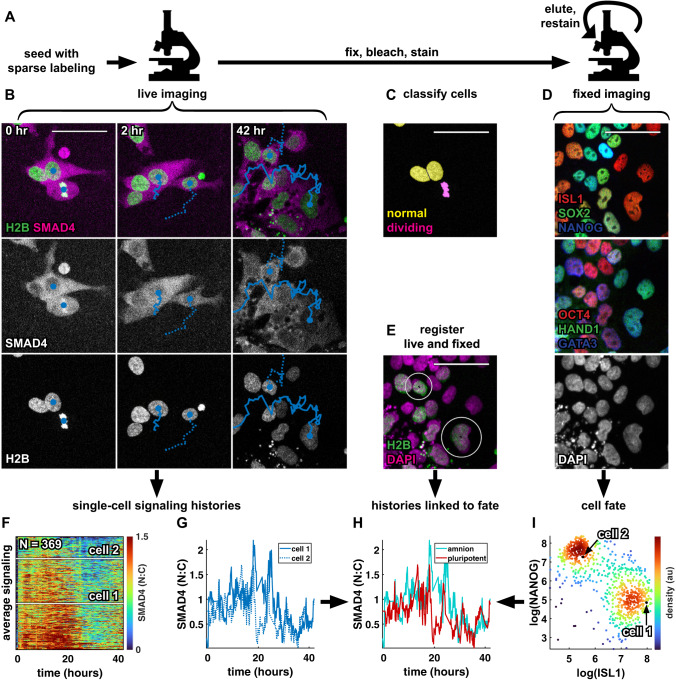
How paracrine signals are interpreted to yield multiple cell fate decisions in a dynamic context during human development in vivo and in vitro remains poorly understood. Here we report an automated tracking method to follow signaling histories linked to cell fate in large numbers of human pluripotent stem cells (hPSCs). Using an unbiased statistical approach, we discover that measured BMP signaling history correlates strongly with fate in individual cells. We find that BMP response in hPSCs varies more strongly in the duration of signaling than the level. However, both the level and duration of signaling activity control cell fate choices only by changing the time integral. Therefore, signaling duration and level are interchangeable in this context. In a stem cell model for patterning of the human embryo, we show that signaling histories predict the fate pattern and that the integral model correctly predicts changes in cell fate domains when signaling is perturbed. Our data suggest that mechanistically, BMP signaling is integrated by SOX2.
© 2024. The Author(s).
Conflict of interest statement
The authors declare no competing interests.
Figures


Update of
-
The time integral of BMP signaling determines fate in a stem cell model for early human development.bioRxiv [Preprint]. 2023 Apr 10:2023.04.10.536068. doi: 10.1101/2023.04.10.536068. bioRxiv. 2023. Update in: Nat Commun. 2024 Feb 17;15(1):1471. doi: 10.1038/s41467-024-45719-9. PMID: 37090515 Free PMC article. Updated. Preprint.
References
MeSH terms
Grants and funding
LinkOut - more resources
Full Text Sources
Molecular Biology Databases
