Model-based correction of rapid thermal confounds in fluorescence neuroimaging of targeted perturbation
- PMID: 38371339
- PMCID: PMC10871046
- DOI: 10.1117/1.NPh.11.1.014413
Model-based correction of rapid thermal confounds in fluorescence neuroimaging of targeted perturbation
Abstract
Significance: An array of techniques for targeted neuromodulation is emerging, with high potential in brain research and therapy. Calcium imaging or other forms of functional fluorescence imaging are central solutions for monitoring cortical neural responses to targeted neuromodulation, but often are confounded by thermal effects that are inter-mixed with neural responses.
Aim: Here, we develop and demonstrate a method for effectively suppressing fluorescent thermal transients from calcium responses.
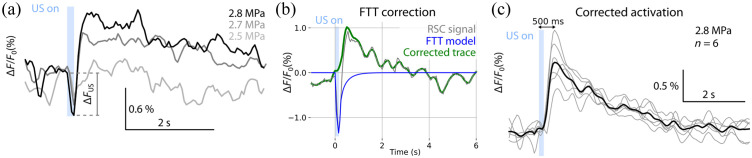
Approach: We use high precision phased-array 3 MHz focused ultrasound delivery integrated with fiberscope-based widefield fluorescence to monitor cortex-wide calcium changes. Our approach for detecting the neural activation first takes advantage of the high inter-hemispheric correlation of resting state dynamics and then removes the ultrasound-induced thermal effect by subtracting its simulated spatio-temporal signature from the processed profile.
Results: The focused -sized ultrasound stimulus triggered rapid localized activation events dominated by transient thermal responses produced by ultrasound. By employing bioheat equation to model the ultrasound heat deposition, we can recover putative neural responses to ultrasound.
Conclusions: The developed method for canceling transient thermal fluorescence quenching could also find applications with optical stimulation techniques to monitor thermal effects and disentangle them from neural responses. This approach may help deepen our understanding of the mechanisms and macroscopic effects of ultrasound neuromodulation, further paving the way for tailoring the stimulation regimes toward specific applications.
Keywords: calcium imaging; mouse brain; neuroimaging; thermal effects; ultrasound neuromodulation.
© 2024 The Authors.
Figures


References
Grants and funding
LinkOut - more resources
Full Text Sources
Miscellaneous