


Effect of fear of hypoglycaemia on sleep quality of patients with type 2 mellitus diabetes: The mediating role of alexithymia
- PMID: 38375274
- PMCID: PMC10875557
- DOI: 10.1016/j.heliyon.2024.e26137
Effect of fear of hypoglycaemia on sleep quality of patients with type 2 mellitus diabetes: The mediating role of alexithymia
Abstract
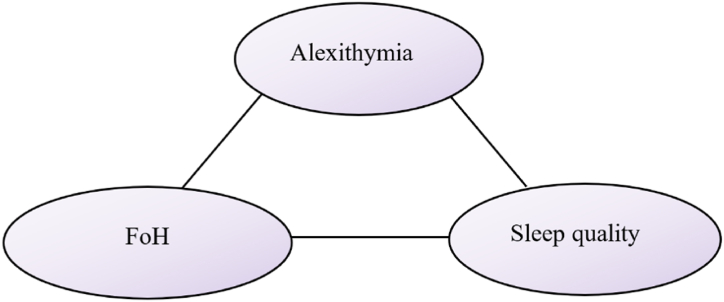
Background: Patients with type 2 diabetes mellitus (T2DM) commonly experience poor sleep quality. This study aimed to investigate whether alexithymia mediates the association between fear of hypoglycaemia (FoH) and sleep quality in patients with T2DM.
Methods: From September 2021 to November 2021, a cross-sectional survey was conducted on 407 patients with T2DM in China. Data collection was made possible through the administration of the Chinese Version of the Worry Scale, Toronto Alexithymia Scale and Chinese version of the Pittsburgh Sleep Quality Index (CPSQI). Multiple linear regression analyses were also performed.
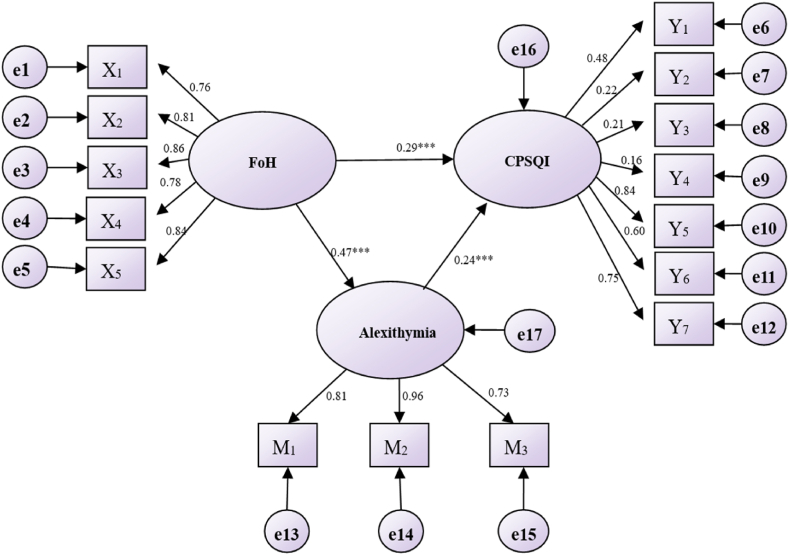
Results: A total of 65.6% of the participants were male, and 75.7% were aged 18-40 years. FoH showed a moderate and positive correlation with CPSQI scores (r = 0.308, p < 0.001). Alexithymia was weakly and positively correlated with CPSQI scores (r = 0.185, p < 0.001). Meanwhile, FoH exhibited a moderate and positive correlation with alexithymia (r = 0.422, p < 0.001), and difficulty in identifying (r = 0.414, p < 0.001) and describing feelings (r = 0.416, p < 0.001) and a weak and positive correlation with externally oriented thinking (r = 0.221, p < 0.001). The total effect (β = 0.408, p < 0.001) of FoH on CPSQI comprised not only the direct (β = 0.293, 95% confidence interval: 0.174-0.411, p < 0.001) but also the indirect effect (β = 0.115, p < 0.001) of alexithymia.
Conclusions: Alexithymia can mediate the association between FoH and sleep quality. Clinicians should recognize the potential effect of alexithymia and incorporate it in intervention planning and care. Addressing the affective disturbances arising from FoH can enhance emotional expression and sleep quality among T2DM patients.
Keywords: Alexithymia; Diabetes; Fear of hypoglycaemia; Sleep quality.
© 2024 Published by Elsevier Ltd.
Conflict of interest statement
The authors declare that they have no known competing financial interests or personal relationships that could have appeared to influence the work reported in this paper.
Figures
Similar articles
-
Impact of fear of hypoglycaemia on self-management in patients with type 2 diabetes mellitus: structural equation modelling.Acta Diabetol. 2022 May;59(5):641-650. doi: 10.1007/s00592-021-01839-y. Epub 2022 Jan 27. Acta Diabetol. 2022. PMID: 35083591
-
The impact of fear of hypoglycaemia on sleep in adolescents with type 1 diabetes.Diabet Med. 2023 May;40(5):e15066. doi: 10.1111/dme.15066. Epub 2023 Feb 23. Diabet Med. 2023. PMID: 36786042 Free PMC article.
-
[Affectivity and alexithymia: two dimensions explicative of the relationship between anxiety and depressive symptoms].Encephale. 2012 Jun;38(3):187-93. doi: 10.1016/j.encep.2011.03.006. Epub 2011 Oct 7. Encephale. 2012. PMID: 22726406 French.
-
Development and validation of fear of hypoglycemia screener: results from the T1D exchange registry.J Patient Rep Outcomes. 2023 May 9;7(1):43. doi: 10.1186/s41687-023-00585-9. J Patient Rep Outcomes. 2023. PMID: 37160500 Free PMC article. Review.
-
The association between alexithymia as assessed by the 20-item Toronto Alexithymia Scale and depression: A meta-analysis.Psychiatry Res. 2015 May 30;227(1):1-9. doi: 10.1016/j.psychres.2015.02.006. Epub 2015 Feb 19. Psychiatry Res. 2015. PMID: 25769520 Review.
Cited by
-
Smoking disrupts the relationship between cerebrospinal fluid IL-1β and multiple subdimensions of sleep.Brain Behav Immun Health. 2025 Mar 26;45:100987. doi: 10.1016/j.bbih.2025.100987. eCollection 2025 May. Brain Behav Immun Health. 2025. PMID: 40235833 Free PMC article.
References
-
- International Diabetes Federation . tenth ed. Brussels; elgium: 2021. DF Diabetes Atlas.https://www.diabetesatlas.org Available at:
LinkOut - more resources
Full Text Sources
