


Indirect orthodontic bonding using an original 3D method compared with conventional technique: A narrative review
- PMID: 38375395
- PMCID: PMC10874802
- DOI: 10.1016/j.sdentj.2023.09.009
Indirect orthodontic bonding using an original 3D method compared with conventional technique: A narrative review
Abstract
As well known success in orthodontics is related to a correct diagnosis and to a carefull treatment planning. Our study aims to provide clinician with a reproducible and precise method, for orthodontic indirect bonding, thanks to CBCT images and due to a CAD-CAM process.
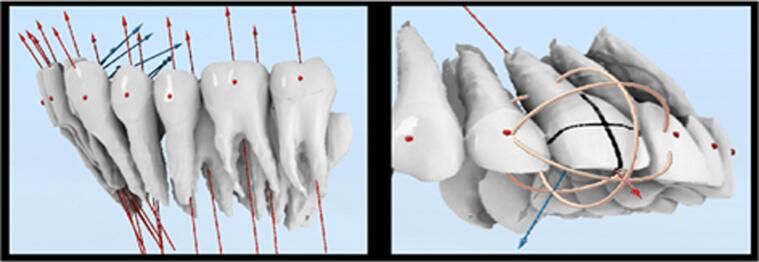
Methods: A case of an orthodontic treatment plan, of a female patient, 37 years old, was selected. Plaster models were digitally acquired using the Extra-Oral scanner Maestro 3D and processed within the Studio Maestro 3D software. CBCT images in DICOM format were imported into the MIMICS software, in order to perform the segmentation of the dental elements, and to obtain a three-dimensional coronal-root dental arches model. The DICOM file thus processed was exported in an STL file, reworked with Meshmixer software to improve image quality, and imported into the 3D Maestro software to be superimposed on the digital model. In this way a three-dimensional real model of the dental arches was developed. After an accurate orthodontic virtual set-up, we proceeded to brackets positioning on the 3D model of the dental arches. Subsequently, a virtual transfer template was created, in order to carry out the digital printing of a thermo-printed mask necessary to perform an indirect bonding of the orthodontic appliance.
Results: The original digital workflow proposed in this study allows the development of a real and non-ideal three-dimensional coronal-root model of the dental arches; this model can be used for indirect orthodontic bonding eliminating any errors in the expression of 1st, 2nd and 3rd order information of the pre-informed orthodontic appliance.
Conclusions: Technological advancements in oral scanning and 3D printing will allow the achievement of an easy and reproducible ideal positioning of the orthodontic brackets.
Keywords: CAD-CAM; CBCT; Indirect Orthodontic Bonding.
© 2023 THE AUTHORS.
Conflict of interest statement
The authors declare that they have no known competing financial interests or personal relationships that could have appeared to influence the work reported in this paper.
Figures



References
-
- Aksakalli S., Demir A. Indirect bonding: a literature review. Eur J General Dentistry. 2012;1:6.
-
- Burhardt L., Livas C., Kerdijk W., Wan der Meer W.J., Ren Y. Treatment comfort, time perception, and preference for conventional and digital impression techniques: a comparative study in young patients. Am. J. Orthod. Dentofac. Orthop. 2016;150(1):261–267. - PubMed
-
- Carlson K., Johnson E. Bracket positioning and resets: five steps to align crowns and roots consistently. Am. J. Orthod. Dentof. Orthop. 2001;119(1):76–80. - PubMed
LinkOut - more resources
Full Text Sources
Research Materials
Miscellaneous
