Healthcare infections and antimicrobial consumption in pre-COVID-19 era: a point prevalence survey in three hospitals in a region of Central Italy
- PMID: 38379748
- PMCID: PMC10876034
- DOI: 10.15167/2421-4248/jpmh2023.64.4.2962
Healthcare infections and antimicrobial consumption in pre-COVID-19 era: a point prevalence survey in three hospitals in a region of Central Italy
Abstract
Introduction: Healthcare-associated infections (HAIs) are a major global public health concern, increasing the transmission of drug-resistant infections. This point prevalence survey investigated HAIs occurrence and antimicrobial consumption (AMC) in pre-COVID-19 era in the public hospitals of a region of Central Italy.
Methods: Data were collected using the protocol standardised by the European Centre for Disease Prevention and Control.
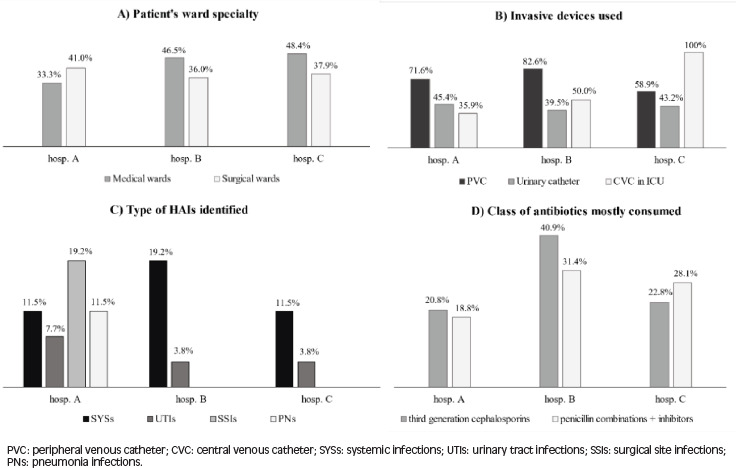
Results: Three-hundred and sixty-four patients were included (59.3% male) in the study. Overall, HAIs prevalence was 6.6% (95%CI 4.4-9.5), ranging from 5.2% to 7.1% within the surveyed hospitals, with at least one infection in 24 patients (ten each in medical and surgical specialties wards, and four in intensive care). Risk factors for HAIs were advanced age, having undergone surgery and wearing invasive devices. At time of the survey, 44.7% (95%CI 39.7-49.9) of patients was under treatment with at least one antibiotic, and AMC varied between 43% and 48% within hospitals. In all hospitals, a prevalence higher than 10% was found for the prescription reasons other than prophylaxis or therapy.
Conclusions: The results revealed a HAIs prevalence lower than that estimated compared to the most recent national data, in contrast to higher antimicrobial usage. These findings highlight the need to reinforce hygiene practices and develop bundles for HAIs, as a broad implementation of infection prevention and control practices extensively applied to both hub and spoke hospitals could significantly reduce their occurrence, as well as to implement antimicrobial stewardship for prescriptive appropriateness.
Keywords: Antibiotics; Antimicrobial stewardship; Hospital acquired infection; Indication for prescription; Infection control; Point prevalence survey.
©2024 Pacini Editore SRL, Pisa, Italy.
Conflict of interest statement
The authors report there are no competing interests to declare.
Figures
References
-
- Shafer CW, Allison JR, Hogue AL, Huntington MK. Infectious disease: health care-associated infections. FP Essent 2019;476:30-42. - PubMed
-
- Nimer NA. Nosocomial infection and antibiotic-resistant threat in the Middle East. Infect Drug Resist 2022;15:631-9. https://doi.org/10.2147/IDR.S351755 10.2147/IDR.S351755 - DOI - PMC - PubMed
-
- Antimicrobial Resistance Collaborators. Global burden of bacterial antimicrobial resistance in 2019: a systematic analysis. Lancet 2022;399:629-55. https://doi.org/10.1016/S0140-6736(21)02724-0 10.1016/S0140-6736(21)02724-0 - DOI - PMC - PubMed
-
- Stevens MP, Doll M, Pryor R, Godbout E, Cooper K, Bearman G. Impact of COVID-19 on traditional healthcare-associated infection prevention efforts. Infect Control Hosp Epidemiol 2020;41:946-7. https://doi.org/10.1017/ice.2020.141 10.1017/ice.2020.141 - DOI - PMC - PubMed
-
- Ghosh S, Bornman C, Zafer MM. Antimicrobial Resistance Threats in the emerging COVID-19 pandemic: where do we stand? J Infect Public Health 2021;14:555-60. https://doi.org/10.1016/j.jiph.2021.02.011 10.1016/j.jiph.2021.02.011 - DOI - PMC - PubMed
MeSH terms
Substances
LinkOut - more resources
Full Text Sources
Medical