. 2024 Mar 14;120(3):318-328.
doi: 10.1093/cvr/cvae027.

Marginal zone B cells produce 'natural' atheroprotective IgM antibodies in a T cell-dependent manner

Affiliations

Marginal zone B cells produce 'natural' atheroprotective IgM antibodies in a T cell-dependent manner

James Harrison et al. Cardiovasc Res. .

Abstract

Aims: The adaptive immune response plays an important role in atherosclerosis. In response to a high-fat/high-cholesterol (HF/HC) diet, marginal zone B (MZB) cells activate an atheroprotective programme by regulating the differentiation and accumulation of 'poorly differentiated' T follicular helper (Tfh) cells. On the other hand, Tfh cells activate the germinal centre response, which promotes atherosclerosis through the production of class-switched high-affinity antibodies. We therefore investigated the direct role of Tfh cells and the role of IL18 in Tfh differentiation in atherosclerosis.

Methods and results: We generated atherosclerotic mouse models with selective genetic deletion of Tfh cells, MZB cells, or IL18 signalling in Tfh cells. Surprisingly, mice lacking Tfh cells had increased atherosclerosis. Lack of Tfh not only reduced class-switched IgG antibodies against oxidation-specific epitopes (OSEs) but also reduced atheroprotective natural IgM-type anti-phosphorylcholine (PC) antibodies, despite no alteration of natural B1 cells. Moreover, the absence of Tfh cells was associated with an accumulation of MZB cells with substantially reduced ability to secrete antibodies. In the same manner, MZB cell deficiency in Ldlr-/- mice was associated with a significant decrease in atheroprotective IgM antibodies, including natural anti-PC IgM antibodies. In humans, we found a positive correlation between circulating MZB-like cells and anti-OSE IgM antibodies. Finally, we identified an important role for IL18 signalling in HF/HC diet-induced Tfh.

Conclusion: Our findings reveal a previously unsuspected role of MZB cells in regulating atheroprotective 'natural' IgM antibody production in a Tfh-dependent manner, which could have important pathophysiological and therapeutic implications.

Keywords: Antibodies; Atherosclerosis; B cells; Interleukin-18; T cells.


Conflict of interest statement

Conflict of interest: none declared.

Figures
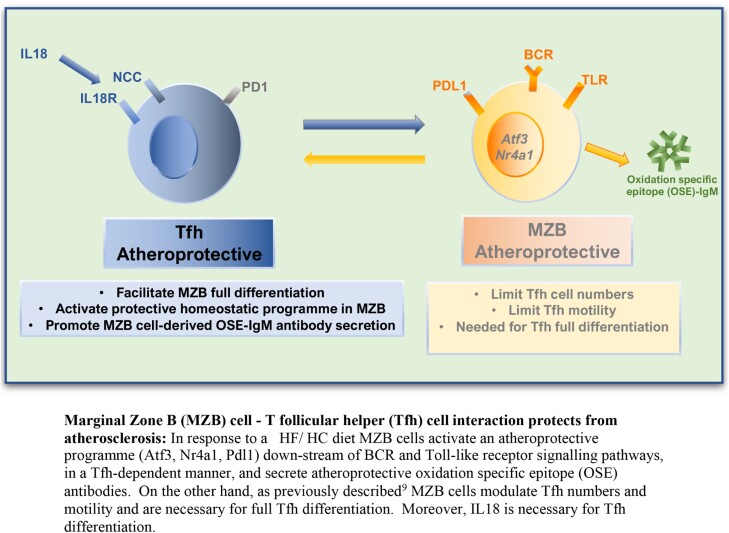
Graphical Abstract
Graphical Abstract
Figure 1
Figure 1
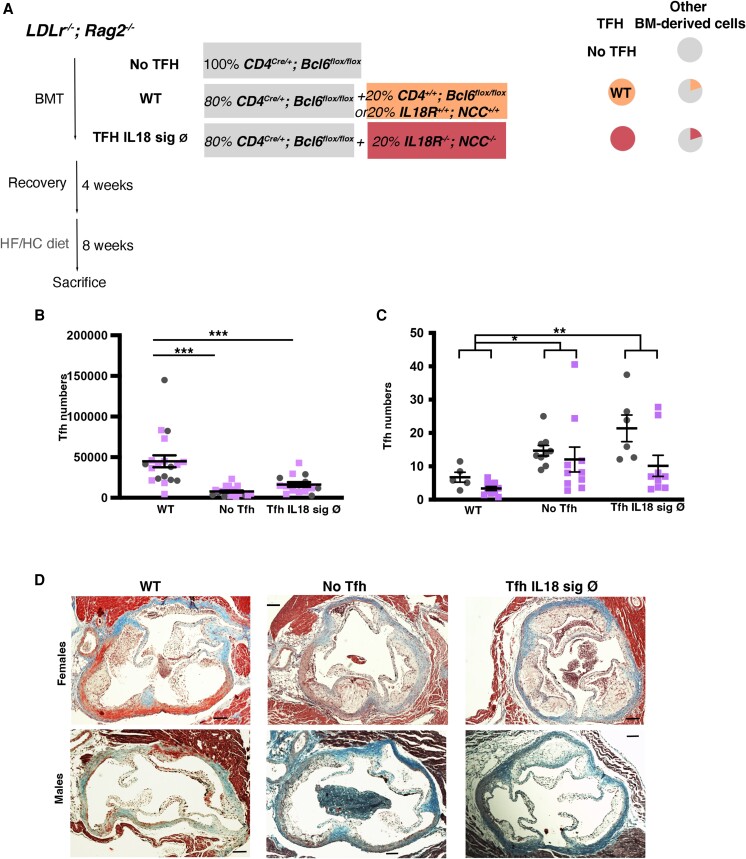
Tfh cell deficiency and the absence of IL18 signalling in Tfh cells accelerate the development of atherosclerosis in mice. Data from males and females Ldlr−/−; Rag2−/− after BM transplant with 100% CD4Cre/+; Bcl6flox/flox (No Tfh); 80% CD4Cre/+; Bcl6flox/flox + 20% CD4+/+; Bcl6flox/flox; or 20% Il18r+/+; NCC+/+ (WT) and 80% CD4Cre/+; Bcl6flox/flox + 20% Il18r−/−; NCC−/− (Tfh Il18 sign Ø) fed a HF/HC diet for 8 weeks. Represented data from five experiments. WT group includes mice that are either CD4+/+; Bcl6flox/flox (littermates to the No TFH group) or Il18r+/+; NCC+/+ WT (littermates to Il18r−/−; NCC−/− mice) and were combined to reduce the number of animals used in these experiments (3Rs). (A) Schematic diagram of the experiment. (B) Total splenic Tfh cells (CD4+ CD44hi CXCR5+ PD1+; n = 6–10 mice/group). (C) Quantification of atherosclerotic plaque area in aortic roots. (D) Representative images of Masson’s trichrome staining (original magnification ×10; scale bars: 200 μm). Each symbol represents an individual mouse; horizontal bars denote mean ± SEM. (B) Student’s t-test and (C) two-way ANOVA. *P < 0.05, **P < 0.01, and ***P < 0.001.
Figure 2
Figure 2
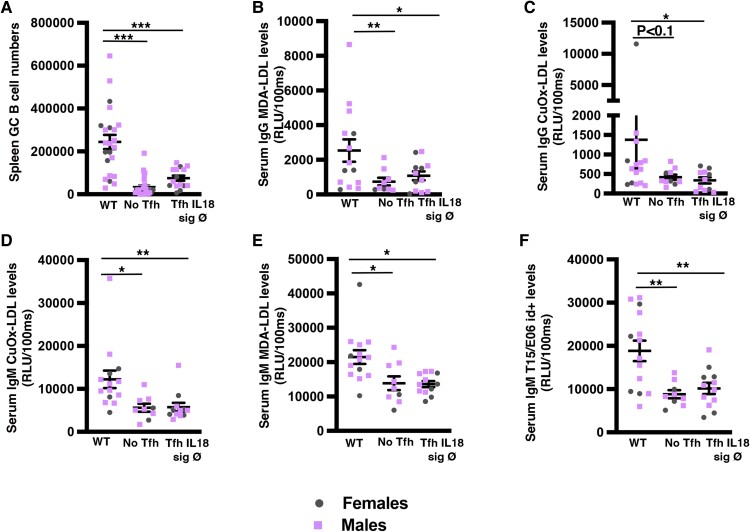
Lack of Tfh cells and absence of IL18 signalling in Tfh lead to a profound reduction of anti-OSE IgG and IgM antibodies, including ‘natural’ IgM antibodies. Data from the same experimental groups as in Figure 1. (A) Total numbers of splenic GC B cells (B220+ Gl7hi CD95hi; n = 6–11 mice/group). (B–F) Graphs showing total serum subtypes of IgG (B, C) and IgM (D–F) levels. Student’s t-test. *P < 0.05, **P < 0.01, and ***P < 0.001.
Figure 3
Figure 3
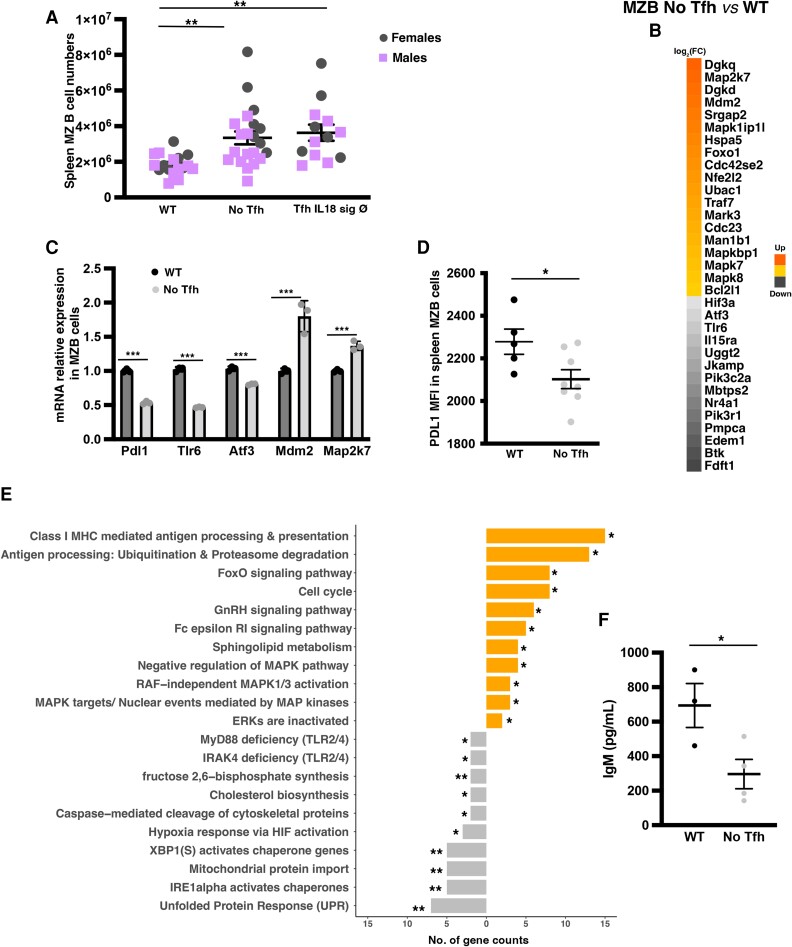
Lack of Tfh cells leads to accumulation of ‘aberrant’ MZB cells. Data from the same experimental No Tfh and WT groups. (A) Total splenic MZB cells (n = 12–15 mice/group). (B, C, and E) MZB cell RNA-seq from No Tfh and WT groups (n = 5–6 mice/group). (B) Clustered heat map of 33 genes that were differentially expressed. (C) qRT-PCR for Pdl1 (n = 3 mice/group). (D) PDL1 surface expression by flow cytometry. (E) Selected significantly enriched GSEA pathways. Each bar represents the number of significantly expressed genes in each pathway. Orange denotes up- and grey downregulated in MZB cells from No Tfh vs. WT. (F) IgM levels in the supernatants of sorted MZB cells (n = 6–9 mice/group) after culture with CpG. Representative plot from two independent experiments with similar results. P < 0.05 (Student’s t-test) and P < 0.1 (Mann–Whitney). (A, C, D, and F) Student’s t-test and (E) Fisher’s exact test. *P < 0.05, **P < 0.01, and ***P < 0.001.
Figure 4
Figure 4
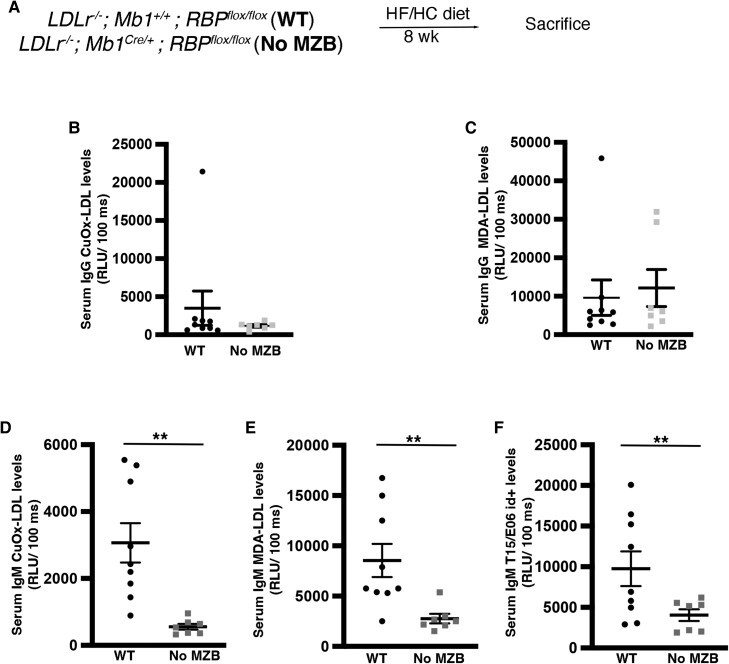
MZB cells are necessary for the formation of IgM natural antibodies. Males and females Ldlr−/−; Cd79aCre/+; RBPflox/flox and Ldlr−/−; Cd79a+/+; RBPflox/flox (WT) were fed a HF/HC diet for 8 weeks (A–F). (A) Schematic diagram of the experimental procedure. (B–F) Graphs showing total serum subtypes of IgG (B–D) and IgM (E–G) levels. Student’s t-test. **P < 0.01.
Figure 5
Figure 5
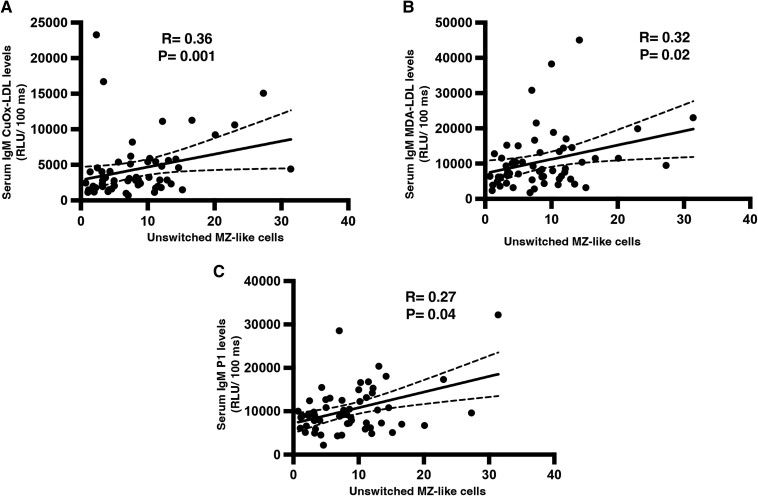
Circulating human MZ-like B cells positively correlate with anti-OSE IgM levels. PBMCs and serum were collected from patients of the RIPPLE (2 weeks post-MI), RITA-MI (2 days post-MI), and CAVA (stable CAD) populations (n = 57; A–C). Correlations between unswitched MZ-like B cells and (A) IgM CuOx-LDL, (B) IgM MDA-LDL, and (C) IgM-P1 antibodies. Spearman’s rank order correlation.

References

    1. Mallat Z, Binder CJ. The why and how of adaptive immune responses in ischemic cardiovascular disease. Nat Cardiovasc Res 2022;1:431–444. - PMC - PubMed
    1. Soehnlein O, Libby P. Targeting inflammation in atherosclerosis—from experimental insights to the clinic. Nat Rev Drug Discov 2021;20:589–610. - PMC - PubMed
    1. Crotty S. T follicular helper cell biology: a decade of discovery and diseases. Immunity 2019;50:1132–1148. - PMC - PubMed
    1. Lee SK, Rigby RJ, Zotos D, Tsai LM, Kawamoto S, Marshall JL, Ramiscal RR, Chan TD, Gatto D, Brink R, Yu D, Fagarasan S, Tarlinton DM, Cunningham AF, Vinuesa CG. B cell priming for extrafollicular antibody responses requires Bcl-6 expression by T cells. J Exp Med 2011;208:1377–1388. - PMC - PubMed
    1. Centa M, Jin H, Hofste L, Hellberg S, Busch A, Baumgartner R, Verzaal NJ, Lind Enoksson S, Perisic Matic L, Boddul SV, Atzler D, Li DY, Sun C, Hansson GK, Ketelhuth DFJ, Hedin U, Wermeling F, Lutgens E, Binder CJ, Maegdesfessel L, Malin SG. Germinal center-derived antibodies promote atherosclerosis plaque size and stability. Circulation 2019;139:2466–2482. - PubMed

Publication types