Review
. 2024 Jul;24(7):487-502.
doi: 10.1038/s41577-024-00996-9. Epub 2024 Feb 21.

The conneXion between sex and immune responses

Affiliations
Review

The conneXion between sex and immune responses

Katherine S Forsyth et al. Nat Rev Immunol. 2024 Jul.

Abstract

There are notable sex-based differences in immune responses to pathogens and self-antigens, with female individuals exhibiting increased susceptibility to various autoimmune diseases, and male individuals displaying preferential susceptibility to some viral, bacterial, parasitic and fungal infections. Although sex hormones clearly contribute to sex differences in immune cell composition and function, the presence of two X chromosomes in female individuals suggests that differential gene expression of numerous X chromosome-linked immune-related genes may also influence sex-biased innate and adaptive immune cell function in health and disease. Here, we review the sex differences in immune system composition and function, examining how hormones and genetics influence the immune system. We focus on the genetic and epigenetic contributions responsible for altered X chromosome-linked gene expression, and how this impacts sex-biased immune responses in the context of pathogen infection and systemic autoimmunity.


Figures

Figure 1.
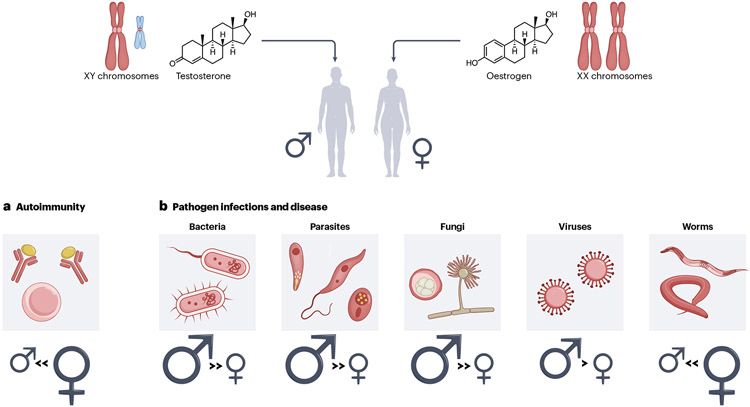
Figure 1.. Sex differences with pathogen infections and autoimmune disease.
The sex chromosomes and the sex hormones in biological males (XY) and females (XX) are responsible for the observed sex differences with responses to various pathogens (a) and in autoimmune disease (b). (a) The overall sex bias associated with a particular class of pathogen infection (and associated disease) is shown. Size of the symbol reflects amount of sex bias. (b) Autoimmune diseases are strongly female-biased.
Figure 2.
Figure 2.. Number of X chromosomes and risk for autoimmune disease.
Increased numbers of X chromosomes is associated with higher risk for the female-biased autoimmune diseases SLE, SS, scleroderma, polymyositis, and dermatomyositis.
Figure 3.
Figure 3.. Impairments with dynamic XCI maintenance result in aberrant overexpression of X-linked genes in female-biased autoimmune disease.
(a) The Xi in naïve lymphocytes lack cytological enrichment of Xist RNA (pink curvey lines) and heterochromatic marks (colored circles), and these modifications return to the Xi in activated cells. (b) Activated lymphocytes from patients with autoimmune disease have dispersed Xist RNA and heterochromatic marks from the Xi, and increased expression of some X-linked genes (denoted with red arrows). Prevention of Xist RNA tethering to the Xi reduces enrichment of histone heterochromatic marks on this chromosome, and persistent absence of these epigenetic modifications across multiple cell divisions may increase abnormal overexpression across the Xi.

References

    1. Libert C, Dejager L & Pinheiro I The X chromosome in immune functions: when a chromosome makes the difference. Nat Rev Immunol 10, 594–604 (2010). 10.1038/nri2815 - DOI - PubMed
    1. Pasche B. et al. Sex-dependent susceptibility to Listeria monocytogenes infection is mediated by differential interleukin-10 production. Infect Immun 73, 5952–5960 (2005). 10.1128/IAI.73.9.5952-5960.2005 - DOI - PMC - PubMed
    1. Natri H, Garcia AR, Buetow KH, Trumble BC & Wilson MA The Pregnancy Pickle: Evolved Immune Compensation Due to Pregnancy Underlies Sex Differences in Human Diseases. Trends Genet 35, 478–488 (2019). 10.1016/j.tig.2019.04.008 - DOI - PMC - PubMed
    1. Patin E. et al. Natural variation in the parameters of innate immune cells is preferentially driven by genetic factors. Nat Immunol 19, 302–314 (2018). 10.1038/s41590-018-0049-7 - DOI - PubMed
    1. Clave E. et al. Human thymopoiesis is influenced by a common genetic variant within the TCRA-TCRD locus. Sci Transl Med 10 (2018). 10.1126/scitranslmed.aao2966 - DOI - PubMed

Substances

LinkOut - more resources