


Exploring how health-related advertising interference contributes to the development of cyberchondria: A stressor-strain-outcome approach
- PMID: 38384368
- PMCID: PMC10880534
- DOI: 10.1177/20552076241233138
Exploring how health-related advertising interference contributes to the development of cyberchondria: A stressor-strain-outcome approach
Abstract
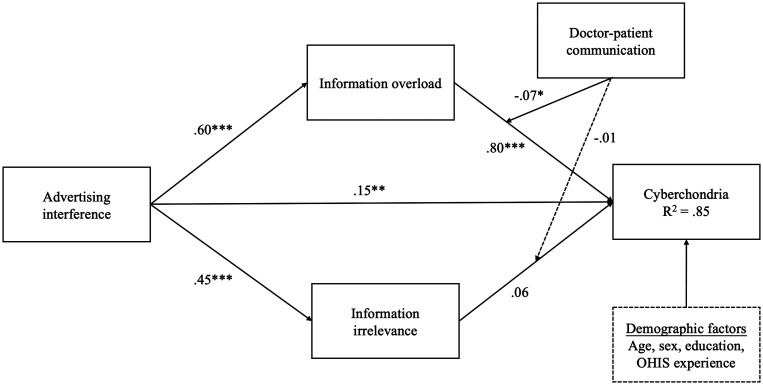
Objectives: Cyberchondria is increasingly recognized as the dark side of digital health, given the pervasive use of the internet as a main source of health information in people's daily lives. While previous studies have identified many factors contributing to cyberchondria, there is a dearth of research on the impact of health-related advertisements. Therefore, this study adopts the stressor-strain-outcome (SSO) model to investigate how health-related advertising interference is directly and indirectly related to cyberchondria.
Methods: To empirically validate the proposed research model, we conducted an online survey with 437 internet users with medical information seeking experience in China. Structural equation modeling (SEM) was employed to analyze the survey data.
Results: Our findings revealed a positive, direct association between health-related advertising interference and cyberchondria. Meanwhile, advertising interference was positively related to both information overload and information irrelevance, with the former further predicting cyberchondria. Moreover, doctor-patient communication weakened the positive effect of information overload on cyberchondria.
Conclusions: The study not only theoretically contributes to the literature by theorizing the relationship between health-related advertising interference and cyberchondria but also practically underlines the pivotal role of effective doctor-patient communication in reducing the development of cyberchondria.
Keywords: Cyberchondria; advertising interference; doctor–patient communication; information irrelevance; information overload.
© The Author(s) 2024.
Conflict of interest statement
The authors declared no potential conflicts of interest with respect to the research, authorship, and/or publication of this article.
Figures

References
-
- Zheng H, Kyung Kim H, Joanna Sin S-Cet al. et al. Exploring developmental trajectory of cyberchondria over time: a three-wave panel study. Telemat Informatics 2022; 75: 101892.
-
- China Research Institute for Science Popularization. Report on Search behavior of Chinese netizens. Published 2019. Accessed July 15, 2023. https://www.crsp.org.cn/m/
-
- Wang X, Shi J, Kong H. Online health information seeking: a review and meta-analysis. Health Commun 2021; 36: 1163–1175. - PubMed
-
- Zheng H, Sin S-CJS-CJ, Kim HKHKet al. et al. Cyberchondria: a systematic review. Internet Res 2021; 31: 677–698.
-
- White RW, Horvitz E. Cyberchondria: studies of the escalation of medical concerns in web search. Microsoft Research. 2009; 27: 1–37. doi:10.1145/1629096.1629101 - DOI
LinkOut - more resources
Full Text Sources
