


Acidic Urine pH and Clinical Outcome of Lower Urinary Tract Infection in Kidney Transplant Recipients Treated with Ciprofloxacin and Fosfomycin
- PMID: 38391502
- PMCID: PMC10886300
- DOI: 10.3390/antibiotics13020116
Acidic Urine pH and Clinical Outcome of Lower Urinary Tract Infection in Kidney Transplant Recipients Treated with Ciprofloxacin and Fosfomycin
Abstract
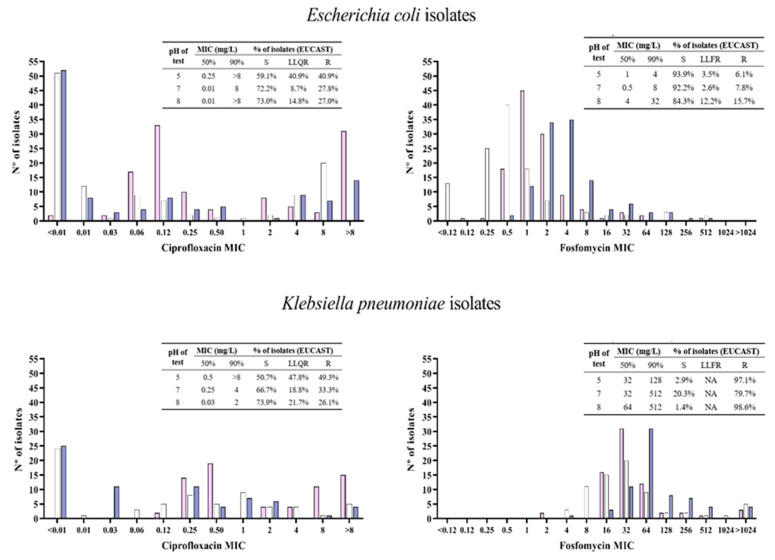
Different factors, including antimicrobial resistance, may diminish the effectiveness of antibiotic therapy, challenging the management of post-transplant urinary tract infection (UTI). The association of acidic urine pH with microbiological and clinical outcomes was evaluated after fosfomycin or ciprofloxacin therapy in 184 kidney transplant recipients (KTRs) with UTI episodes by Escherichia coli (N = 115) and Klebsiella pneumoniae (N = 69). Initial urine pH, antimicrobial therapy, and clinical and microbiological outcomes, and one- and six-month follow-up were assessed. Fosfomycin was prescribed in 88 (76.5%) E. coli and 46 (66.7%) K. pneumoniae UTI episodes in the total cohort. When the urine pH ≤ 6, fosfomycin was prescribed in 60 (52.2%) E. coli and 29 (42.0%) K. pneumoniae. Initial urine pH ≤ 6 in E. coli UTI was associated with symptomatic episodes (8/60 vs. 0/55, p = 0.04) at one-month follow-up, with a similar trend in those patients receiving fosfomycin (7/47 vs. 0/41, p = 0.09). Acidic urine pH was not associated with microbiological or clinical cure in K. pneumoniae UTI. At pH 5, the ciprofloxacin MIC90 increased from 8 to >8 mg/L in E. coli and from 4 to >8 mg/L in K. pneumoniae. At pH 5, the fosfomycin MIC90 decreased from 8 to 4 mg/L in E. coli and from 512 to 128 mg/L in K. pneumoniae. Acidic urine is not associated with the microbiological efficacy of fosfomycin and ciprofloxacin in KTRs with UTI, but it is associated with symptomatic UTI episodes at one-month follow-up in E. coli episodes.
Keywords: Escherichia coli; Klebsiella pneumoniae; ciprofloxacin; fosfomycin; kidney transplant recipients; urinary tract infections; urine pH.
Conflict of interest statement
The authors declare no conflicts of interest. The funders had no role in the design of the study, in the collection, analyses, or interpretation of data, in the writing of the manuscript, or in the decision to publish the results.
Figures
References
-
- Bodro M., Sanclemente G., Lipperheide I., Allali M., Marco F., Bosch J., Cofan F., Ricart M.J., Esforzado N., Oppenheimer F., et al. Impact of urinary tract infections on short-term kidney graft outcome. Clin. Microbiol. Infect. Off. Publ. Eur. Soc. Clin. Microbiol. Infect. Dis. 2015;21:1104.e1–1104.e8. doi: 10.1016/j.cmi.2015.07.019. - DOI - PubMed
-
- Naik A.S., Dharnidharka V.R., Schnitzler M.A., Brennan D.C., Segev D.L., Axelrod D., Xiao H., Kucirka L., Chen J., Lentine K.L. Clinical and economic consequences of first-year urinary tract infections, sepsis, and pneumonia in contemporary kidney transplantation practice. Transpl. Int. 2016;29:241–252. doi: 10.1111/tri.12711. - DOI - PMC - PubMed
-
- Fontserè S., Infante-Domínguez C., Suárez-Benjumea A., Suñer-Poblet M., González-Corvillo C., Martín-Gutiérrez G., Bernal G., Pachón J., Pachón-Ibáñez M.E., Cordero E. Impact of Treating Asymptomatic Bacteriuria in Kidney Transplant Recipients: A Prospective Cohort Study. Antibiotics. 2021;10:218. doi: 10.3390/antibiotics10020218. - DOI - PMC - PubMed
-
- Ny S., Edquist P., Dumpis U., Gröndahl-Yli-Hannuksela K., Hermes J., Kling A.M., Klingeberg A., Kozlov R., Källman O., Lis D.O., et al. Antimicrobial resistance of Escherichia coli isolates from outpatient urinary tract infections in women in six European countries including Russia. J. Glob. Antimicrob. Resist. 2019;17:25–34. doi: 10.1016/j.jgar.2018.11.004. - DOI - PubMed
Grants and funding
- PI17/01405/Instituto de Salud Carlos III
- PI20/01255/Instituto de Salud Carlos III
- US-1381501 US/JUNTA/FEDER, UE/Subdirección General de Evaluación y Fomento de la Investigación, Ministerio de Economía, Industria y Competitividad
- REIPI, RD16/0016/0009/Subdirección General de Redes y Centros de Investigación Cooperativa, Ministerio de Economía, Industria y Competitividad, and the Spanish Network for Research in Infectious Diseases
LinkOut - more resources
Full Text Sources
