


Exploring Endogenous and Exogenous Factors for Successful Artificial Insemination in Sheep: A Global Overview
- PMID: 38393104
- PMCID: PMC10891879
- DOI: 10.3390/vetsci11020086
Exploring Endogenous and Exogenous Factors for Successful Artificial Insemination in Sheep: A Global Overview
Abstract
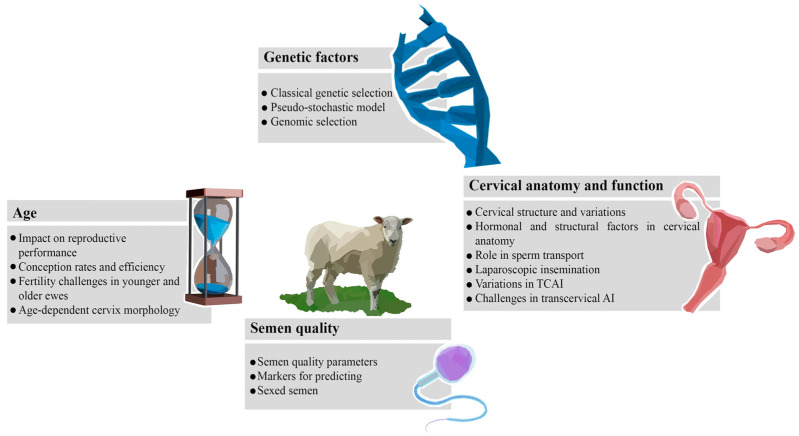
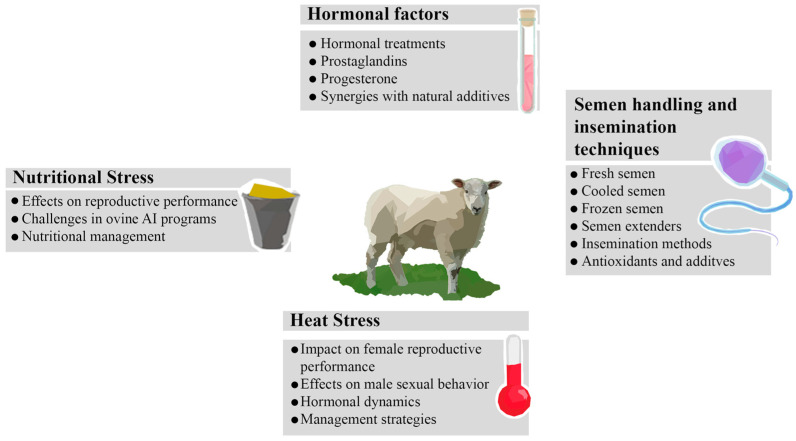
Artificial insemination (AI) plays a vital role in animal breeding programs. AI is applied to enhance animal genetics and facilitate the widespread integration of desirable characteristics with a high potential for productivity. However, in sheep, this biotechnology is not commonly practicable due to multi-factorial challenges, resulting in inconsistent outcomes and unpredictable results. Thoughtful selection of semen donors and recipients based on genetic merit deeply impacts ovine AI outcomes. Additionally, endogenous factors such as breed, age, fertility traits, genetic disorders, and cervical anatomy in ewes contribute to ovine AI success. Extensive research has studied exogenous influences on sexual behavior, reproductive health, and hormonal regulation, all impacting ovine AI success. These exogenous factors include techniques like estrus induction, synchronization, semen handling methods (fresh/chilled/frozen), and insemination methods (cervical/laparoscopic), as well as nutritional factors and climatic conditions. This overview of the literature highlights the endogenous and exogenous challenges facing successful ovine AI and proposes strategies and best practices for improvement. This paper will serve as a guide for understanding and optimizing the success of ovine AI.
Keywords: artificial insemination; breeding success; endogenous factors; exogenous factors; sheep.
Conflict of interest statement
The authors declare no conflicts of interest.
Figures
References
-
- Raoul J., Elsen J.-M. Effect of the Rate of Artificial Insemination and Paternity Knowledge on the Genetic Gain for French Meat Sheep Breeding Programs. Livest. Sci. 2020;232:103932. doi: 10.1016/j.livsci.2020.103932. - DOI
-
- Fleming A., Abdalla E.A., Maltecca C., Baes C.F. Invited Review: Reproductive and Genomic Technologies to Optimize Breeding Strategies for Genetic Progress in Dairy Cattle. Arch. Anim. Breed. 2018;61:43–57. doi: 10.5194/aab-61-43-2018. - DOI
-
- Knap P.W. Pig Breeding for Increased Sustainability. In: Spangler M.L., editor. Animal Breeding and Genetics. Springer; New York, NY, USA: 2023. pp. 139–179. (Encyclopedia of Sustainability Science and Technology Series).
-
- Hamisi A., Eslami M., Farrokhi-Ardabili F., Bahmani S. Timing of Ovulation in the Fat-Tailed Qezel Ewes after Synchronization with Vaginal Devices Containing Endogenous or Exogenous Synthetic Progestogens during out of the Breeding Season. Vet. Med. Sci. 2023;9:2835–2843. doi: 10.1002/vms3.1269. - DOI - PMC - PubMed
Publication types
LinkOut - more resources
Full Text Sources
