. 2024 Feb 27;121(9):e2313964121.
doi: 10.1073/pnas.2313964121. Epub 2024 Feb 23.

IL-27 regulates the differentiation of follicular helper NKT cells via metabolic adaptation of mitochondria

Affiliations

IL-27 regulates the differentiation of follicular helper NKT cells via metabolic adaptation of mitochondria

Yasuhiro Kamii et al. Proc Natl Acad Sci U S A. .

Abstract

Invariant natural killer T (iNKT) cells are innate-like T lymphocytes that express an invariant T cell receptor α chain and contribute to bridging innate and acquired immunity with rapid production of large amounts of cytokines after stimulation. Among effecter subsets of iNKT cells, follicular helper NKT (NKTFH) cells are specialized to help B cells. However, the mechanisms of NKTFH cell differentiation remain to be elucidated. In this report, we studied the mechanism of NKTFH cell differentiation induced by pneumococcal surface protein A and α-galactosylceramide (P/A) vaccination. We found that Gr-1+ cells helped iNKT cell proliferation and NKTFH cell differentiation in the spleen by producing interleukin-27 (IL-27) in the early phase after vaccination. The neutralization of IL-27 impaired NKTFH cell differentiation, which resulted in compromised antibody production and diminished protection against Streptococcus pneumoniae infection by the P/A vaccine. Our data indicated that Gr-1+ cell-derived IL-27 stimulated mitochondrial metabolism, meeting the energic demand required for iNKT cells to differentiate into NKTFH cells. Interestingly, Gr-1+ cell-derived IL-27 was induced by iNKT cells via interferon-γ production. Collectively, our findings suggest that optimizing the metabolism of iNKT cells was essential for acquiring specific effector functions, and they provide beneficial knowledge on iNKT cell-mediated vaccination-mediated therapeutic strategies.

Keywords: IL-27; Streptococcus pneumoniae; follicular helper; iNKT; mitochondrial metabolism.


Conflict of interest statement

Competing interests statement:The authors declare no competing interest.

Figures

Fig. 1.
Fig. 1.
Gr-1+ cells play a crucial role in proliferation of iNKT cells and differentiation of NKTFH cells. (A) Kinetics of the absolute number of iNKT cells after P/A immunization. (B) Flow cytometry plots showing NKTFH cells on day 5 after P/A immunization. (C) Kinetics of frequency of iNKT cells and NKTFH as a percentage of iNKT cells after P/A immunization. (D) Percentage incorporating EdU of naive iNKT cells, NKTeff cells, and NKTFH cells on day 3 after P/A immunization. (E) Flow cytometry plots and percentage of IL-4 and IL-21 produced by NKTFH cells on day 5 after P/A immunization. (F) Confocal immunofluorescence microscopy of the spleen on day 3 after P/A immunization. (G) Flow cytometry plots and absolute numbers of NKTFH cells from mice on day 5 after P/A immunization treated with anti-Gr-1 antibody or isotype control. (H) Flow cytometry plots and absolute numbers of NKTFH cells from mice on day 5 after P/A immunization treated with anti-Gr-1 antibody or isotype control at indicated time points. Isotype control was administered on day 1 after P/A immunization. Data are pooled from two experiments (A and C) with two to seven mice per group and are representative of two independent experiments. Data in (D, E, G, and H) with three to five mice per group. Statistical analyses were performed using one-way ANOVA with Tukey’s correction (D, G, and H); *P < 0.05, ***P < 0.001, ****P < 0.0001; ns, not significant.
Fig. 2.
Fig. 2.
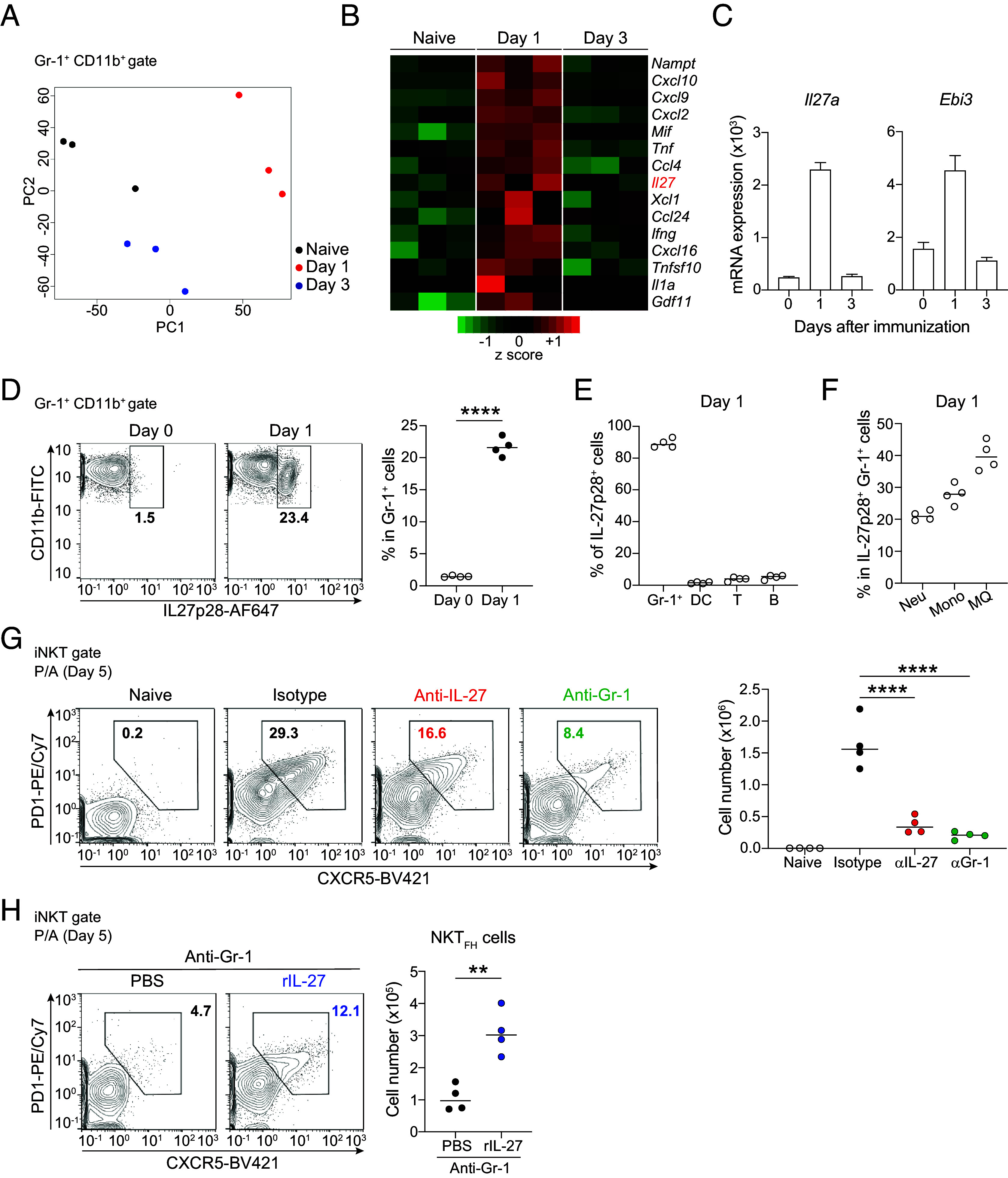
IL-27 derived from Gr-1+ cells is required for maximal proliferation of iNKT cells and differentiation of NKTFH cells. (A) PCA plot of RNA-seq data from naive Gr-1+ cells, Gr-1+ cells on day 1, and Gr-1+ cells on day 3 after P/A immunization. Each symbol represents the analysis of cells from a single mouse. (B) Heat map of genes differentially expressed in experimental replicates between naive Gr-1+ cells, Gr-1+ cells on day 1, and Gr-1+ cells on day 3 after P/A immunization. (C) Il27A and Ebi3 mRNA expression in naive Gr-1+ cells, Gr-1+ cells on day 1, and Gr-1+ cells on day 3 after P/A immunization. (D) Flow cytometry plots and frequency of IL-27 p28 expression in naive Gr-1+ cells and Gr-1+ cells on day 1 after P/A immunization. (E) Frequency of IL-27 p28-producing cells on day 1 after P/A immunization. (DC: dendritic cell, T: T cell, B: B cell). (F) Frequency of percentage of IL-27 p28-producing Gr-1+ cells on day 1 after P/A immunization. (Neu: neutrophil, Mono: monocyte, MQ: macrophage). (G) Flow cytometry plots and absolute numbers of NKTFH cells from naive mice, mice on day 5 after P/A immunization treated with anti-IL-27 antibody, anti-Gr-1 antibody, or isotype control. (H) Flow cytometry plots and absolute numbers of NKTFH cells from Gr-1+ cell–depleted mice on day 5 after P/A immunization treated with or without rIL-27. Data are representative of two independent experiments (CH) with four mice per group (DH), and error bars represent mean ± SD. Statistical analyses were performed using unpaired Student’s t test (D and H) or one-way ANOVA with Tukey’s correction (G); **P < 0.01, ****P < 0.0001.
Fig. 3.
Fig. 3.
IL-27 supports metabolic adaptation of iNKT cells by enhancing the mitochondrial metabolism. (A) Venn diagram analysis of differences in gene expression comparing isotype control/naive >2.0 increase and isotype control/anti-IL-27 antibody >2.0 expression increase. (B) Enrichment scores of isotype control/naive >2.0 population and isotype control/anti-IL-27 antibody >2.0 population. (C) Heat map of genes differentially expressed between iNKT cells from naive mice, mice on day 3 after P/A immunization treated with anti-IL-27 antibody, or isotype control. (D) gMFI of iNKT cells from mice on day 3 after P/A immunization treated with anti-IL-27 antibody or isotype control showing mitochondrial mass, potential, and ROS measured by staining with MitoTracker, TMRM, and MitoSox, respectively. (E) gMFI of iNKT cells and CD4+T cells cultured with and without rIL-27 showing mitochondrial mass, potential, and ROS measured by staining with MitoTracker, TMRM, and MitoSox. (F) TEM showing the mitochondrial morphology of iNKT cells cultured with and without rIL-27. (G) The number and area of mitochondria of iNKT cells cultured with and without rIL-27. (H) Intracellular levels of ATP in iNKT cells cultured with and without rIL-27. Data are representative of two independent experiments (D, E, and H) with three to four mice per group and error bars represent mean ± SD. Representative TEM images are shown (F). (Scale bar, 2.0 μm.) The number and area of mitochondria were quantified from more than 50 cells per group (G). Statistical analyses were performed using unpaired Student’s t test (D, E, G, and H) *P < 0.05, **P < 0.01, ***P < 0.001; ns, not significant.
Fig. 4.
Fig. 4.
IFNγ from activated iNKT cells reprograms Gr-1+ cells to produce IL-27. (A) GSEA of response to IFNγ genes comparing naive Gr-1+ cells and Gr-1+ cells on day 1 after P/A immunization. (B) Flow cytometry plots and frequency of IFNγ producing iNKT cells from naive mice and 2 h after P/A immunization. (C) Il27a and Ebi3 mRNA expression in Gr-1+ cells cultured with and without IFNγ for 3 h. (D) Flow cytometry plots and absolute numbers of Gr-1+ cells on day 1 after P/A immunization treated with anti-IFNγ antibody or isotype control. (E) Absolute numbers of NKTFH cells from mice on day 5 after P/A immunization treated with anti-IFNγ antibody, anti-Gr-1 antibody, or isotype control. Data are representative of two independent experiments (BE) with four mice per group (B, D, and E) and error bars represent mean ± SD. Statistical analyses were performed using unpaired Student’s t test (B) or one-way ANOVA with Tukey’s correction (D and E); *P < 0.05, ***P < 0.001, ****P < 0.0001.
Fig. 5.
Fig. 5.
P/A immunization confers long-term protection against S. pneumoniae systemic infection. (A) PspA-specific antibody titers determined by ELISA on day 14 after P/A immunization. (B) Urea wash analysis of PspA-specific antibody titers determined by ELISA on day 14 after P/A immunization. (C) Survival curve after S. pneumoniae (BG7322) systemic infection comparing P/A and P/Veh immunization. (D) PspA-specific antibody titers determined by ELISA on day 14 after P/A immunization treated with anti-IL-27 antibody or isotype control. (E) Avidity of PspA-specific antibody titers determined by ELISA on day 14 after P/A immunization in mice treated with anti-IL-27 antibody or isotype control. (F) Survival curve after S. pneumoniae (BG7322) systemic infection comparing P/Veh, P/A immunization with anti-IL-27 antibody, and P/A immunization with isotype control. Data are representative of two independent experiments with six to eight mice per group, and error bars represent mean ± SD. Statistical analyses were performed using unpaired Student’s t test (A, B, D, and E) or log-rank tests (C and F); **P < 0.01, ***P < 0.001, ****P < 0.0001.

References

    1. Brennan P. J., Brigl M., Brenner M. B., Invariant natural killer T cells: An innate activation scheme linked to diverse effector functions. Nat. Rev. Immunol. 13, 101–117 (2013). - PubMed
    1. Brigl M., Brenner M. B., CD1: Antigen presentation and T cell function. Annu. Rev. Immunol. 22, 817–890 (2004). - PubMed
    1. Gapin L., Development of invariant natural killer T cells. Curr. Opin. Immunol. 39, 68–74 (2016). - PMC - PubMed
    1. Kronenberg M., Toward an understanding of NKT cell biology: Progress and paradoxes. Annu. Rev. Immunol. 23, 877–900 (2005). - PubMed
    1. Taniguchi M., Harada M., Kojo S., Nakayama T., Wakao H., The regulatory role of Valpha14 NKT cells in innate and acquired immune response. Annu. Rev. Immunol. 21, 483–513 (2003). - PubMed