


Racial/Ethnic Disparities in Pathologic Complete Response and Overall Survival in Patients With Triple-Negative Breast Cancer Treated With Neoadjuvant Chemotherapy
- PMID: 38394476
- PMCID: PMC11095870
- DOI: 10.1200/JCO.23.01199
Racial/Ethnic Disparities in Pathologic Complete Response and Overall Survival in Patients With Triple-Negative Breast Cancer Treated With Neoadjuvant Chemotherapy
Abstract
Purpose: Black women have higher rates of death from triple-negative breast cancer (TNBC) than White women. We hypothesized that pathologic complete response (pCR) to neoadjuvant chemotherapy (NAC) and overall survival (OS) may vary by race/ethnicity in patients with TNBC.
Methods: We identified women 18 years and older with stage I-III TNBC who received NAC followed by surgery from the National Cancer Database (2010-2019). We excluded patients without race/ethnicity or pathology data. Primary outcomes were pCR rates and OS on the basis of race/ethnicity.
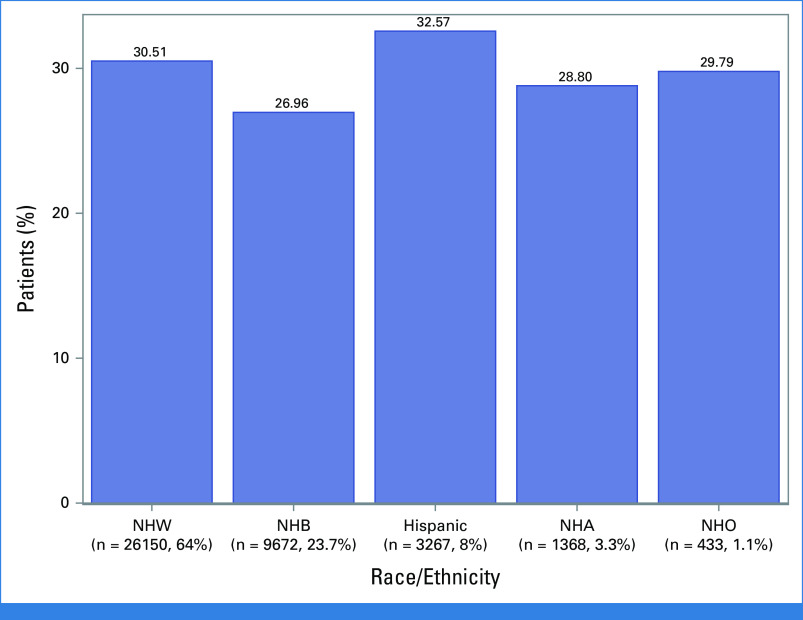
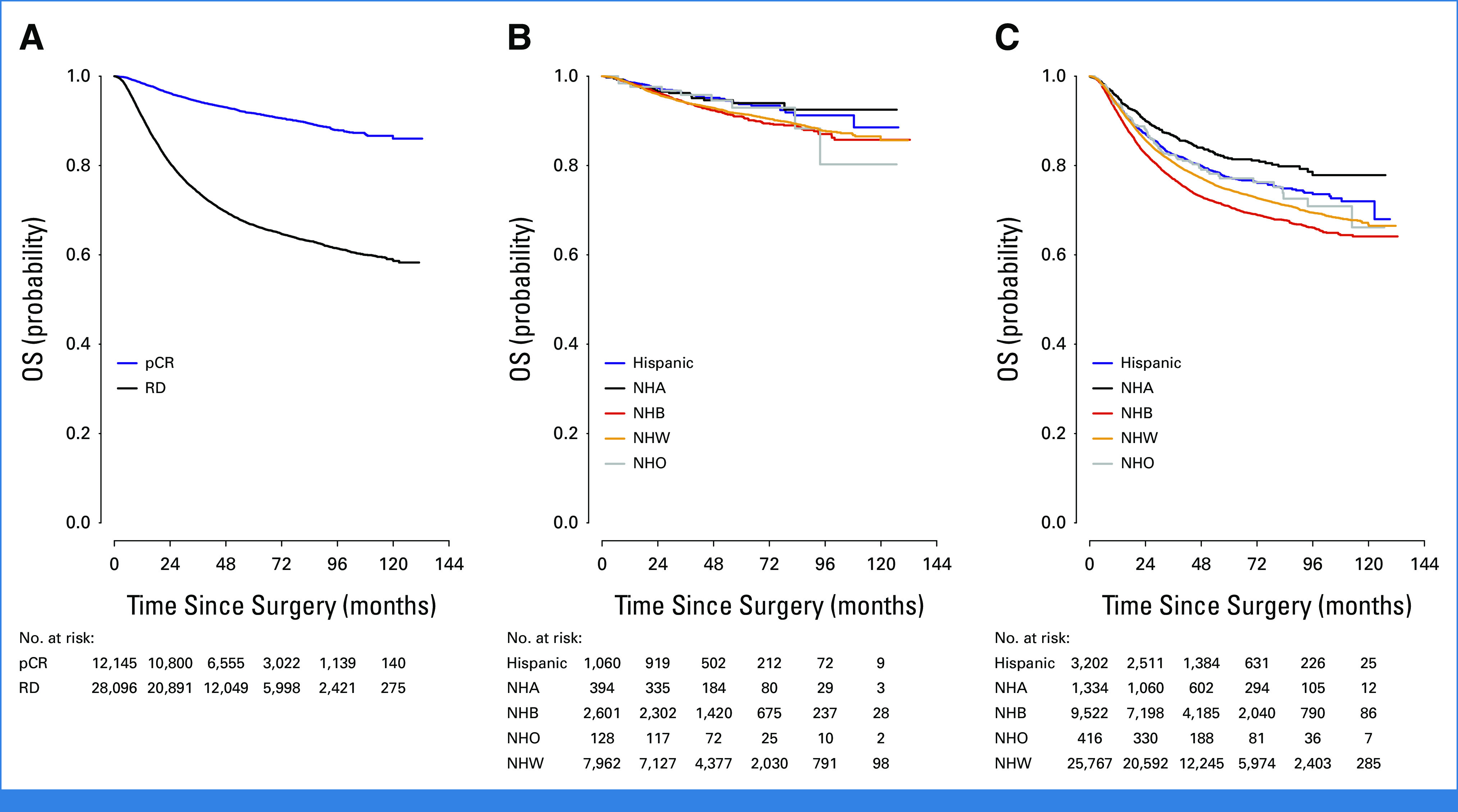
Results: Forty thousand eight hundred ninety women with TNBC met inclusion criteria (median age [IQR], 53 [44-61] years): 26,150 Non-Hispanic White (64%, NHW), 9,672 Non-Hispanic Black (23.7%, NHB), 3,267 Hispanic (8%), 1,368 Non-Hispanic Asian (3.3%, NHA), and 433 Non-Hispanic Other (1.1%, NHO) patients. Overall, 29.8% demonstrated pCR (NHW: 30.5%, NHB: 27%, Hispanic: 32.6%, NHA: 28.8%, NHO: 29.8%). Unadjusted OS was significantly higher for those with pCR compared with those with residual disease (5-year OS, 0.917 [95% CI, 0.911 to 0.923] v 0.667 [95% CI, 0.661 to 0.673], log-rank P < .001), and this association persisted after adjustment for demographic and tumor factors. The effect of achieving pCR on OS did not differ by race/ethnicity (interaction P = .10). However, NHB patients were less likely (odds ratio [OR], 0.89 [95% CI, 0.83 to 0.95], P = .001) and Hispanic patients were more likely (OR, 1.19 [95% CI, 1.08 to 1.31], P = .001) to achieve pCR than NHW patients. After adjustment for patient and disease factors, including achievement of pCR, Hispanic (hazard ratio [HR], 0.76 [95% CI, 0.69 to 0.85], P < .001) and NHA (HR, 0.64 [95% CI, 0.55 to 0.75], P < .001) race/ethnicity remained associated with OS.
Conclusion: Odds of achieving pCR and OS in patients with TNBC appear to be associated with race/ethnicity. Additional research is necessary to understand how race/ethnicity is associated with rates of pCR and OS, whether related to socioeconomic factors or biologic variables, or both.
Conflict of interest statement
The following represents disclosure information provided by authors of this manuscript. All relationships are considered compensated unless otherwise noted. Relationships are self-held unless noted. I = Immediate Family Member, Inst = My Institution. Relationships may not relate to the subject matter of this manuscript. For more information about ASCO's conflict of interest policy, please refer to
Open Payments is a public database containing information reported by companies about payments made to US-licensed physicians (
Figures
References
-
- Giaquinto AN, Miller KD, Tossas KY, et al. Cancer statistics for African American/Black people 2022. CA Cancer. J Clin. 2022;72:202–229. - PubMed
-
- Bradley CJ, Given CW, Roberts C. Race, socioeconomic status, and breast cancer treatment and survival. J Natl Cancer Inst. 2002;94:490–496. - PubMed
-
- Ward E, Jemal A, Cokkinides V, et al. Cancer disparities by race/ethnicity and socioeconomic status. CA Cancer J Clin. 2004;54:78–93. - PubMed
-
- Daly B, Olopade OI. A perfect storm: How tumor biology, genomics, and health care delivery patterns collide to create a racial survival disparity in breast cancer and proposed interventions for change. CA Cancer J Clin. 2015;65:221–238. - PubMed
Publication types
MeSH terms
LinkOut - more resources
Full Text Sources
Miscellaneous
