


Hyperphagia and impulsivity: use of self-administered Dykens' and in-house impulsivity questionnaires to characterize eating behaviors in children with severe and early-onset obesity
- PMID: 38395939
- PMCID: PMC10893692
- DOI: 10.1186/s13023-024-03085-1
Hyperphagia and impulsivity: use of self-administered Dykens' and in-house impulsivity questionnaires to characterize eating behaviors in children with severe and early-onset obesity
Abstract
Background: The determinants of early-onset obesity (< 6 years) are not completely elucidated, however eating behavior has a central role. To date no study has explored eating behavior in children with severe, early-onset obesity. Self-administered questionnaire data from these children were examined to evaluate eating behavior and the etiology of early-onset obesity.
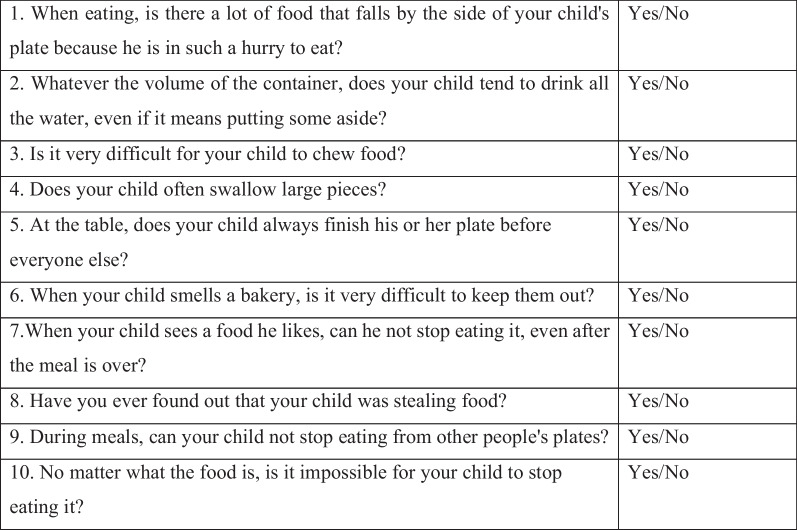
Methods: Children with severe, early-onset obesity (body mass index [BMI] > International Obesity Task Force [IOTF] 30) of different etiologies (hypothalamic obesity [HO], intellectual disability with obesity [IDO], common polygenic obesity [CO]) were prospectively included. BMI history and responses from the Dykens' Hyperphagia Questionnaire and an in-house Impulsivity Questionnaire at first visit were compared between groups.
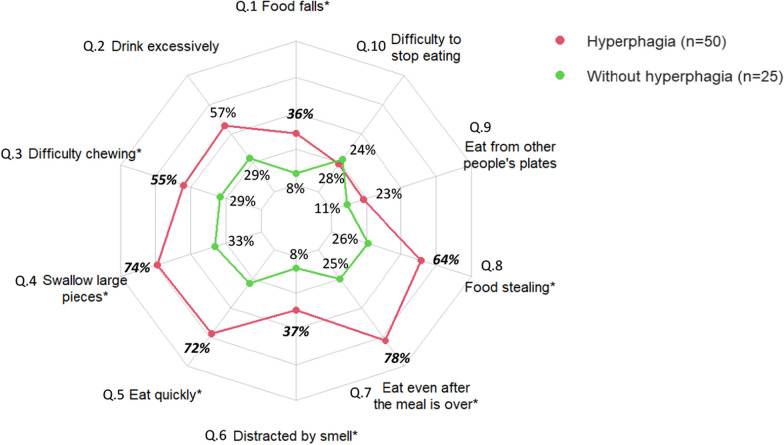
Results: This cohort of 75 children (39 girls; mean age ± standard deviation [SD] 10.8 ± 4.4 years) had severe, early-onset obesity at an age of 3.8 ± 2.7 years, with a BMI Z-score of 4.9 ± 1.5. BMI history varied between the 3 groups, with earlier severe obesity in the HO group versus 2 other groups (BMI > IOTF40 at 3.4 ± 1.6 vs. 4.6 ± 1.6 and 8.4 ± 4.1 years for the IDO and CO groups, respectively [P < 0.01]). Absence of adiposity rebound was more prevalent in the HO group (87% vs. 63% and 33% for the IDO and CO groups, respectively [P < 0.01]). The Dykens' mean total score for the cohort was 22.1 ± 7.2 with no significant between-group differences. Hyperphagia (Dykens' score > 19) and impulsivity (score > 7) were found in 50 (67%) and 11 children (15%), respectively, with no difference between the HO, IDO and CO groups regarding the number of patients with hyperphagia (10 [67%], 14 [74%], and 26 [63%] children, respectively) or impulsivity (2 [13%], 1 [7%], and 8 [19%] children, respectively). Children with food impulsivity had significantly higher total and severity scores on the Dykens' Questionnaire versus those without impulsivity.
Conclusion: The Dykens' and Impulsivity questionnaires can help diagnose severe hyperphagia with/without food impulsivity in children with early-onset obesity, regardless of disease origin. Their systematic use can allow more targeted management of food access control in clinical practice and monitor the evolution of eating behavior in the case of innovative therapeutic targeting hyperphagia.
Keywords: Childhood obesity; Dykens’ questionnaire; Eating behaviors; Food impulsivity questionnaire; Genetics; Hyperphagia; Hypothalamus.
© 2024. The Author(s).
Conflict of interest statement
LA, HC, SC, and PT have nothing to disclose. BD has conference and expertise with Rhythm Pharmaceuticals and Novo-Nordisk and is a clinical investigator for Rhythm Pharmaceuticals. KC is a clinical investigator and performed conference and expertise for Rhythm Pharmaceuticals; a co-clinical investigator and has conference and expertise for Novo-Nordisk; and has collaborated on research for Integrative Phenomics and Confo Therapeutics; and performed conference and expertise with MSD. CP is the coordinator of the Oberar cohort, a clinical investigator and has conference and expertise for Novo-Nordisk and for Rhythm Pharmaceuticals.
Figures
References
-
- Vlaardingerbroek H, van den Akker ELT, Hokken-Koelega ACS. Appetite- and weight-inducing and -inhibiting neuroendocrine factors in Prader-Willi syndrome, Bardet-Biedl syndrome and craniopharyngioma versus anorexia nervosa. Endocr Connect. 2021;10(5):R175–R188. doi: 10.1530/EC-21-0111. - DOI - PMC - PubMed
MeSH terms
LinkOut - more resources
Full Text Sources
Medical
Research Materials
