


Relevance of Individual Data When Assessing the Gastrointestinal Nematode Infection Level, Nutritional and Productive Variables in a Tropical Farm Context: The Median Isn't the Message
- PMID: 38396571
- PMCID: PMC10886404
- DOI: 10.3390/ani14040603
Relevance of Individual Data When Assessing the Gastrointestinal Nematode Infection Level, Nutritional and Productive Variables in a Tropical Farm Context: The Median Isn't the Message
Abstract
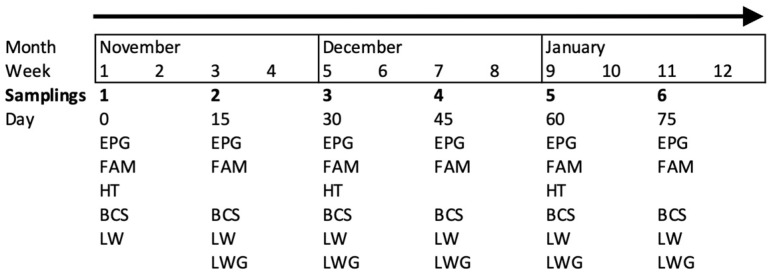
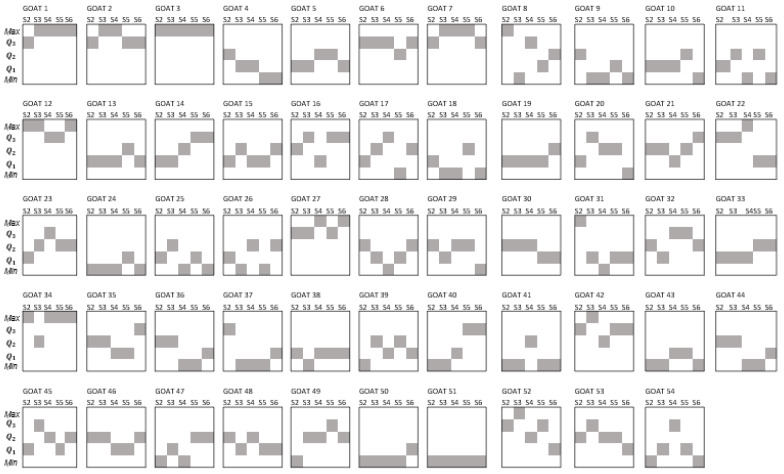
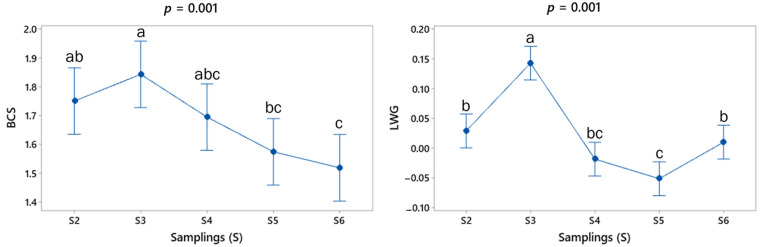
We evaluated the relationship between individual and herd GIN infection level, nutrition, production performance and anemia parameters in a tropical farm context. Fifty-four female goats were monitored to assess their body condition score (BCS, nutritional status indicator), live weight (LW) and LW gain (LWG, both used as production level indicators), FAMACHA© and hematocrit (HT, both used as anemia indicators). Goats browsed for 4 h in a tropical forest and received balanced feed and chopped grass. The eggs per gram of feces (EPG) indicated the GIN burden, with fecal samples obtained at 7:00 (AM) and 15:00 h (PM.) from each goat at six sampling points during the study. The variables and their relationship with GIN burdens were analyzed using Kruskall-Wallis, ANOVA and Friedman tests and Spearman correlations. The fecal samples obtained in the AM and PM can be equally representative of parasitic burdens (similar and highly correlated). However, the EPG of individual goats from periods of 30 days apart can be considered independent. The BCS and LWG varied between sampling times (p < 0.05), whereas EPG, LW and HT did not (p > 0.05). The GIN burden was negatively correlated with HT and BCS (-0.21, p = 0.01 for each one). The individual pattern of infection demonstrates the true impact of GINs on their hosts. Additionally, feeding and nutritional status may present important variations influencing the performance of the goats more than the impact of GINs under the farm conditions of the present study. However, GIN infection contributed to the variation in goat health and productivity in this tropical farm.
Keywords: Criollo goats; body condition; farming conditions; gastrointestinal nematodes; productive parameters.
Conflict of interest statement
The authors declare no conflicts of interest. The funders had no role in the design of the study; in the collection, analyses, or interpretation of data; in the writing of the manuscript; or in the decision to publish the results.
Figures
References
-
- Ares Annual State-of-the Art Report on Animal Health Research on IRC Priorities. European H2020. 5094086—18/10/2017. [(accessed on 6 May 2021)]. Available online: https://ec.europa.eu/research/participants/documents/downloadPublic?docu....
-
- Charlier J., Rinaldi L., Musella V., Ploegerd H.W., Chartier C., Rose Vineer H., Hinney B., von Samson-Himmelstjerna G., Băcescu B., Mickiewicz M., et al. Initial assessment of the economic burden of major parasitic helminth infections to the ruminant livestock industry in Europe. Prev. Vet. Med. 2020;182:105103. doi: 10.1016/j.prevetmed.2020.105103. - DOI - PubMed
-
- Jaimez-Rodríguez P.R., González-Pech P.G., Ventura-Cordero J., Brito D.R.B., Costa-Júnior L.M., Sandoval-Castro C.A., Torres-Acosta J.F.J. The worm burden of tracer kids and lambs browsing heterogeneous vegetation is influenced by strata harvested and not total dry matter intake or plant life form. Trop. Anim. Health Prod. 2019;51:2243–2251. doi: 10.1007/s11250-019-01928-9. - DOI - PubMed
-
- Torres-Acosta J.F.J., Pérez-Cruz M., Canul-Ku H.L., Soto-Barrientos N., Cámara-sarmiento R., Aguilar-Caballero A.J., Lozano-Argáes I., Le-Bigot C., Hoste H. Building a combined targeted selective treatment scheme against gastrointestinal nematodes in tropical goats. Small Rumin. Res. 2014;121:27–35. doi: 10.1016/j.smallrumres.2014.01.009. - DOI
Grants and funding
LinkOut - more resources
Full Text Sources
