


The Relationship between Injury Characteristics and Post-Traumatic Recovery after Diffuse Axonal Injury
- PMID: 38397913
- PMCID: PMC10886783
- DOI: 10.3390/biomedicines12020311
The Relationship between Injury Characteristics and Post-Traumatic Recovery after Diffuse Axonal Injury
Abstract
Background: The diagnosis and prognosis of diffuse axonal injury (DAI) remain challenging. This research aimed to analyze the impact on activities of daily living (ADL), functional outcomes, quality of life (QoL), and the association between lesion severity and DAI location identified through imaging exams.
Methods: This prospective cohort study included 95 patients diagnosed with DAI. Data were collected at admission, three, six, and twelve months post-injury. The associations between variables were evaluated using a mixed-effects model.
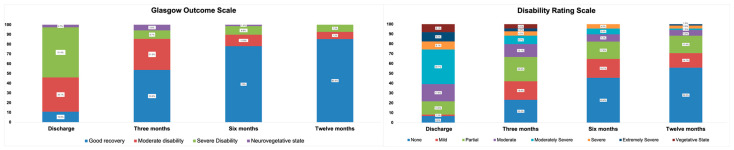
Results: Functional recovery and QoL improved between three and twelve months after DAI. An interaction was observed between independence in performing ADL and subarachnoid hemorrhage (p = 0.043) and intraventricular hemorrhage (p = 0.012). Additionally, an interaction over time was observed between the Glasgow Outcome Scale (GOS) and DAI severity (p < 0.001), brain lesions (p = 0.014), and the Disability Rating Scale (DRS) with injury in brain hemispheres (p = 0.026) and Adams classification (p = 0.013). Interaction effects over time were observed with the general health perceptions and energy/vitality domains with intraventricular hemorrhage, and the social functioning domain with the obliteration of basal cisterns and Gentry's classification.
Conclusion: The use of CT in the acute phase of DAI is important for predicting outcomes. The severity and location of DAI are associated with functional outcomes, ADL, and QoL.
Keywords: CT imaging; diffuse axonal injury; functional outcomes; quality of life; traumatic brain injury.
Conflict of interest statement
The authors declare no conflicts of interest.
Figures



References
-
- Gennarelli T.A. Cerebral Concussion and Diffuse Brain Injuries. In: Cooper P.R., editor. Head Injury. Williams & Wilkins; Baltimore, MD, USA: 1987. pp. 108–124.
-
- Scholten A.C., Haagsma J.A., Andriessen T.M.J.C., Vos P.E., Steyerberg E.W., Van Beeck E.F., Polinder S. Health-Related Quality of Life after Mild, Moderate and Severe Traumatic Brain Injury: Patterns and Predictors of Suboptimal Functioning during the First Year after Injury. Injury. 2015;46:616–624. doi: 10.1016/j.injury.2014.10.064. - DOI - PubMed
-
- Liew B.S., Johari S.A., Nasser A.W., Abdullah J. Severe Traumatic Brain Injury: Outcome in Patients with Diffuse Axonal Injury Managed Conservatively in Hospital Sultanah Aminah, Johor Bahru—An Observational Study. Med. J. Malays. 2009;64:280–288. - PubMed
Grants and funding
LinkOut - more resources
Full Text Sources
