. 2024 Feb 9;24(4):1155.
doi: 10.3390/s24041155.

Gait Event Detection and Travel Distance Using Waist-Worn Accelerometers across a Range of Speeds: Automated Approach

Affiliations

Gait Event Detection and Travel Distance Using Waist-Worn Accelerometers across a Range of Speeds: Automated Approach

Albara Ah Ramli et al. Sensors (Basel). .

Abstract

Estimation of temporospatial clinical features of gait (CFs), such as step count and length, step duration, step frequency, gait speed, and distance traveled, is an important component of community-based mobility evaluation using wearable accelerometers. However, accurate unsupervised computerized measurement of CFs of individuals with Duchenne muscular dystrophy (DMD) who have progressive loss of ambulatory mobility is difficult due to differences in patterns and magnitudes of acceleration across their range of attainable gait velocities. This paper proposes a novel calibration method. It aims to detect steps, estimate stride lengths, and determine travel distance. The approach involves a combination of clinical observation, machine-learning-based step detection, and regression-based stride length prediction. The method demonstrates high accuracy in children with DMD and typically developing controls (TDs) regardless of the participant's level of ability. Fifteen children with DMD and fifteen TDs underwent supervised clinical testing across a range of gait speeds using 10 m or 25 m run/walk (10 MRW, 25 MRW), 100 m run/walk (100 MRW), 6-min walk (6 MWT), and free-walk (FW) evaluations while wearing a mobile-phone-based accelerometer at the waist near the body's center of mass. Following calibration by a trained clinical evaluator, CFs were extracted from the accelerometer data using a multi-step machine-learning-based process and the results were compared to ground-truth observation data. Model predictions vs. observed values for step counts, distance traveled, and step length showed a strong correlation (Pearson's r = -0.9929 to 0.9986, p < 0.0001). The estimates demonstrated a mean (SD) percentage error of 1.49% (7.04%) for step counts, 1.18% (9.91%) for distance traveled, and 0.37% (7.52%) for step length compared to ground-truth observations for the combined 6 MWT, 100 MRW, and FW tasks. Our study findings indicate that a single waist-worn accelerometer calibrated to an individual's stride characteristics using our methods accurately measures CFs and estimates travel distances across a common range of gait speeds in both DMD and TD peers.

Keywords: Duchenne muscular dystrophy; accelerometer; gait cycle; machine learning; temporospatial gait clinical features; typically developing.


Conflict of interest statement

The authors declare no conflict of interest.

Figures
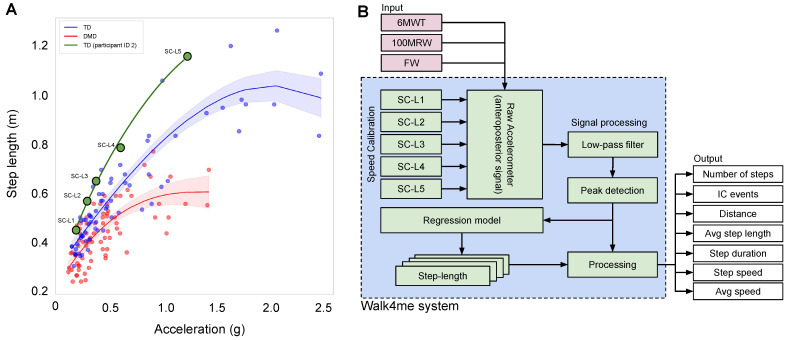
Figure 1
Figure 1
(A) The relationship between step length and acceleration of the body’s center of mass at various speeds for TD individuals and those with DMD. The plotted curves depict the regression model, with the black line representing all participants, the green line representing TD participants, and the red line representing DMD participants. (B) The diagram depicts the data flow of our model training and prediction process. In the training phase, the model uses five speed calibrations, SC-L1 to SC-L5, with ground truth to predict the average step length. The input to our model is the acceleration signal from unseen gait activities (6 MWT, 100 MRW, and FW).
Figure 2
Figure 2
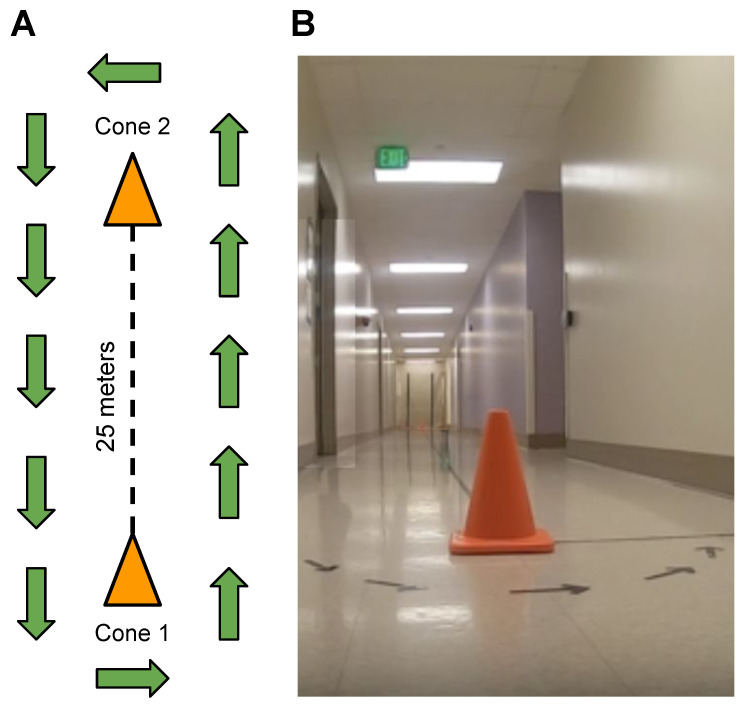
(A) Diagram depicting the corridor layout with two cones positioned 25 m apart, guiding walking, running, and jogging directions. Exception for free-walk (FW), allowing participants the freedom to move within the building. (B) Image showcasing the real-life corridor environment.
Figure 3
Figure 3
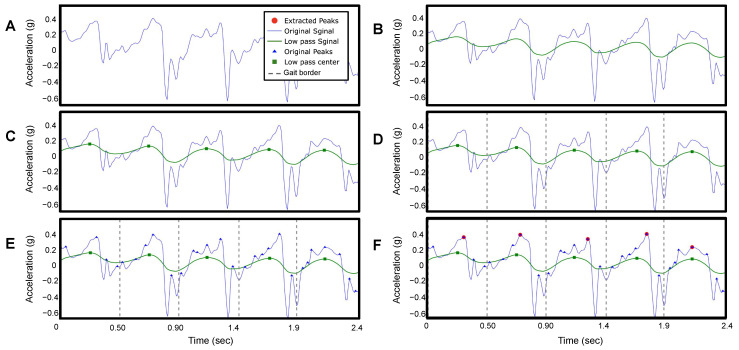
This figure presents the signal processing of the raw accelerometer signal of the anteroposterior movement (z−axis) of participant ID 2 on fast-walk speed calibration (SC-L4) for 2.4 s. (A) Original raw accelerometer signal. (B) Filtered signal. (C) Peak detection of the filtered signal. (D) Locate the beginning and the end of each step. (E) Peaks detection of the original signal. (F) Locate the highest peak in the original signal.
Figure 4
Figure 4
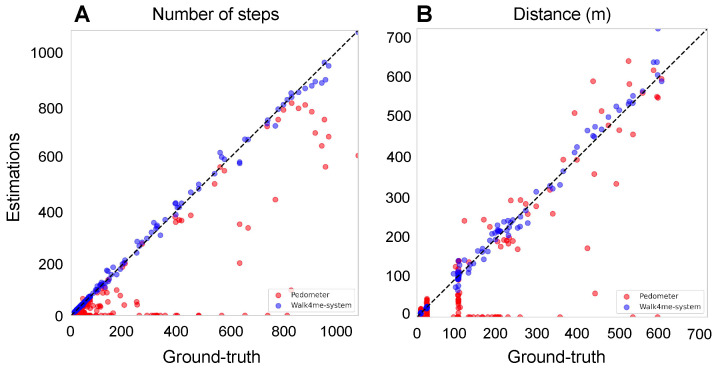
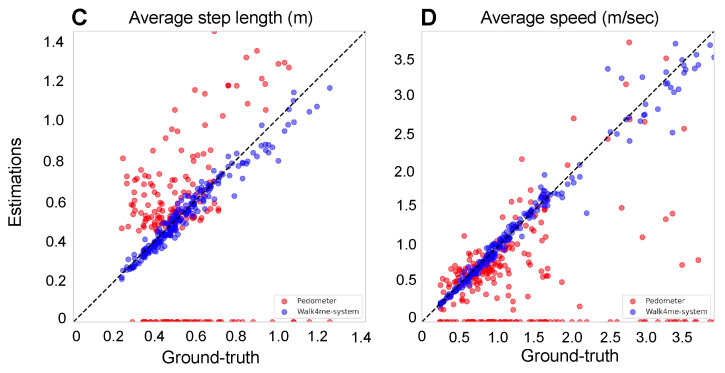
Comparison between the estimates and ground-truth values for both pedometers and our Walk4Me system to illustrate the accuracy across four key metrics: (A) the number of steps. The adjusted R-squared of our Walk4Me is 0.9973, while the pedometer is 0.6826. (B) The distance in meters. The adjusted R-squared of our Walk4Me is 0.9937, while the pedometer is 0.6987. (C) The average step length in meters. The adjusted R-squared of our Walk4Me is 0.9595, while the pedometer is 0.0094. (D) the average speed in meters per second.
Figure 4
Figure 4
Comparison between the estimates and ground-truth values for both pedometers and our Walk4Me system to illustrate the accuracy across four key metrics: (A) the number of steps. The adjusted R-squared of our Walk4Me is 0.9973, while the pedometer is 0.6826. (B) The distance in meters. The adjusted R-squared of our Walk4Me is 0.9937, while the pedometer is 0.6987. (C) The average step length in meters. The adjusted R-squared of our Walk4Me is 0.9595, while the pedometer is 0.0094. (D) the average speed in meters per second.
Figure 5
Figure 5
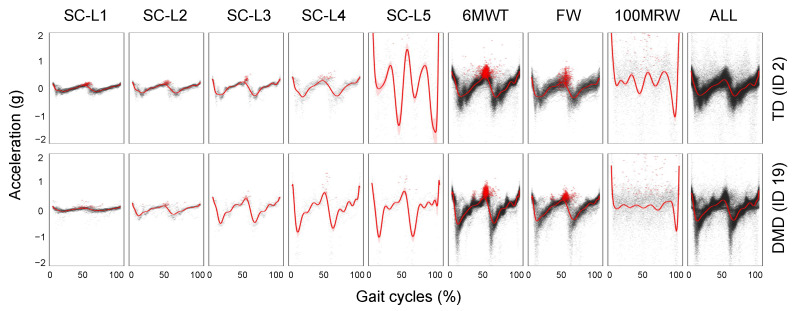
The gait pattern comparison of an individual with TD and an individual with DMD at varying speeds and a combination of multiple speeds and the effects of different speeds on gait pattern.

References

    1. Duan D., Goemans N., Takeda S., Mercuri E., Aartsma-Rus A. Duchenne muscular dystrophy. Nat. Rev. Dis. Prim. 2021;7:13. doi: 10.1038/s41572-021-00248-3. - DOI - PMC - PubMed
    1. Sutherland D.H., Olshen R., Cooper L., Wyatt M., Leach J., Mubarak S., Schultz P. The pathomechanics of gait in Duchenne muscular dystrophy. Dev. Med. Child Neurol. 1981;23:3–22. doi: 10.1111/j.1469-8749.1981.tb08442.x. - DOI - PubMed
    1. Zijlstra W., Hof A.L. Assessment of spatio-temporal gait parameters from trunk accelerations during human walking. Gait Posture. 2003;18:1–10. doi: 10.1016/S0966-6362(02)00190-X. - DOI - PubMed
    1. Le Masurier G.C., Tudor-Locke C. Comparison of pedometer and accelerometer accuracy under controlled conditions. Med. Sci. Sport Exerc. 2003;35:867–871. doi: 10.1249/01.MSS.0000064996.63632.10. - DOI - PubMed
    1. Aminian K., Robert P., Jéquier E., Schutz Y. Incline, speed, and distance assessment during unconstrained walking. Med. Sci. Sport Exerc. 1995;27:226–234. doi: 10.1249/00005768-199502000-00012. - DOI - PubMed