


Mapping awareness-raising and capacity-building materials on developmental disabilities for non-specialists: a review of the academic and grey literature
- PMID: 38402178
- PMCID: PMC10893740
- DOI: 10.1186/s13033-024-00627-9
Mapping awareness-raising and capacity-building materials on developmental disabilities for non-specialists: a review of the academic and grey literature
Abstract
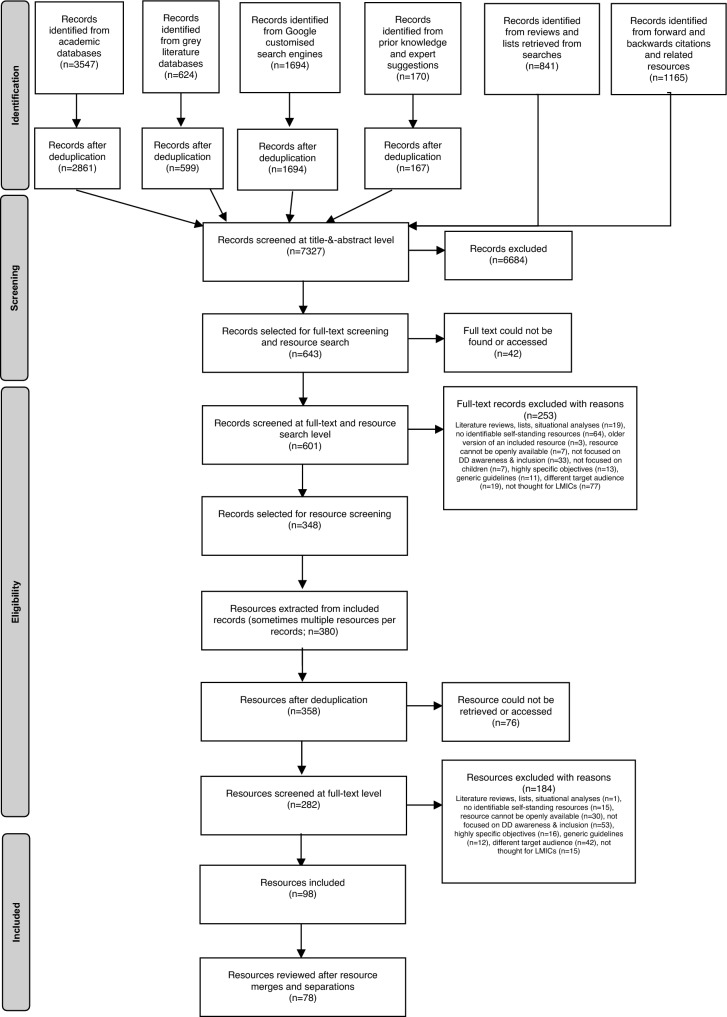
Most children with developmental disabilities (DD), such as intellectual disabilities and autism, live in low- and middle-income countries (LMICs), where services are usually limited. Various governmental, non-governmental and research organisations in LMICs have developed awareness-raising campaigns and training and education resources on DD in childhood relevant to LMICs. This study aimed to comprehensively search and review freely available materials in the academic and grey literature, aimed at awareness raising, training and education on DD among non-specialist professionals and community members in LMICs. We consulted 183 experts, conducted key-word searches in five academic databases, four grey-literature databases and seventeen customised Google search engines. Following initial screening, we manually searched relevant systematic reviews and lists of resources and conducted forwards and backwards citation checks of included articles. We identified 7327 articles and resources after deduplication. We then used a rigorous multi-step screening process to select 78 training resources on DD relevant to LMICs, of which 43 aimed at informing and/or raising awareness DD, 16 highlighted specific strategies for staff in health settings and 19 in education settings. Our mapping analysis revealed that a wealth of materials is available for both global and local use, including comics, children's books, flyers, posters, fact sheets, blogs, videos, websites pages, social media channels, handbooks and self-education guides, and training programmes or sessions. Twelve resources were developed for cross-continental or global use in LMICs, 19 were developed for and/or used in Africa, 23 in Asia, 24 in Latin America. Most resources were developed within the context where they were intended to be used. Identified gaps included a limited range of resources on intellectual disabilities, manuals for actively delivering training to staff in education settings and resources targeted at eastern European LMICs: future intervention development and adaptation efforts should address such gaps, to ensure capacity building materials exist for a sufficient variety of DD, settings and geographical areas. Beyond identifying these gaps, the value of the review lies in the compilation of summary tables of information on all freely available resources found, to support their selection and use in wider contexts. Information on the resource content, country of original development and copyright is provided to facilitate resource sharing and uptake.
Keywords: Autism; Capacity building; Developmental disabilities; Grey literature; Low- and Middle-Income Countries.
© 2024. The Author(s).
Conflict of interest statement
The authors declare that they have no competing interests.
Figures
References
-
- Beckman PJ, Montagna D. Research Brief: Understanding and Responding to the Needs of Individuals with Disabilities in Rural El Salvador: “Comunidades Inclusivas”. Montrouge: Firah. 2015a. https://www.firah.org/upload/l-appel-a-projets/projets-laureats/2015/sal.... Accessed 6 Feb 2024
Publication types
Grants and funding
LinkOut - more resources
Full Text Sources
