Safety of the novel oral poliovirus vaccine type 2 (nOPV2) in infants and young children aged 1 to <5 years and lot-to-lot consistency of the immune response to nOPV2 in infants in The Gambia: a phase 3, double-blind, randomised controlled trial
- PMID: 38402887
- PMCID: PMC10985839
- DOI: 10.1016/S0140-6736(23)02844-1
Safety of the novel oral poliovirus vaccine type 2 (nOPV2) in infants and young children aged 1 to <5 years and lot-to-lot consistency of the immune response to nOPV2 in infants in The Gambia: a phase 3, double-blind, randomised controlled trial
Abstract
Background: Novel oral poliovirus vaccine type 2 (nOPV2) has been engineered to improve the genetic stability of Sabin oral poliovirus vaccine (OPV) and reduce the emergence of circulating vaccine-derived polioviruses. This trial aimed to provide key safety and immunogenicity data required for nOPV2 licensure and WHO prequalification.
Methods: This phase 3 trial recruited infants aged 18 to <52 weeks and young children aged 1 to <5 years in The Gambia. Infants randomly assigned to receive one or two doses of one of three lots of nOPV2 or one lot of bivalent OPV (bOPV). Young children were randomised to receive two doses of nOPV2 lot 1 or bOPV. The primary immunogenicity objective was to assess lot-to-lot equivalence of the three nOPV2 lots based on one-dose type 2 poliovirus neutralising antibody seroconversion rates in infants. Equivalence was declared if the 95% CI for the three pairwise rate differences was within the -10% to 10% equivalence margin. Tolerability and safety were assessed based on the rates of solicited adverse events to 7 days, unsolicited adverse events to 28 days, and serious adverse events to 3 months post-dose. Stool poliovirus excretion was examined. The trial was registered as PACTR202010705577776 and is completed.
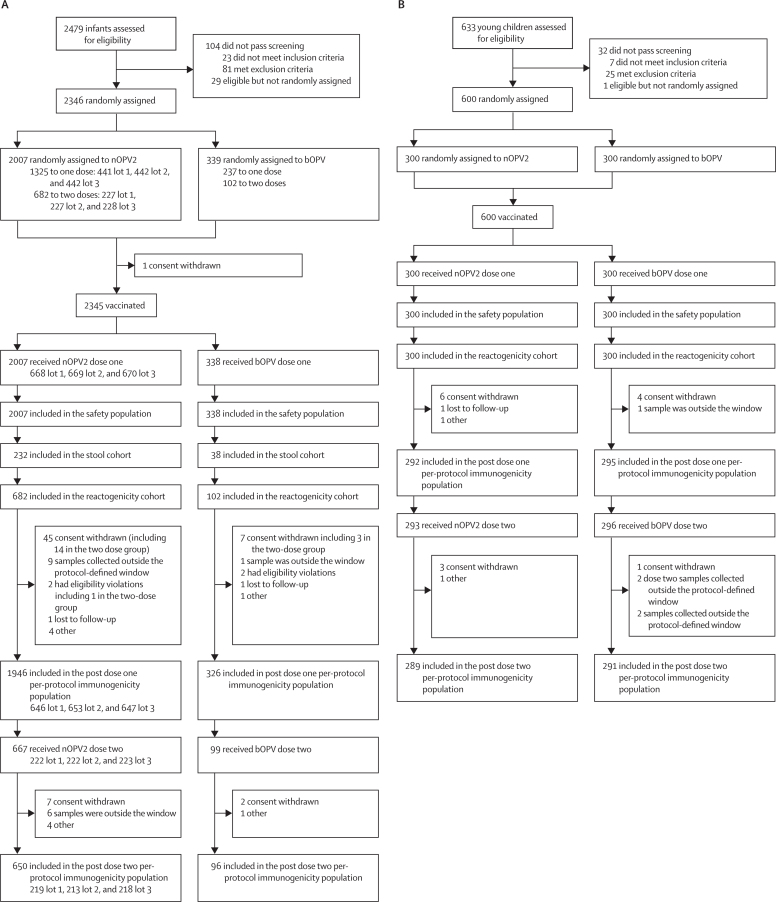
Findings: Between February and October, 2021, 2345 infants and 600 young children were vaccinated. 2272 (96·9%) were eligible for inclusion in the post-dose one per-protocol population. Seroconversion rates ranged from 48·9% to 49·2% across the three lots. The minimum lower bound of the 95% CIs for the pairwise differences in seroconversion rates between lots was -5·8%. The maximum upper bound was 5·4%. Equivalence was therefore shown. Of those seronegative at baseline, 143 (85·6%) of 167 (95% CI 79·4-90·6) infants and 54 (83·1%) of 65 (71·7-91·2) young children seroconverted over the two-dose nOPV2 schedule. The post-two-dose seroprotection rates, including participants who were both seronegative and seropositive at baseline, were 604 (92·9%) of 650 (95% CI 90·7-94·8) in infants and 276 (95·5%) of 289 (92·4-97·6) in young children. No safety concerns were identified. 7 days post-dose one, 78 (41·7%) of 187 (95% CI 34·6-49·1) infants were excreting the type 2 poliovirus.
Interpretation: nOPV2 was immunogenic and safe in infants and young children in The Gambia. The data support the licensure and WHO prequalification of nOPV2.
Funding: Bill & Melinda Gates Foundation.
Copyright © 2024 The Author(s). Published by Elsevier Ltd. This is an Open Access article under the CC BY 4.0 license. Published by Elsevier Ltd.. All rights reserved.
Conflict of interest statement
Declaration of interests ET works for PT Biofarma who manufacture the novel oral poliovirus vaccine type 2 and the bivalent oral poliovirus vaccine used in this trial. All other authors declare no competing interests.
Figures

Comment in
-
First Africa-based clinical trial for novel type 2 oral poliovirus vaccine.Lancet. 2024 Mar 23;403(10432):1113-1115. doi: 10.1016/S0140-6736(24)00053-9. Epub 2024 Feb 22. Lancet. 2024. PMID: 38402883 No abstract available.
References
-
- Global Polio Eradication Initiative Polio today. https://polioeradication.org/polio-today/
-
- Global Polio Eradication Initiative Polio eradication strategy 2022–2026: delivering on a promise. 2022. https://polioeradication.org/gpei-strategy-2022-2026/
-
- WHO Global polio eradication initiative. Circulating vaccine-derived polioviruses, global update. August, 2020. https://polioeradication.org/wp-content/uploads/2020/12/20201118_cVDPV2_...
Publication types
MeSH terms
Substances
LinkOut - more resources
Full Text Sources
Medical