


Influence of Socioeconomic Status on the Association Between Pregnancy Complications and Premature Coronary Artery Disease: Linking Three Cohorts
- PMID: 38404672
- PMCID: PMC10890942
- DOI: 10.1089/whr.2023.0092
Influence of Socioeconomic Status on the Association Between Pregnancy Complications and Premature Coronary Artery Disease: Linking Three Cohorts
Abstract
Background: We hypothesized that there is an influence of socioeconomic status (SES) on association between pregnancy complications and premature coronary artery disease (PCAD) risk.
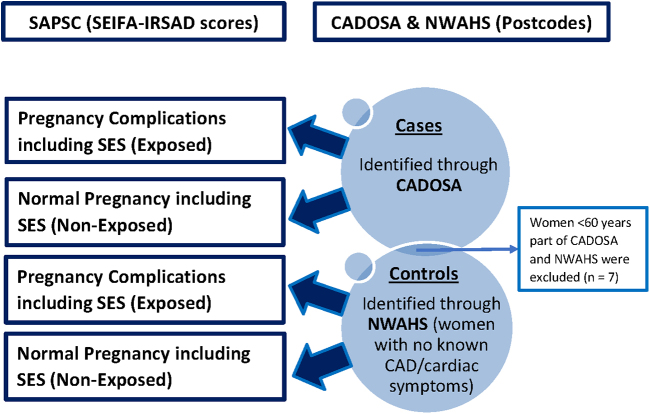
Materials and methods: This project involved a data linkage approach merging three databases of South Australian cohorts using retrospective, age-matched case-control study design. Cases (n = 721), that is, women aged <60 years from Coronary Angiogram Database of South Australia (CADOSA) were linked to South Australian Perinatal Statistics Collection (SAPSC) to ascertain prior pregnancy outcomes and SES. Controls (n = 194) were selected from North West Adelaide Health Study (NWAHS), comprising women who were healthy or had health conditions unrelated to CAD, age matched to CADOSA (±5 years), and linked to SAPSC to determine prior pregnancy outcomes and SES. This project performed comparative analysis of SES using socioeconomic indexes for areas-index of relative socioeconomic advantage and disadvantage (SEIFA-IRSAD) scores across three databases.
Results: Findings revealed that SEIFA-IRSAD scores at the time of pregnancy (p-value = 0.005) and increase in SEIFA-IRSAD scores over time (p-value = 0.040) were significantly associated with PCAD. In addition, when models were adjusted for SEIFA-IRSAD scores at the time of pregnancy and age, risk factors including placenta-mediated pregnancy complications such as preterm birth (odds ratio [OR] = 4.77, 95% confidence interval [CI]: 1.74-13.03) and history of a miscarriage (OR = 2.14, 95% CI: 1.02-4.49), and cardiovascular disease (CVD) risk factors including smoking (OR = 8.60, 95% CI: 3.25-22.75) were significantly associated with PCAD. When the model was adjusted for change in SEIFA-IRSAD scores (from CADOSA/NWAHS to SAPSC) and age, pregnancy-mediated pregnancy complications including preterm birth (OR = 4.40, 95% CI: 1.61-12.05) and history of a miscarriage (OR = 2.09, 95% CI: 1.00-4.35), and CVD risk factor smoking (OR = 8.75, 95% CI: 3.32-23.07) were significantly associated with PCAD.
Conclusion: SES at the time of pregnancy and change in SES were not associated with PCAD risk.
Keywords: coronary artery disease; data linkage; databases; pregnancy complications; premature; socioeconomic status.
© Adeel Khoja et al., 2024; Published by Mary Ann Liebert, Inc.
Conflict of interest statement
No competing financial interests exist.
Figures
References
-
- Scanlon PJ, Faxon DP, Audet A-M, et al. ACC/AHA guidelines for coronary angiography: executive summary and recommendations: A report of the American College of Cardiology/American Heart Association Task Force on Practice Guidelines (Committee on Coronary Angiography) developed in collaboration with the Society for Cardiac Angiography and Interventions. Circulation 1999;99:2345–2357; doi: 10.1161/01.CIR.99.17.2345 - DOI - PubMed
LinkOut - more resources
Full Text Sources
Miscellaneous