


Prevalence of menstrual irregularities after coronavirus disease 2019 vaccination: A cross-sectional study in the Eastern Province, Saudi Arabia
- PMID: 38406218
- PMCID: PMC10883425
- DOI: 10.4103/jfcm.jfcm_115_23
Prevalence of menstrual irregularities after coronavirus disease 2019 vaccination: A cross-sectional study in the Eastern Province, Saudi Arabia
Abstract
Background: Reports indicate that there are menstrual cycle disturbances following coronavirus disease 2019 (COVID-19) vaccination. The present study explored the prevalence of menstrual irregularities after COVID-19 vaccination and the association of menstrual irregularities with vaccine type, doses, immediate adverse effects, history of COVID-19 infection, and its severity.
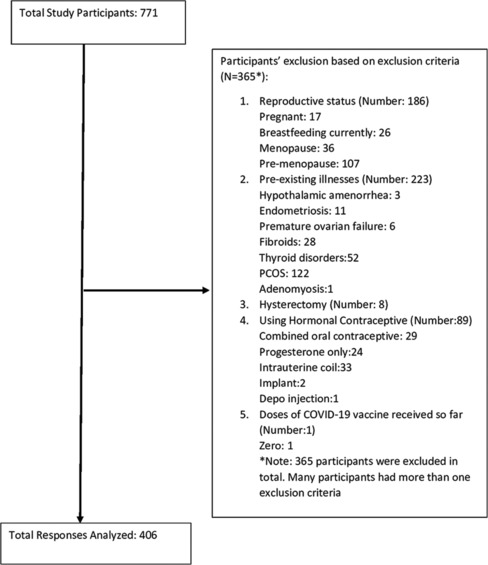
Materials and methods: For this cross-sectional study, 406 women of reproductive age completed an online survey about the postvaccine changes in their menstruation (cycle duration, bleeding days, and bleeding amount), COVID-19 vaccine history (doses, type of vaccine, and immediate adverse effects), history of COVID-19 infection, and its severity. Data was analyzed using SPSS; descriptive statistics were computed and Chi-square test, and binary logistic regression analysis were performed.
Results: Of the total 406 women, 45% reported postvaccine changes in their menstrual cycle. The most common menstrual change was increased dysmenorrhea (68%), followed by an increase in the length of the cycle (52%). There was a significant association between postvaccine menstrual changes and the age, marital status, and family history of menstrual irregularities. No association was observed between postvaccine menstrual changes and COVID-19 vaccine-and COVID-19 infection-related variables. As per the best-fit model of our predictors, the odds of having postvaccine menstrual changes were 0.41 times less in "single" women (confidence interval [CI] = 0.26-0.27; P < 0.001) and 1.714 times greater in women who had a "family history of menstrual irregularities" (CI = 1.092-2.690; P = 0.02), respectively.
Conclusion: A substantial number of women complained of postvaccine menstrual changes regardless of their age, type of COVID-19 vaccine, doses, immediate adverse effects, and COVID-19 infection history/severity. Being "single" decreased the probability, whereas having a family history of menstrual irregularities increased the probability significantly of having postvaccine menstrual changes.
Keywords: Coronavirus disease 2019 vaccines; SARS-CoV-2; dysmenorrhea; menstrual cycle; menstruation disturbances.
Copyright: © 2024 Journal of Family and Community Medicine.
Conflict of interest statement
There are no conflicts of interest.
Figures
References
LinkOut - more resources
Full Text Sources
Research Materials
Miscellaneous