Clinical Trial
. 2024 Feb;17(2):e13724.
doi: 10.1111/cts.13724.

LTA4H inhibitor LYS006: Clinical PK/PD and safety in a randomized phase I clinical trial

Affiliations
Clinical Trial

LTA4H inhibitor LYS006: Clinical PK/PD and safety in a randomized phase I clinical trial

Christian Loesche et al. Clin Transl Sci. 2024 Feb.

Abstract

LYS006 is a novel, highly potent and selective, new-generation leukotriene A4 hydrolase (LTA4H) inhibitor in clinical development for the treatment of neutrophil-driven inflammatory diseases. We describe the complex pharmacokinetic to pharmacodynamic (PD) relationship in blood, plasma, and skin of LYS006-treated nonclinical species and healthy human participants. In a randomized first in human study, participants were exposed to single ascending doses up to 100 mg and multiple ascending doses up to 80 mg b.i.d.. LYS006 showed rapid absorption, overall dose proportional plasma exposure and nonlinear blood to plasma distribution caused by saturable target binding. The compound efficiently inhibited LTB4 production in human blood and skin blister cells, leading to greater than 90% predose target inhibition from day 1 after treatment initiation at doses of 20 mg b.i.d. and above. Slow re-distribution from target expressing cells resulted in a long terminal half-life and a long-lasting PD effect in ex vivo stimulated blood and skin cells despite low plasma exposures. LYS006 was well-tolerated and demonstrated a favorable safety profile up to highest doses tested, without any dose-limiting toxicity. This supported further clinical development in phase II studies in predominantly neutrophil-driven inflammatory conditions, such as hidradenitis suppurativa, inflammatory acne, and ulcerative colitis.


Conflict of interest statement

We disclose that all authors associated with Novartis Biomedical Research or Novartis Pharma AG are current or former employees of and hold company stocks or stock options with Novartis Pharma AG, the company that is developing LYS006 as pharmacological treatment in inflammatory diseases. All other authors declared no competing interests for this work.

Figures
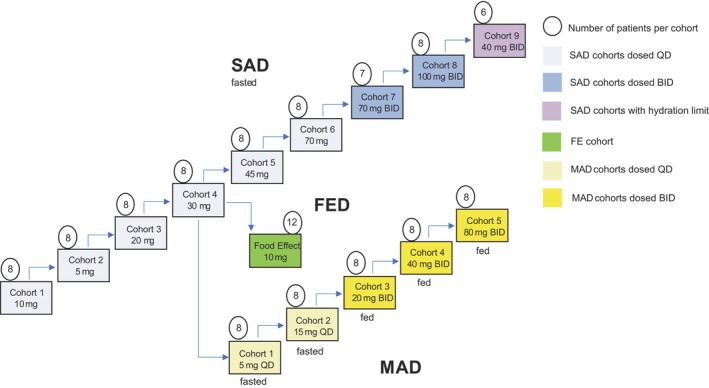
FIGURE 1
FIGURE 1
Study design of the first‐in‐human assessment of safety, PK and PD effects of LYS006. SAD part depicted in blue, FE arm depicted in green, and MAD part depicted in yellow. Numbers in circles indicate number of participants per cohort. Arrows indicate the sequence of the dosing in the different cohorts. After the fourth SAD cohort, the fifth SAD cohort, and, in addition, also the FE cohort and the first cohort in the MAD part were initiated. Cohorts with b.i.d. dosing received two equal doses per day separated by 12 h, in the SAD part for 1 day, and in the MAD part for 12 consecutive days. FE, food effect; MAD, multiple ascending dose; PD, pharmacodynamic; PK, pharmacokinetic; SAD, single ascending dose.
FIGURE 2
FIGURE 2
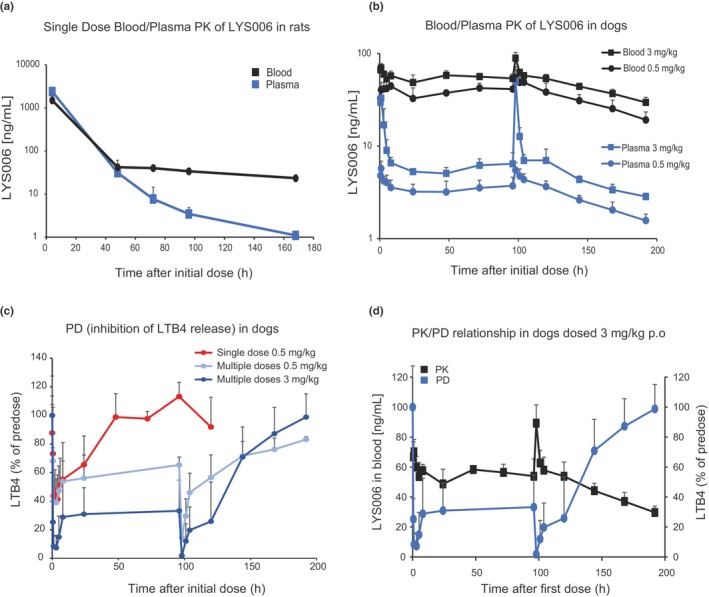
Characterization of the blood/plasma PK and PD relationship of LYS006 in preclinical species. (a) Male Wistar rats (n = 3) were dosed once with 3 mg/kg [3H]‐labeled LYS006 p.o. and distribution of compound between blood and plasma was determined by LC–MS/MS over time. Sampling was done at 4, 48, 72, 96, and 168 h postdose. Depicted are mean concentration‐time curves ±SD. (b) Fasted male beagle dogs (n = 3) were dosed once daily p.o. with 0.5 and 3 mg/kg LYS006 for 5 consecutive days. Concentration‐time curves (mean ± SD) of LYS006 in blood and plasma were determined by LC–MS/MS. Sampling was done at 0.5, 1, 3, 5, 8, and 24 h (at trough before the second dose), 48 h and 72 h (at trough before the third and fourth dose), and 96 h (at trough before the fifth dose), 98, 101, 104, 120, 144, 168, and 192 h post first dose. (c) LTB4 release of ionophore stimulated dog whole blood was determined at different timepoints after a single dose of 0.5 mg/kg LYS006 (red line). LTB4 release was also determined at the above‐mentioned timepoints after multiple doses of a once daily dosing regimen of 0.5 mg/kg (light blue) and 3 mg/kg (dark blue). LTB4 levels were determined by ELISA and given as percent LTB4 in relation to predose levels. (d) Overlay of PK (black curve) and PD (blue curve) of the 3 mg/kg p.o. dose group. Shown are means ± SD. ELISA, enzyme‐linked immunosorbent assay; LC–MS/MS, liquid chromatography tandem mass spectrometry; PD, pharmacodynamic; PK, pharmacokinetic.
FIGURE 3
FIGURE 3
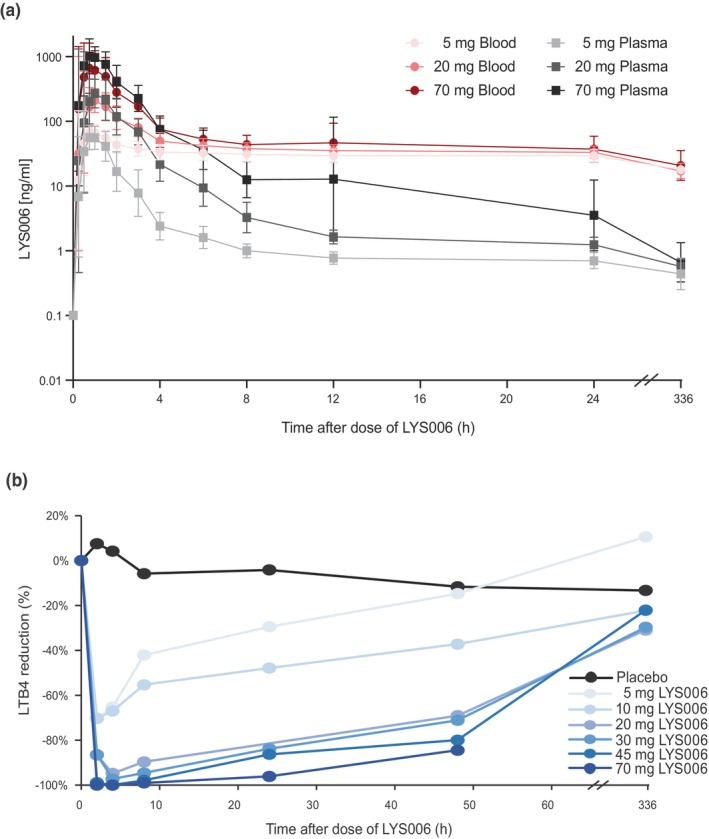
PK/PD profile of the SAD part. (a) Blood (red lines) and plasma (gray lines) concentrations of LYS006 after a single low (5 mg), a medium (20 mg), and a high (70 mg) dose of LYS006 during the SAD part of the study. Profiles of the first 24 h after dosing and of final timepoint 14 days after dosing are shown as arithmetic means ± errors. (b) Blood PDs of all single dose cohorts of the SAD part are shown for up to 48 h and at end of study after single ascending doses of LYS006. Reduction of LTB4 (in percent) versus pretreatment in ex vivo stimulated blood is shown as mean. PD, pharmacodynamic; PK, pharmacokinetic; SAD, single ascending dose.
FIGURE 4
FIGURE 4
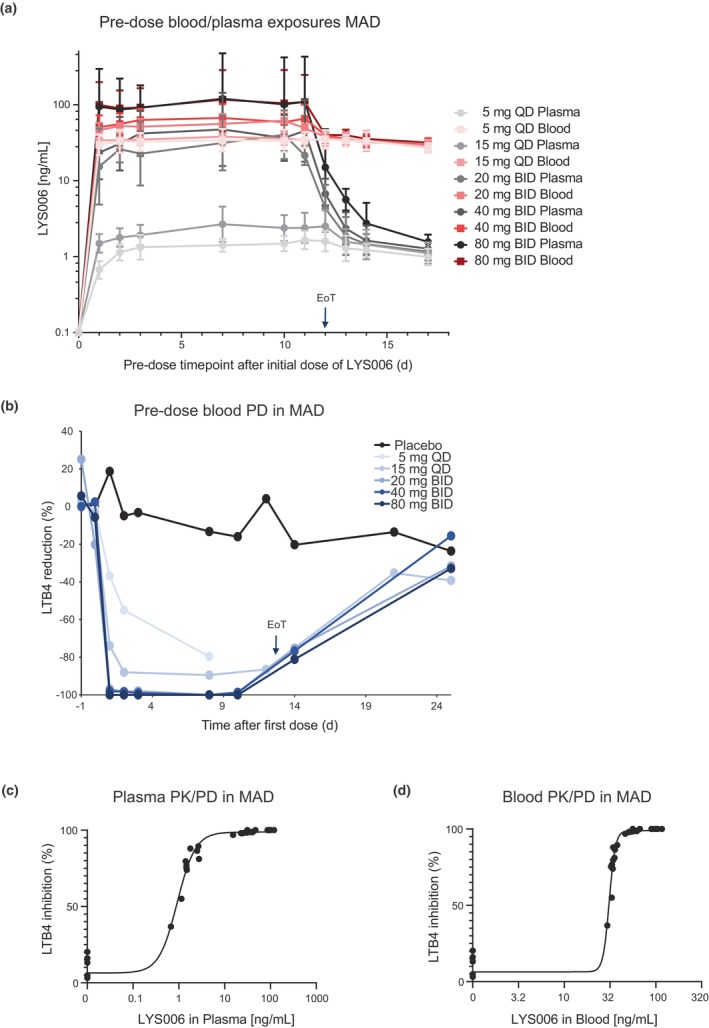
PK/PD profile of the MAD part. (a) Blood (red lines) and plasma (gray lines) predose concentrations of LYS006 at indicated timepoints after once‐daily doses of 5 mg and 15 mg q.d. or twice‐daily doses of 20 mg, 40 mg or 80 mg b.i.d. of LYS006. Profiles during the 12 days of repeated dosing and after EoT are depicted as arithmetic means ± errors. (b) PD effect of LYS006 in all MAD cohorts are shown at indicated days during repeated treatment and after EoT. PD effect is depicted at the predose timepoint of each day as LTB4 reduction versus pre‐treatment in percent (shown are means). (c) Mean predose plasma levels from all MAD cohorts are plotted versus mean predose LTB4 inhibition levels to depict a plasma PK/PD response curve. (d) Mean predose blood levels from all MAD cohorts are plotted versus mean predose LTB4 inhibition levels to depict a blood PK/PD response curve. EoT, end‐of‐treatment; MAD, multiple ascending dose; PD, pharmacodynamic; PK, pharmacokinetic.
FIGURE 5
FIGURE 5
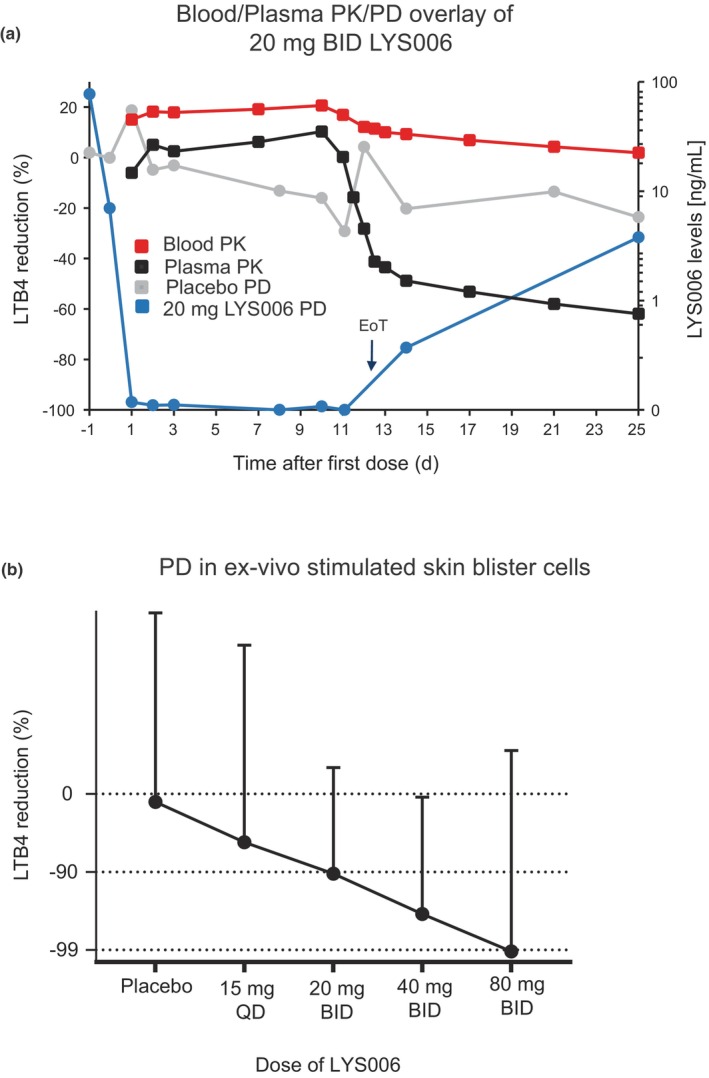
Blood and skin blister cell PD effect of LYS006 in MAD. (a) Overlays of blood PK (red curve), plasma PK (black curve), and PD effects of placebo (gray curve) and 20 mg b.i.d. LYS006 (blue curve) during repeated dose treatment and after EoT. PD effect is shown as mean LTB4 reduction in percentage versus pretreatment (left axis) and PK as mean LYS006 concentrations in blood and plasma (right axis) at indicated days at predose timepoints. (b) PD effect in skin blister cells is depicted as percent LTB4 reduction in ex vivo stimulated skin blister cells in placebo, 15 mg q.d. and 20, 40, and 80 mg b.i.d. treated patients. Shown are median values + errors. EoT, end‐of‐treatment; MAD, multiple ascending dose; PD, pharmacodynamic; PK, pharmacokinetic.

References

    1. Ford‐Hutchinson AW, Bray MA, Doig MV, Shipley ME, Smith MJ. Leukotriene B, a potent chemokinetic and aggregating substance released from polymorphonuclear leukocytes. Nature. 1980;286(5770):264‐265. - PubMed
    1. Peters‐Golden M, Henderson WR Jr. Leukotrienes. N Engl J Med. 2007;357(18):1841‐1854. - PubMed
    1. Afonso PV, Janka‐Junttila M, Lee YJ, et al. LTB4 is a signal‐relay molecule during neutrophil chemotaxis. Dev Cell. 2012;22(5):1079‐1091. - PMC - PubMed
    1. Lammermann T, Afonso PV, Angermann BR, et al. Neutrophil swarms require LTB4 and integrins at sites of cell death in vivo. Nature. 2013;498(7454):371‐375. - PMC - PubMed
    1. Sadik CD, Luster AD. Lipid‐cytokine‐chemokine cascades orchestrate leukocyte recruitment in inflammation. J Leukoc Biol. 2012;91(2):207‐215. - PMC - PubMed

Publication types

Substances

Grants and funding

LinkOut - more resources