. 2024 Feb 23;16(5):4378-4395.
doi: 10.18632/aging.205594. Epub 2024 Feb 23.

The prognosis, chemotherapy and immunotherapy efficacy of the SUMOylation pathway signature and the role of UBA2 in lung adenocarcinoma

Affiliations

The prognosis, chemotherapy and immunotherapy efficacy of the SUMOylation pathway signature and the role of UBA2 in lung adenocarcinoma

Liying Yu et al. Aging (Albany NY). .

Abstract

Lung adenocarcinoma (LUAD) is one of the most common malignant tumors worldwide. Small Ubiquitin-like Modifier (SUMO)-ylation plays a crucial role in tumorigenesis. However, the SUMOylation pathway landscape and its clinical implications in LUAD remain unclear. Here, we analyzed genes involved in the SUMOylation pathway in LUAD and constructed a SUMOylation pathway signature (SUMOPS) using the LASSO-Cox regression model, validated in independent cohorts. Our analysis revealed significant dysregulation of SUMOylation-related genes in LUAD, comprising of favorable or unfavorable prognostic factors. The SUMOPS model was associated with established molecular and histological subtypes of LUAD, highlighting its clinical relevance. The SUMOPS stratified LUAD patients into SUMOPS-high and SUMOPS-low subtypes with distinct survival outcomes and adjuvant chemotherapy responses. The SUMOPS-low subtype showed favorable responses to adjuvant chemotherapy. The correlations between SUMOPS scores and immune cell infiltration suggested that patients with the SUMOPS-high subtype exhibited favorable immune profiles for immune checkpoint inhibitor (ICI) treatment. Additionally, we identified UBA2 as a key SUMOylation-related gene with an increased expression and a poor prognosis in LUAD. Cell function experiment confirmed the role of UBA2 in promoting LUAD cell proliferation, invasion, and migration. These findings provide valuable insights into the SUMOylation pathway and its prognostic implications in LUAD, paving the way for personalized treatment strategies and the development of novel therapeutic targets.

Keywords: LUAD; SUMOylation; UBA2; prognosis; treatment.


Conflict of interest statement

CONFLICTS OF INTEREST: The authors declare no conflicts of interest related to this study.

Figures

Figure 1
Figure 1
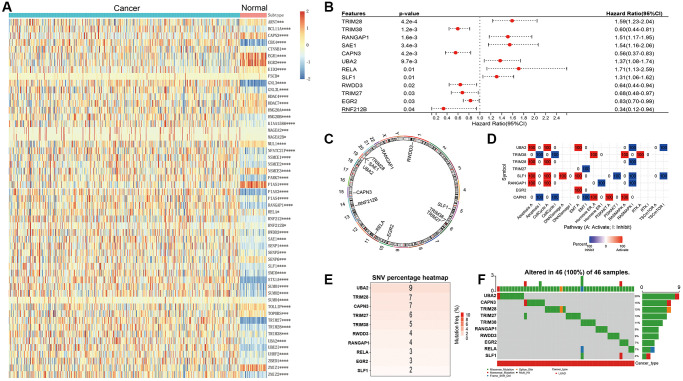
Landscape of genetic variation and correlation of SUMOylation pathway-related genes in LUAD. (A) The heat map demonstrates the differential expression of SUMOylation pathway genes between LUAD and adjacent non-tumor tissues. (B) Univariate survival analysis results of SUMOylation pathway genes in LUAD patients. (C) The chromosomal locations of the 12 SUMOylation pathway genes were determined. (D) Pathway analysis of SUMOylation pathway genes in LUAD. (E) The number of patients with mutations in SUMOylation pathway genes using TCGA-LUAD cohort. (F) Oncoplots showing the mutation landscape of SUMOylation pathway genes in LUAD patients from TCGA-LUAD cohort. *p < 0.05; **p < 0.01, ***p < 0.001, ****p < 0.0001.
Figure 2
Figure 2
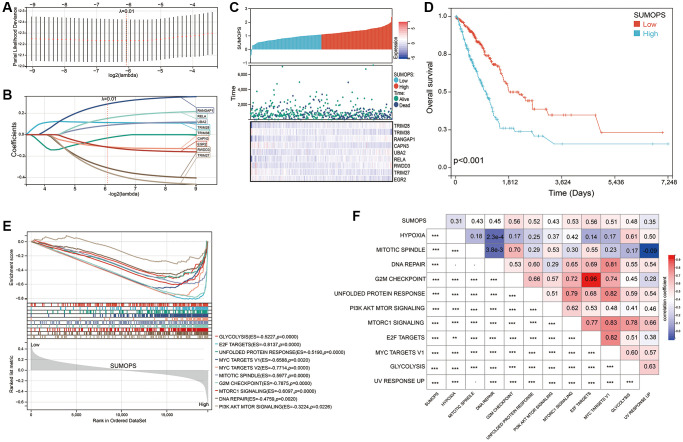
Construction of a SUMOPS to predict the prognosis of LUAD patients. (A) LASSO coefficient profile illustrating the relationship between overall survival and partial likelihood deviation. (B) Distribution of LASSO coefficients for the SUMOPS genes, indicating their respective contributions to the model. (C) Distribution of SUMOPS expression, survival status, and SUMOPS gene expression in the TCGA-LUAD dataset. (D) Prognostic analysis investigating the role of SUMOPS in predicting outcomes in the TCGA-LUAD cohort. (E) ssGSEA analysis of SUMOPS-low and SUMOPS-high subtypes. (F) Correlation analysis using Spearman’s rank correlation to examine the associations between SUMOPS and known gene signatures. p > 0.05; **p < 0.01, ***p < 0.001.
Figure 3
Figure 3
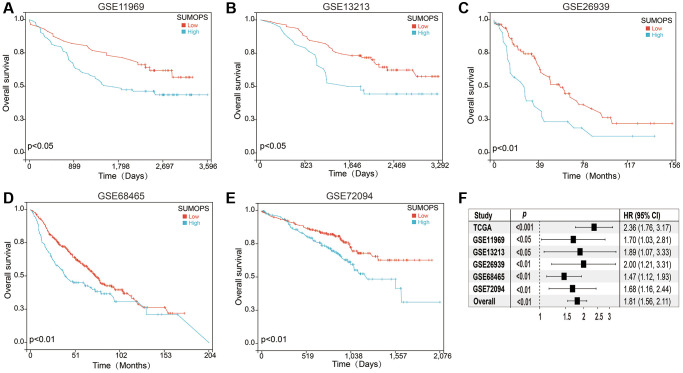
Validation of the SUMOPS model to predict the prognosis of LUAD patients. (AE) Prognostic analysis investigating the role of SUMOPS in predicting outcomes within the (A) GSE11969, (B) GSE13213, (C) GSE26939, (D) GSE68465, and (E) GSE72094 cohort. (F) The meta-analysis indicated that the LUAD patients with high SUMOPS suffered poorer overall survival.
Figure 4
Figure 4
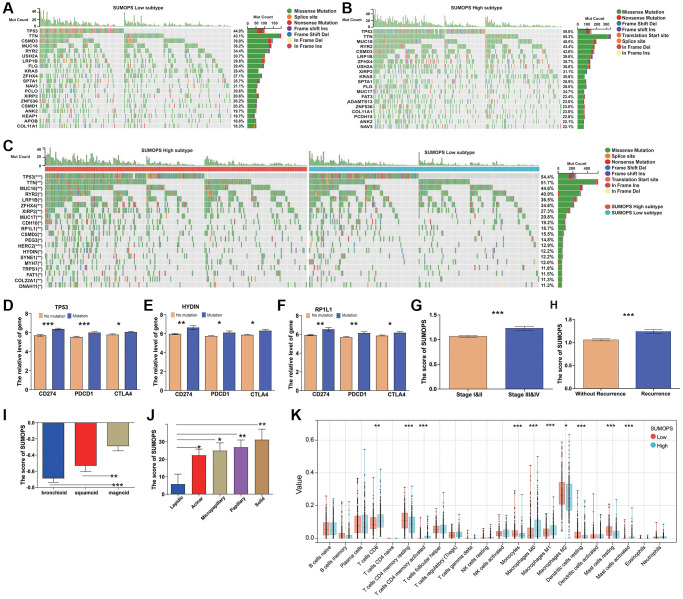
Relationship between the SUMOPS and genomic alterations as well as molecular subtypes in LUAD. (A, B) Oncoplots showing landscapes of genomic alterations in (A) SUMOPS-low and (B) SUMOPS-high subtypes. (C) Top 20 SUMOPS-related genes with the highest mutation frequency based on TCGA-LUAD cohort. (D) TP53, (E) HYDIN and (F) RP1L1 mutations distinctly facilitated expression of immune checkpoints (CTLA4, CD274, and PDCD1). (G) The score of SUMOPS at different stages. (H) The score of SUMOPS in recurrence and non-recurrence LUAD patients. (I) The score of SUMOPS in different molecular subtypes based on the GSE26939 cohort. (J) The score of SUMOPS in different molecular subtypes based on the GSE58772 cohort. (K) Box plots illustrating the relationships between SUMOPS subtypes and the infiltration of immune cells. *p < 0.05; **p < 0.01, ***p < 0.001.
Figure 5
Figure 5
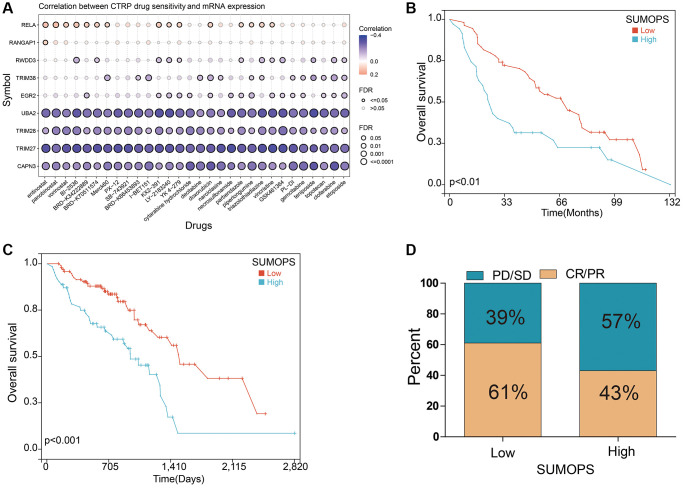
Prediction and correlation of the sensitivity to chemotherapy drugs in LUAD. (A) The correlation between GDSC drug sensitivity and SUMOPS gene expression. (B) The predictive value of SUMOPS in LUAD patients treated with chemotherapy in the GSE68465 cohort. (C) The predictive value of SUMOPS in LUAD patients treated with chemotherapy in the TCGA-LUAD cohort. (D) The correlation of UMOPS with response to chemotherapy in the TCGA-LUAD cohort.
Figure 6
Figure 6
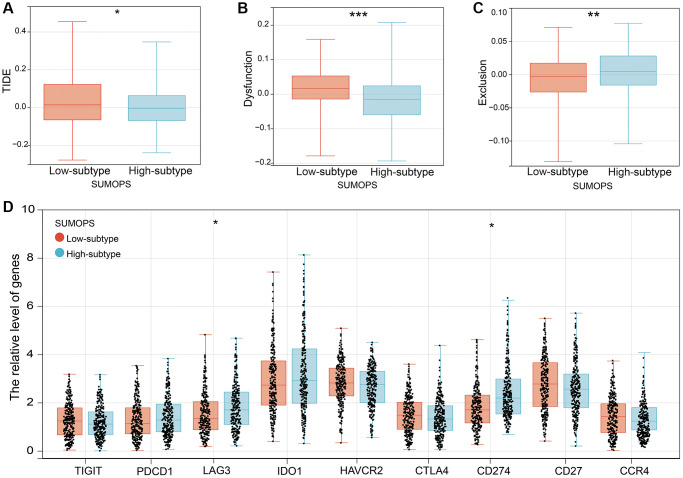
The prognostic value of SUMOPS for ICI treatment. (AC) Scores of (A) TIDE, (B) T cell dysfunction and (C) T cell exclusion in different SUMOPS subtypes. (D) Box plots illustrating the relationships between SUMOPS subtypes and the expression of immune checkpoints. *p < 0.05; **p < 0.01, ***p < 0.001.
Figure 7
Figure 7
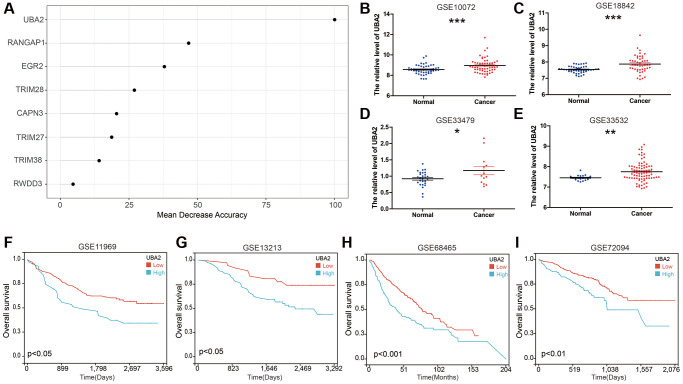
UBA2 is highly expressed in LUAD and is associated with poor prognosis in LUAD patients. (A) Random forest feature importance ranking for the SUMOPS genes; (BE) The expression of UBA2 between LUAD and normal tissues in the (B) GSE10072, (C) GSE18842, (D) GSE33479 and (E) GSE33532 cohorts. (FI) Prognostic analysis investigating the role of UBA2 in predicting outcomes in the (F) GSE11969, (G) GSE13213, (H) GSE68465 and (I) GSE72094 cohorts. *p < 0.05; **p < 0.01, ***p < 0.001.
Figure 8
Figure 8
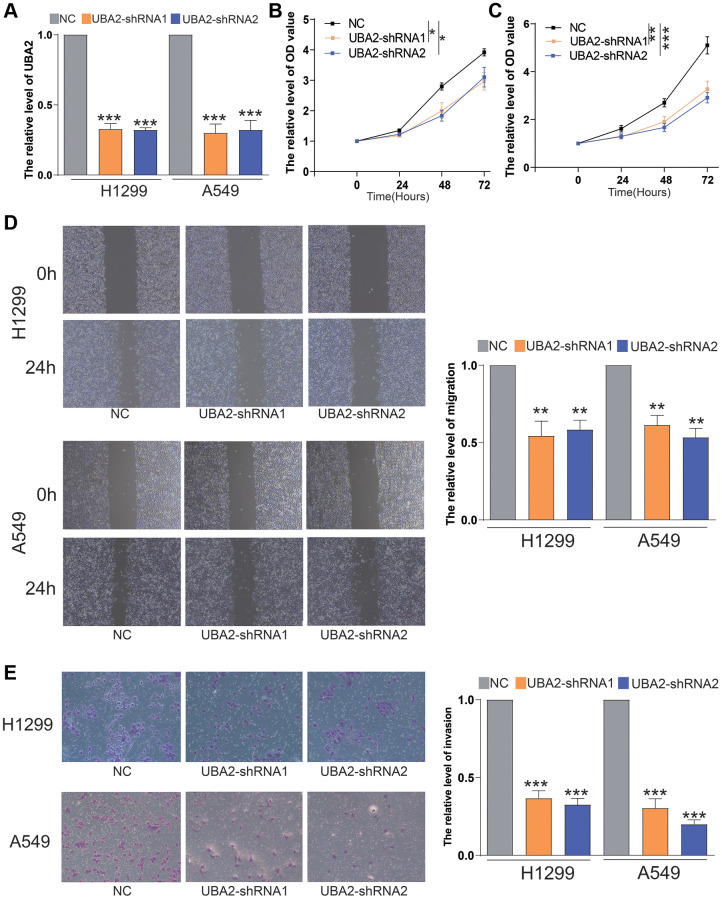
Knockdown of UBA2 inhibited the proliferation, invasion and migration of LUAD cells. (A) The UBA2 expression was measured by quantitative RT-PCR after transfecting UBA2-shRNAs in A549 and H1299. (B, C) The proliferative capacities of (B) H1299 and (C) A549 cells were measured by CCK8. (D) The migrative capacities of A549 and H1299 cells were measured by wound healing assay. (E) The invasive capacities of A549 and H1299 cells were measured by transwell assays. *p < 0.05, **p < 0.01 ***p < 0.001.

References

    1. Sung H, Ferlay J, Siegel RL, Laversanne M, Soerjomataram I, Jemal A, Bray F. Global Cancer Statistics 2020: GLOBOCAN Estimates of Incidence and Mortality Worldwide for 36 Cancers in 185 Countries. CA Cancer J Clin. 2021; 71:209–49. 10.3322/caac.21660 - DOI - PubMed
    1. Ma Y, Yang J, Ji T, Wen F. Identification of a novel m5C/m6A-related gene signature for predicting prognosis and immunotherapy efficacy in lung adenocarcinoma. Front Genet. 2022; 13:990623. 10.3389/fgene.2022.990623 - DOI - PMC - PubMed
    1. Gridelli C, Rossi A, Carbone DP, Guarize J, Karachaliou N, Mok T, Petrella F, Spaggiari L, Rosell R. Non-small-cell lung cancer. Nat Rev Dis Primers. 2015; 1:15009. 10.1038/nrdp.2015.9 - DOI - PubMed
    1. Shukla S, Evans JR, Malik R, Feng FY, Dhanasekaran SM, Cao X, Chen G, Beer DG, Jiang H, Chinnaiyan AM. Development of a RNA-Seq Based Prognostic Signature in Lung Adenocarcinoma. J Natl Cancer Inst. 2016; 109:djw200. 10.1093/jnci/djw200 - DOI - PMC - PubMed
    1. Pao W, Girard N. New driver mutations in non-small-cell lung cancer. Lancet Oncol. 2011; 12:175–80. 10.1016/S1470-2045(10)70087-5 - DOI - PubMed

Publication types

Substances