


Effect of carboxymethyl cellulose and gibberellic acid-enriched biochar on osmotic stress tolerance in cotton
- PMID: 38408939
- PMCID: PMC10895763
- DOI: 10.1186/s12870-024-04792-4
Effect of carboxymethyl cellulose and gibberellic acid-enriched biochar on osmotic stress tolerance in cotton
Abstract
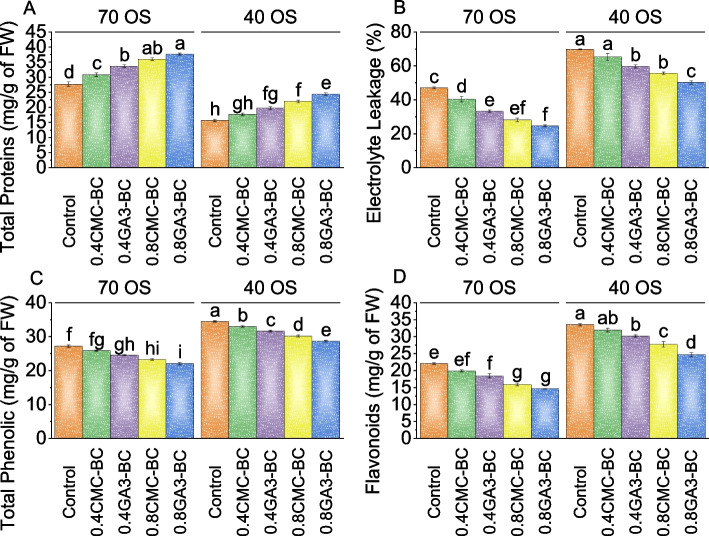
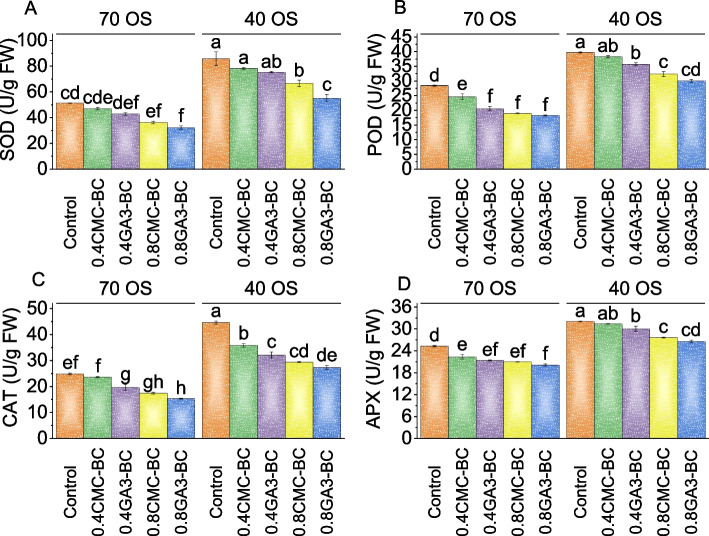
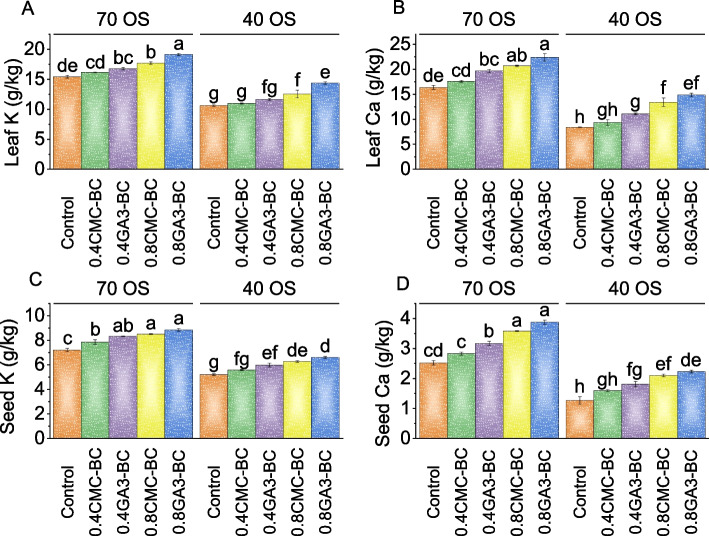
The deleterious impact of osmotic stress, induced by water deficit in arid and semi-arid regions, poses a formidable challenge to cotton production. To protect cotton farming in dry areas, it's crucial to create strong plans to increase soil water and reduce stress on plants. The carboxymethyl cellulose (CMC), gibberellic acid (GA3) and biochar (BC) are individually found effective in mitigating osmotic stress. However, combine effect of CMC and GA3 with biochar on drought mitigation is still not studied in depth. The present study was carried out using a combination of GA3 and CMC with BC as amendments on cotton plants subjected to osmotic stress levels of 70 (70 OS) and 40 (40 OS). There were five treatment groups, namely: control (0% CMC-BC and 0% GA3-BC), 0.4%CMC-BC, 0.4%GA3-BC, 0.8%CMC-BC, and 0.8%GA3-BC. Each treatment was replicated five times with a completely randomized design (CRD). The results revealed that 0.8 GA3-BC led to increase in cotton shoot fresh weight (99.95%), shoot dry weight (95.70%), root fresh weight (73.13%), and root dry weight (95.74%) compared to the control group under osmotic stress. There was a significant enhancement in cotton chlorophyll a (23.77%), chlorophyll b (70.44%), and total chlorophyll (35.44%), the photosynthetic rate (90.77%), transpiration rate (174.44%), and internal CO2 concentration (57.99%) compared to the control group under the 40 OS stress. Thus 0.8GA3-BC can be potential amendment for reducing osmotic stress in cotton cultivation, enhancing agricultural resilience and productivity.
Keywords: Biochar; Carboxymethyl cellulose; Chlorophyll content; Osmotic stress; Reactive oxygen species.
© 2024. The Author(s).
Conflict of interest statement
The authors declare no competing interests.
Figures




References
-
- Konieczna W, Mierek-Adamska A, Warchoł M, Skrzypek E, Dąbrowska GB. The involvement of metallothioneins and stress markers in response to osmotic stress in Avena sativa L. J Agron Crop Sci. 2023;209:371–389. doi: 10.1111/jac.12633. - DOI
-
- Akalin GO, Pulat M. Controlled release behavior of zinc-loaded carboxymethyl cellulose and carrageenan hydrogels and their effects on wheatgrass growth. J Polym Res. 2020;27:6. doi: 10.1007/s10965-019-1950-y. - DOI
-
- Wang Y, Gao M, Chen H, Chen Y, Wang L, Wang R. Fertigation and carboxymethyl cellulose applications enhance water-use efficiency, improving soil available nutrients and maize yield in salt-affected soil. Sustainability. 2023;15:9602. doi: 10.3390/su15129602. - DOI
MeSH terms
Substances
LinkOut - more resources
Full Text Sources
