


Patterns of Chlamydia trachomatis and Neisseria gonorrhoeae in different anatomical sites among Pre-Exposure Prophylaxis (PrEP) users in Brazil
- PMID: 38408940
- PMCID: PMC10895759
- DOI: 10.1186/s12879-024-09144-z
Patterns of Chlamydia trachomatis and Neisseria gonorrhoeae in different anatomical sites among Pre-Exposure Prophylaxis (PrEP) users in Brazil
Abstract
Background: The presence of untreated sexually transmitted infections (STIs) significantly increases the chance of acquiring HIV. In Brazil, testing for Chlamydia trachomatis (CT) and Neisseria gonorrhoeae (NG) among Pre-Exposure Prophylaxis (PrEP) users is insufficient, and syndromic treatment is a priority in clinical practice. Multi-site testing for CT/NG improves thescreening of asymptomatic cases and ensures timely treatment. Therefore, it is essential for HIV prevention. This study aims to test the importance of two-site testing for better screening of these pathogens and to determine whether the presence of symptoms is an indicator of CT/NG infection.
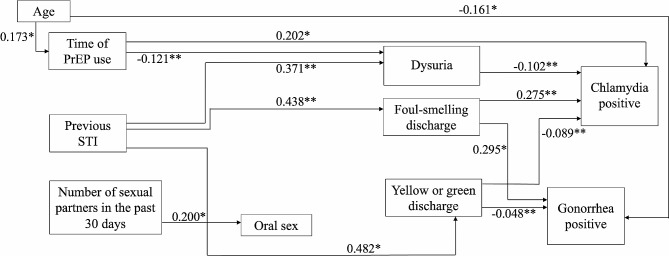
Methods: This is a cross-sectional study carried out in four public infectious diseases clinics in São Paulo State, Brazil between January of 2022 and March of 2023. All participants had an anal swab and a first-pass or mid-stream urine collected for CT/NG analysis by Polymerase chain reaction (PCR). Data about sociodemographic, sexual behavioural and clinical aspects were collected. Pathway analysis was used to examine the direct and indirect relationships between variables according to the theoretical model.
Results: We screened 171 PrEP users which had two samples collected, resulting in 342 samples. Comparing the anatomic sites, the urine samples showed lower sensitivity for CT and NG than anal samples. Gonorrhoea was directly linked to lower age (β= -0.161, p = 0.001). Time of PrEP use was directly associated with CT infection (β = 0.202; p = 0.042) and inversely associated with dysuria (β= -0.121, p = 0.009). Lower occurrence of yellow-green secretion was linked to detection of CT (β= -0.089, p = 0.005) and NG (β= -0.048, p = 0.002) infections. Foul-smelling discharge was directly associated with CT (β = 0.275, p = 0.004) and NG (β = 0.295, p = 0.037) infection.
Conclusion: The symptoms are a bad indicator of CT and NG infection, and the screening must be done in more than one site since most of the positive results would be missed if only urines were tested. In the case of testing only one anatomical site, specifically the urethra, the CT/NG incidence and prevalence would be underestimated. The two-sites testing improves detection rates of CT/NG, and PrEP follow-up benefits people offering STI testing.
Keywords: Chlamydia trachomatis; HIV prevention; HIV/aids; Neisseria gonorrhoeae; Pre-exposure Prophylaxis; Sexually transmitted infections.
© 2024. The Author(s).
Conflict of interest statement
The authors declare no competing interests.
Figures


References
-
- Organização Pan-Americana da Saúde (OPAS). Brasil inicia implementação da PrEP para prevenir novos casos de HIV entre segmentos populacionais de maior risco. [online] available on: https://www.paho.org/pt/noticias/3-1-2018-brasil-inicia-implementacao-da... Acessed 30 Oct 2023.
-
- World Health Organization (WHO). Sexually transmitted infections– Evidence Brief. Switzerland, 3p. 2019. Available from: https://www.who.int/publications/i/item/WHO-RHR-19.22 Acessed 30 Oct 2023.
-
- Brasil. Ministério da Saúde. Departamento de Doenças de Condições Crônicas e Infecções Sexualmente Transmissíveis. Protocolo Clínico e Diretrizes Terapêuticas para Profilaxia Pré-Exposição (PrEP) de Risco à Infecção pelo HIV. Ministério da Saúde. Brasília: 2022. Avaiable from: http://antigo.aids.gov.br/pt-br/pub/2022/protocolo-clinico-e-diretrizes-... Acessed 30 Oct 2023.
MeSH terms
Grants and funding
LinkOut - more resources
Full Text Sources
Medical
Research Materials
Miscellaneous
