


Combining photodynamic therapy and cascade chemotherapy for enhanced tumor cytotoxicity: the role of CTT2P@B nanoparticles
- PMID: 38410166
- PMCID: PMC10895035
- DOI: 10.3389/fbioe.2024.1361966
Combining photodynamic therapy and cascade chemotherapy for enhanced tumor cytotoxicity: the role of CTT2P@B nanoparticles
Abstract
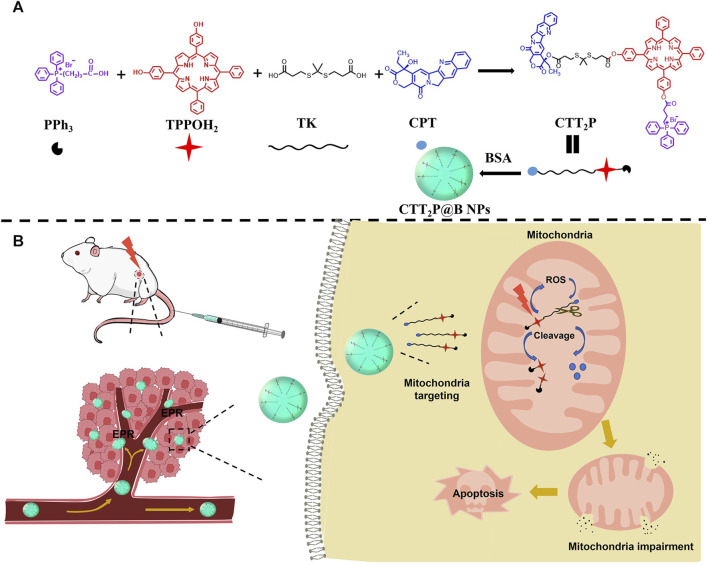
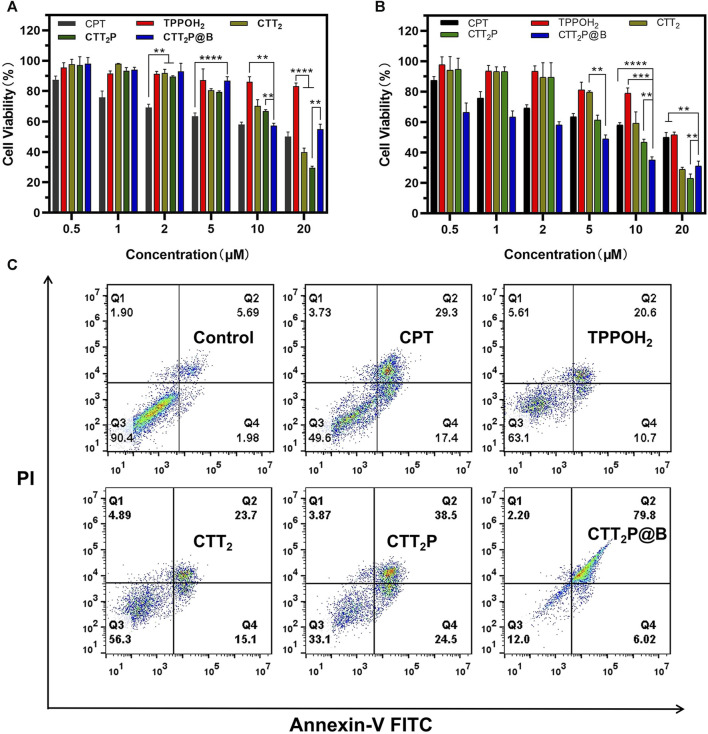
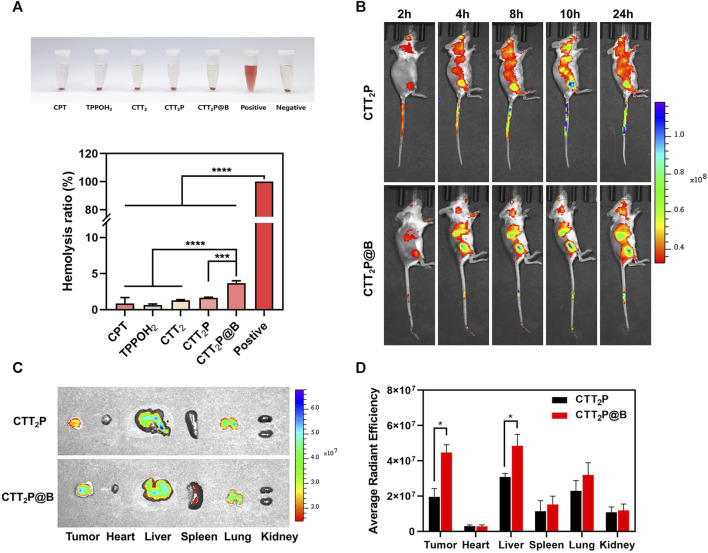
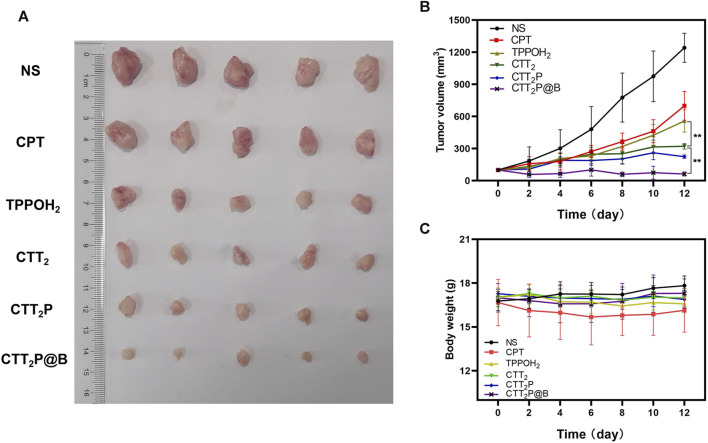
The mitochondria act as the main producers of reactive oxygen species (ROS) within cells. Elevated levels of ROS can activate the mitochondrial apoptotic pathway, leading to cell apoptosis. In this study, we devised a molecular prodrug named CTT2P, demonstrating notable efficacy in facilitating mitochondrial apoptosis. To develop nanomedicine, we enveloped CTT2P within bovine serum albumin (BSA), resulting in the formulation known as CTT2P@B. The molecular prodrug CTT2P is achieved by covalently conjugating mitochondrial targeting triphenylphosphine (PPh3), photosensitizer TPPOH2, ROS-sensitive thioketal (TK), and chemotherapeutic drug camptothecin (CPT). The prodrug, which is chemically bonded, prevents the escape of drugs while they circulate throughout the body, guaranteeing the coordinated dispersion of both medications inside the organism. Additionally, the concurrent integration of targeted photodynamic therapy and cascade chemotherapy synergistically enhances the therapeutic efficacy of pharmaceutical agents. Experimental results indicated that the covalently attached prodrug significantly mitigated CPT cytotoxicity under dark conditions. In contrast, TPPOH2, CTT2, CTT2P, and CTT2P@B nanoparticles exhibited increasing tumor cell-killing effects and suppressed tumor growth when exposed to light at 660 nm with an intensity of 280 mW cm-2. Consequently, this laser-triggered, mitochondria-targeted, combined photodynamic therapy and chemotherapy nano drug delivery system, adept at efficiently promoting mitochondrial apoptosis, presents a promising and innovative approach to cancer treatment.
Keywords: ROS-responsive; bovine serum albumin; camptothecin; mitochondria-targeting; photodynamic therapy.
Copyright © 2024 Wang, Li, Han, Han, Bao, Fan, Sun, Qian, Ma and Zhang.
Conflict of interest statement
The authors declare that the research was conducted in the absence of any commercial or financial relationships that could be construed as a potential conflict of interest.
Figures
References
-
- Agwa M. M., Elmotasem H., Elsayed H., Abdelsattar A. S., Omer A. M., Gebreel D. T., et al. (2023). Carbohydrate ligands-directed active tumor targeting of combinatorial chemotherapy/phototherapy-based nanomedicine: a review. Int. J. Biol. Macromol. 239, 124294. 10.1016/j.ijbiomac.2023.124294 - DOI - PubMed
-
- Chu B., Qu Y., He X., Hao Y., Yang C., Yang Y., et al. (2020). ROS‐Responsive camptothecin prodrug nanoparticles for on‐demand drug release and combination of chemotherapy and photodynamic therapy. Adv. Funct. Mat. 30 (52). 10.1002/adfm.202005918 - DOI
LinkOut - more resources
Full Text Sources
