


Comparison of Conventional Dose Versus Superdose Platelet-Rich Plasma for Knee Osteoarthritis: A Prospective, Triple-Blind, Randomized Clinical Trial
- PMID: 38410168
- PMCID: PMC10896053
- DOI: 10.1177/23259671241227863
Comparison of Conventional Dose Versus Superdose Platelet-Rich Plasma for Knee Osteoarthritis: A Prospective, Triple-Blind, Randomized Clinical Trial
Abstract
Background: Confusion persists regarding the ideal dosage of platelet-rich plasma (PRP) injection for knee osteoarthritis (OA).
Purpose/hypothesis: The purpose of the study was to compare the efficacy of 2 different single-injection PRP dosages in patients with early knee OA-a conventional 4 mL dose and a superdose of 8 mL. It was hypothesized that 8 mL of PRP would be superior to 4 mL of PRP in this patient population.
Study design: Randomized clinical trial; Level of evidence, 1.
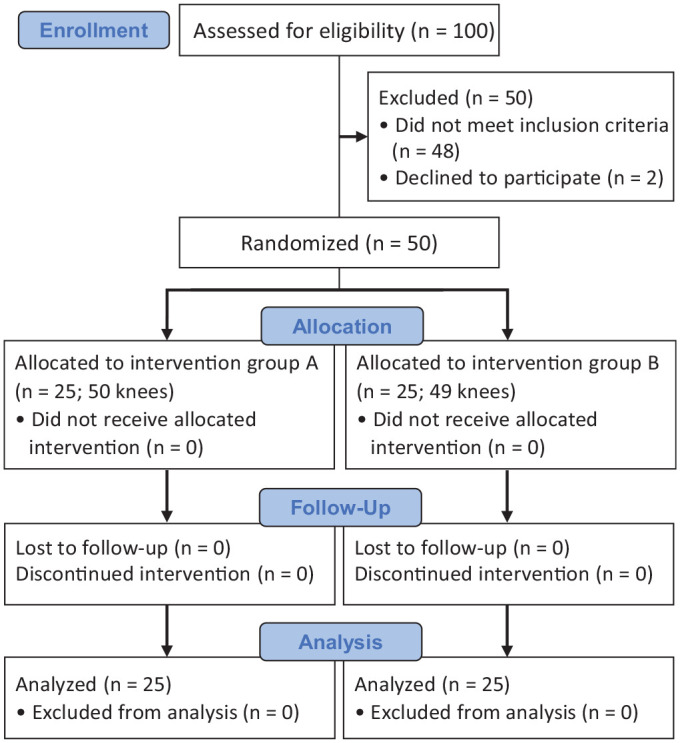
Methods: Patients with early knee OA (Kellgren-Lawrence grades 1 and 2) who met the inclusion criteria were randomly divided into 2 groups: Group A (n = 50 knees) received a 4-mL PRP injection, and group B (n = 49 knees) received an 8-mL PRP injection, both prepared using the same procedure. Patients were evaluated at the baseline, 6 weeks, 3 months, and 6 months using the Western Ontario and McMaster Universities Arthritis Index (WOMAC), the WOMAC-Pain subscale, the visual analog scale for pain, the Knee injury and Osteoarthritis Outcome Score, and patient satisfaction, and results were compared between the groups.
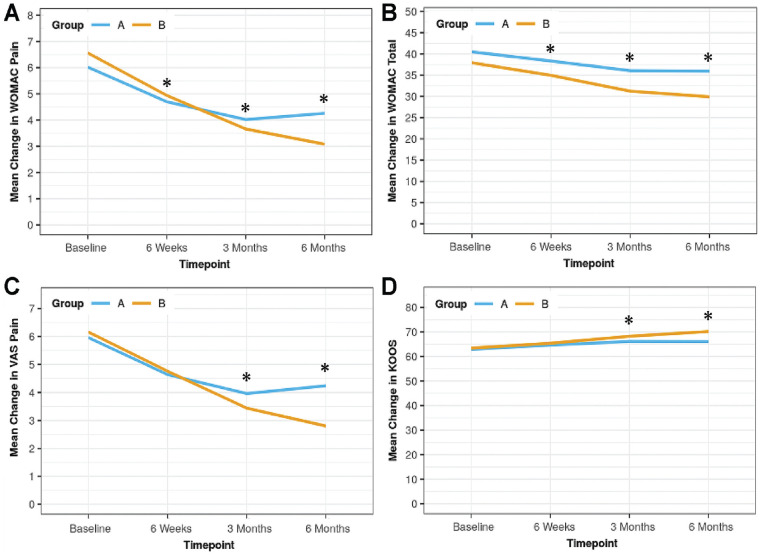
Results: The baseline characteristics of the 2 groups were comparable (group A: mean age, 51.96 ± 6.93 years; group B: mean age, 49.12 ± 9.8 3 years). Leucocyte-depleted PRP with 3.5 times concentration (final product platelet concentration, 706.74 × 10³-μL) was injected. The mean absolute platelet count injected was 2.82 ± 0.0012 billion in group A and 5.65 ± 0.0022 billion in group B. All patient-reported outcome scores improved significantly in both groups from the baseline to the final follow-up (P < .001), with overall trends and results significantly better in group B than in group A (P < .001). Patient satisfaction at the 6-month follow-up was also better in group B (96%) compared with group A (68%). Short (2 to 7 days) self-limiting complications, such as pain and stiffness, occurred more often in group B (P < .001).
Conclusion: Patients with early knee OA had significantly better improvement in pain and function when treated with an 8-mL injection of PRP compared with a 4-mL injection of PRP. The larger dose of PRP had approximately twice the number of platelets.
Registration: CTRI/2020/02/023403 (Clinical Trials Registry-India identifier).
Keywords: knee; osteoarthritis; platelet-rich plasma; superdose platelet-rich plasma.
© The Author(s) 2024.
Conflict of interest statement
The authors have declared that there are no conflicts of interest in the authorship and publication of this contribution. AOSSM checks author disclosures against the Open Payments Database (OPD). AOSSM has not conducted an independent investigation on the OPD and disclaims any liability or responsibility relating thereto.
Figures
References
-
- Bennell KL, Hunter DJ, Paterson KL. Platelet-rich plasma for the management of hip and knee osteoarthritis. Curr Rheumatol Rep. 2017;19(5):24. - PubMed
-
- Chang K-V, Hung C-Y, Aliwarga F, Wang T-G, Han D-S, Chen W-S. Comparative effectiveness of platelet-rich plasma injections for treating knee joint cartilage degenerative pathology: a systematic review and meta-analysis. Arch Phys Med Rehabil. 2014; 95(3):562-575 - PubMed
LinkOut - more resources
Full Text Sources
Medical
Research Materials
Miscellaneous
