


Graft Failure After Revascularization for Chronic Limb-Threatening Ischaemia (CLTI) Patients: The Role of Graft Surveillance
- PMID: 38410345
- PMCID: PMC10895559
- DOI: 10.7759/cureus.53036
Graft Failure After Revascularization for Chronic Limb-Threatening Ischaemia (CLTI) Patients: The Role of Graft Surveillance
Abstract
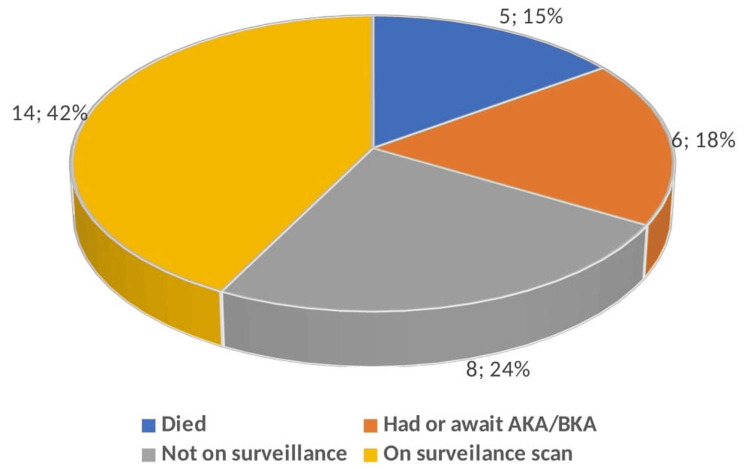
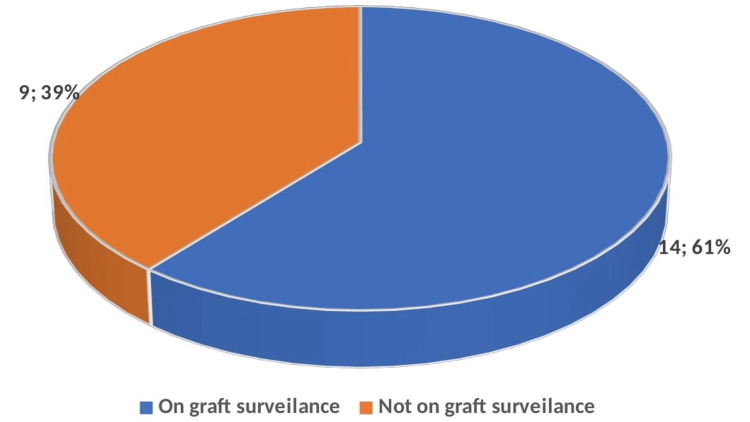
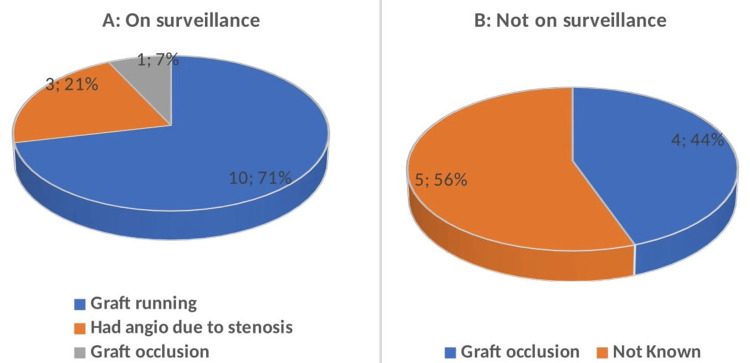
Introduction Failure of infrainguinal bypass grafts remains a major problem tackled by vascular surgeons despite a meticulous surgical technique. All infrainguinal bypasses should go under routine surveillance to pick the grafts at risk for the prevention of graft failure. Objectives The aim was to find out if we were adhering to the European Society of Vascular Surgery (ESVS) guidelines in the management of chronic limb-threatening ischaemia (CLTI) patients, including postoperative follow-up and to monitor whether the patients were having postoperative duplex surveillance scans to pick any graft at risk. Methods All patients who underwent infra-inguinal bypass procedures for CLTI during the last eight months (from mid-January to mid-September 2023) in our vascular unit were included. Retrospective data were collected. Results A total of 38 patients had lower limb bypass procedures over the last eight months (from 15 January till 14 September 2023). However, two femoral-femoral (fem-fem) crossovers, one Ilio-popliteal, and one pedal bypass were excluded. Thus, a total of 36 patients were included in the study (n=34). The vast majority (n=27, 79.4%) had femoro popliteal bypass anastomosing distally to above knee (AK) or below knee (BK) popliteal artery, and the rest (n=7, 20.5%) had distal bypass (fem-distal or pop-distal bypass). Moreover, 18% of patients had amputation, 15% of patients died, and 61% of the remaining patients were on surveillance. Of those, who were not on surveillance, 44% of them had graft occlusion. Conclusion Surveillance can predict graft at risk, and the graft occlusion can be prevented by appropriate intervention. Every vascular unit should have its own post-procedural follow-up strategies.
Keywords: duplex scan; graft occlusion; infrainguinal bypass; risk factors; surveillance.
Copyright © 2024, Miah et al.
Conflict of interest statement
The authors have declared that no competing interests exist.
Figures
References
-
- Vascular graft failure of leg arterial bypasses - a review. Handa R, Sharma S. J Hypertens Cardiol. 2014;1:17–21.
-
- Pathophysiology of vein graft failure: a review. Davies MG, Hagen PO. Eur J Vasc Endovasc Surg. 1995;9:7–18. - PubMed
-
- Risk factors for occlusion of infrainguinal bypass grafts. Tangelder MJ, Algra A, Lawson JA, Eikelboom BC. Eur J Vasc Endovasc Surg. 2000;20:118–124. - PubMed
-
- Is early postoperative duplex scan surveillance of leg bypass grafts clinically important? Ferris BL, Mills JL Sr, Hughes JD, Durrani T, Knox R. J Vasc Surg. 2003;37:495–500. - PubMed
LinkOut - more resources
Full Text Sources