


Post-discharge outcomes of hospitalized children diagnosed with acute SARS-CoV-2 or MIS-C
- PMID: 38410766
- PMCID: PMC10895015
- DOI: 10.3389/fped.2024.1340385
Post-discharge outcomes of hospitalized children diagnosed with acute SARS-CoV-2 or MIS-C
Erratum in
-
Corrigendum: Post-discharge outcomes of hospitalized children diagnosed with acute SARS-CoV-2 or MIS-C.Front Pediatr. 2024 Jul 1;12:1440609. doi: 10.3389/fped.2024.1440609. eCollection 2024. Front Pediatr. 2024. PMID: 39011061 Free PMC article.
Abstract
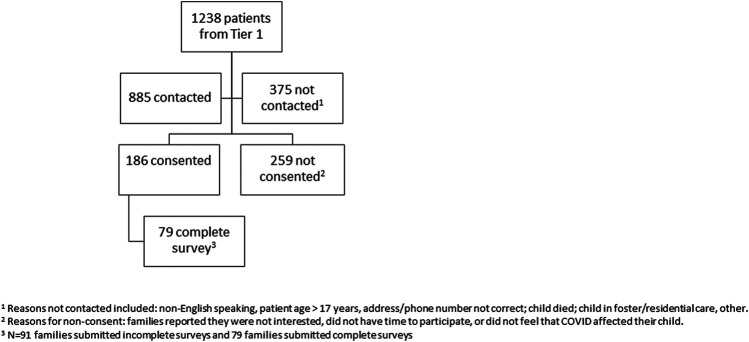
Introduction: Hospitalized children diagnosed with SARS-CoV-2-related conditions are at risk for new or persistent symptoms and functional impairments. Our objective was to analyze post-hospital symptoms, healthcare utilization, and outcomes of children previously hospitalized and diagnosed with acute SARS-CoV-2 infection or Multisystem Inflammatory Syndrome in Children (MIS-C).
Methods: Prospective, multicenter electronic survey of parents of children <18 years of age surviving hospitalization from 12 U.S. centers between January 2020 and July 2021. The primary outcome was a parent report of child recovery status at the time of the survey (recovered vs. not recovered). Secondary outcomes included new or persistent symptoms, readmissions, and health-related quality of life. Multivariable backward stepwise logistic regression was performed for the association of patient, disease, laboratory, and treatment variables with recovered status.
Results: The children [n = 79; 30 (38.0%) female] with acute SARS-CoV-2 (75.7%) or MIS-C (24.3%) had a median age of 6.5 years (interquartile range 2.0-13.0) and 51 (64.6%) had a preexisting condition. Fifty children (63.3%) required critical care. One-third [23/79 (29.1%)] were not recovered at follow-up [43 (31, 54) months post-discharge]. Admission C-reactive protein levels were higher in children not recovered vs. recovered [5.7 (1.3, 25.1) vs. 1.3 (0.4, 6.3) mg/dl, p = 0.02]. At follow-up, 67% overall had new or persistent symptoms. The most common symptoms were fatigue (37%), weakness (25%), and headache (24%), all with frequencies higher in children not recovered. Forty percent had at least one return emergency visit and 24% had a hospital readmission. Recovered status was associated with better total HRQOL [87 (77, 95) vs. 77 (51, 83), p = 0.01]. In multivariable analysis, lower admission C-reactive protein [odds ratio 0.90 (95% confidence interval 0.82, 0.99)] and higher admission lymphocyte count [1.001 (1.0002, 1.002)] were associated with recovered status.
Conclusions: Children considered recovered by their parents following hospitalization with SARS-CoV-2-related conditions had less symptom frequency and better HRQOL than those reported as not recovered. Increased inflammation and lower lymphocyte count on hospital admission may help to identify children needing longitudinal, multidisciplinary care.
Clinical trial registration: ClinicalTrials.gov (NCT04379089).
Keywords: SARS-CoV-2; child development; patient outcome assessment; pediatrics; post-acute COVID-19 syndrome.
© 2024 Fink, Alcamo, Lovett, Hartman, Williams, Garcia, Rasmussen, Pal, Drury, MackDiaz, Ferrazzano, Dervan, Appavu, Snooks, Stulce, Rubin, Pate, Toney, Robertson, Wainwright, Roa, Schober and Slomine.
Conflict of interest statement
The authors declare that the research was conducted in the absence of any commercial or financial relationships that could be construed as a potential conflict of interest. The reviewer MP-E declared a past co-authorship with the author LD to the handling editor.
References
-
- WHO. World Health Organization (WHO) clinical case definition working group on post COVID-19 condition. Retrieved from: About Social Determinants of Health (SDOH). (2021).
Associated data
Grants and funding
LinkOut - more resources
Full Text Sources
Medical
Research Materials
Miscellaneous
