


Saccharomycotina yeasts defy long-standing macroecological patterns
- PMID: 38412132
- PMCID: PMC10927492
- DOI: 10.1073/pnas.2316031121
Saccharomycotina yeasts defy long-standing macroecological patterns
Abstract
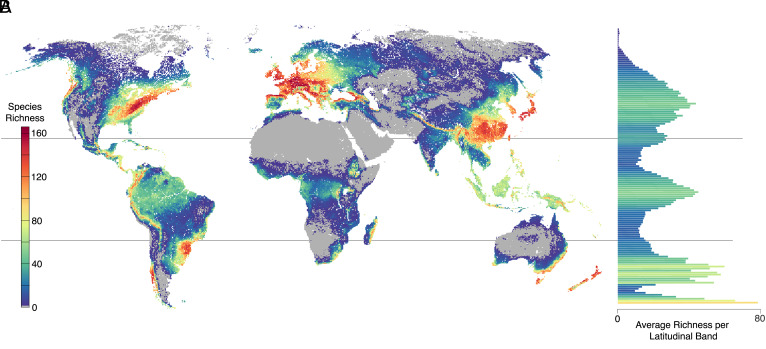
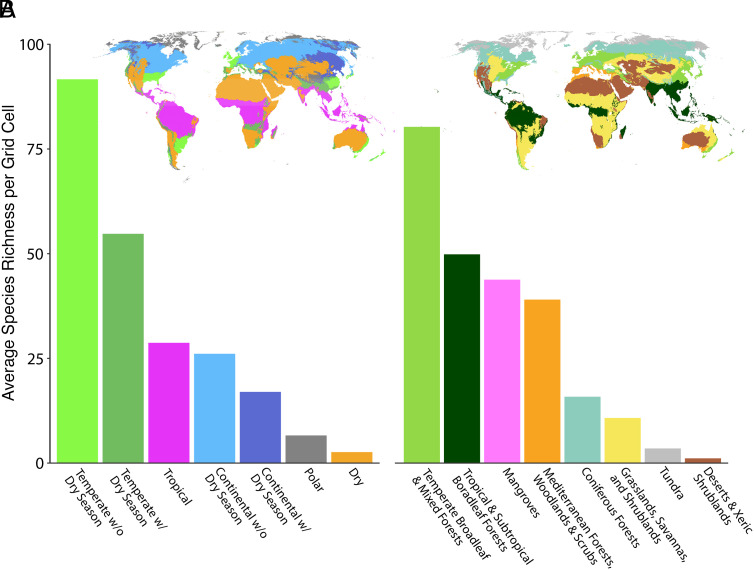
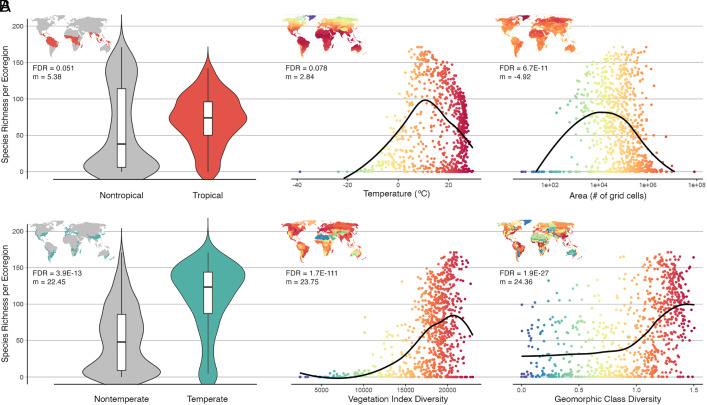
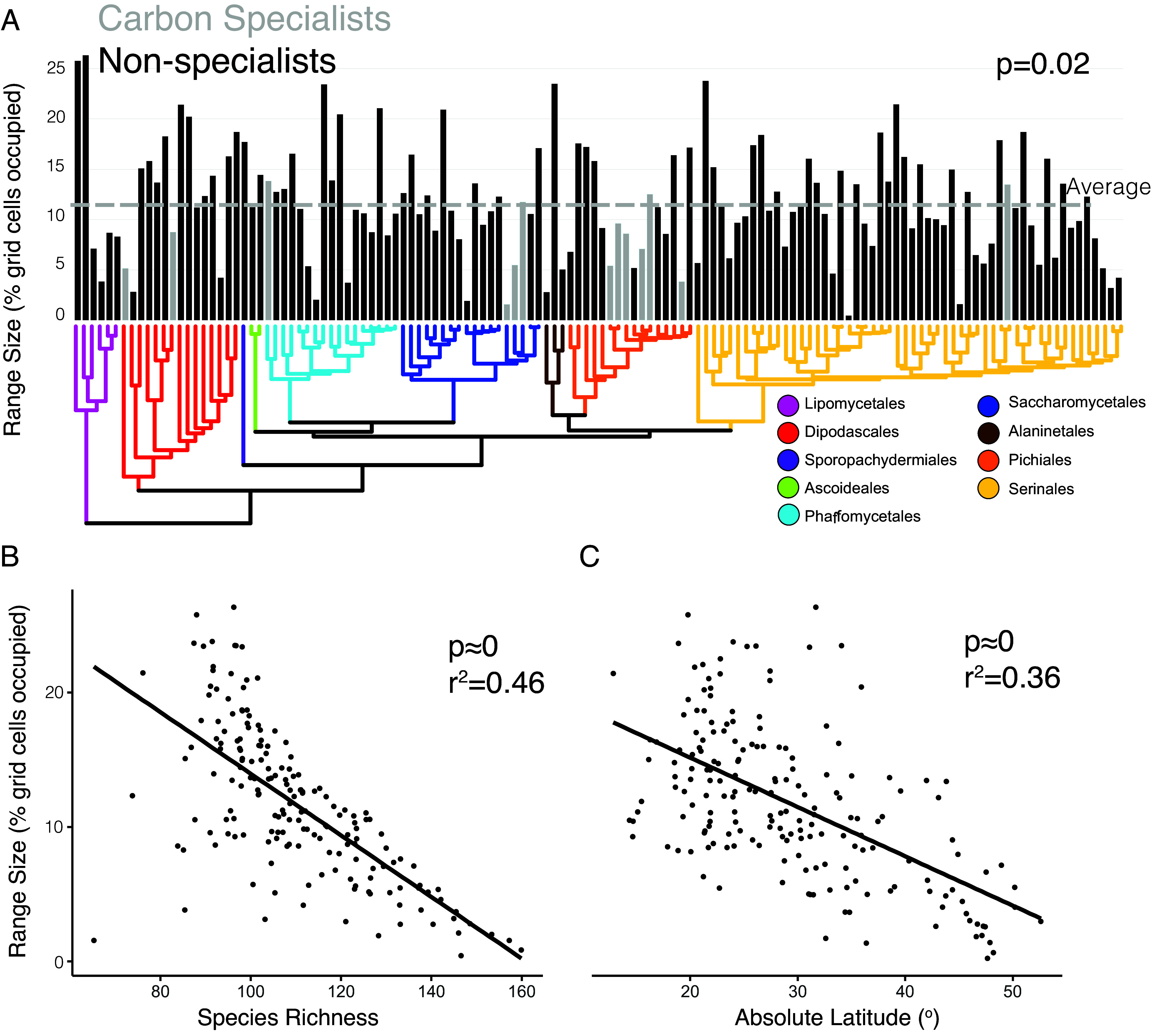
The Saccharomycotina yeasts ("yeasts" hereafter) are a fungal clade of scientific, economic, and medical significance. Yeasts are highly ecologically diverse, found across a broad range of environments in every biome and continent on earth; however, little is known about what rules govern the macroecology of yeast species and their range limits in the wild. Here, we trained machine learning models on 12,816 terrestrial occurrence records and 96 environmental variables to infer global distribution maps at ~1 km2 resolution for 186 yeast species (~15% of described species from 75% of orders) and to test environmental drivers of yeast biogeography and macroecology. We found that predicted yeast diversity hotspots occur in mixed montane forests in temperate climates. Diversity in vegetation type and topography were some of the greatest predictors of yeast species richness, suggesting that microhabitats and environmental clines are key to yeast diversity. We further found that range limits in yeasts are significantly influenced by carbon niche breadth and range overlap with other yeast species, with carbon specialists and species in high-diversity environments exhibiting reduced geographic ranges. Finally, yeasts contravene many long-standing macroecological principles, including the latitudinal diversity gradient, temperature-dependent species richness, and a positive relationship between latitude and range size (Rapoport's rule). These results unveil how the environment governs the global diversity and distribution of species in the yeast subphylum. These high-resolution models of yeast species distributions will facilitate the prediction of economically relevant and emerging pathogenic species under current and future climate scenarios.
Keywords: AI; biogeography; fungi; latitudinal species gradient; macroecology.
Conflict of interest statement
Competing interests statement:A.R. is a scientific consultant of LifeMine Therapeutics, Inc. The authors declare no other competing interests.
Figures
Update of
-
Saccharomycotina yeasts defy longstanding macroecological patterns.bioRxiv [Preprint]. 2023 Aug 31:2023.08.29.555417. doi: 10.1101/2023.08.29.555417. bioRxiv. 2023. Update in: Proc Natl Acad Sci U S A. 2024 Mar 5;121(10):e2316031121. doi: 10.1073/pnas.2316031121. PMID: 37693602 Free PMC article. Updated. Preprint.
References
-
- Opulente D. A., et al. , Genomic and ecological factors shaping specialism and generalism across an entire subphylum. BioRxiv [Preprint] (2023). 10.1101/2023.06.19.545611 (Accessed 8 September 2023). - DOI
-
- Starmer W. T., Lachance M.-A., “Yeast ecology” in The yeasts (2011), pp. 65–83.
-
- Kurtzman C. P., Fell J. W., Boekhout T., The Yeasts: A Taxonomic Study (Elsevier, 2011).
-
- Bread–Worldwide | Statista Market Forecast, Statista. https://www.statista.com/outlook/cmo/food/bread-cereal-products/bread/wo.... Accessed 8 November 2023.
MeSH terms
Substances
Grants and funding
LinkOut - more resources
Full Text Sources
