


Interpretation bias modification for hostility to facilitate smoking cessation in a sample with elevated trait anger: A randomized trial
- PMID: 38412574
- PMCID: PMC11008596
- DOI: 10.1016/j.brat.2024.104499
Interpretation bias modification for hostility to facilitate smoking cessation in a sample with elevated trait anger: A randomized trial
Abstract
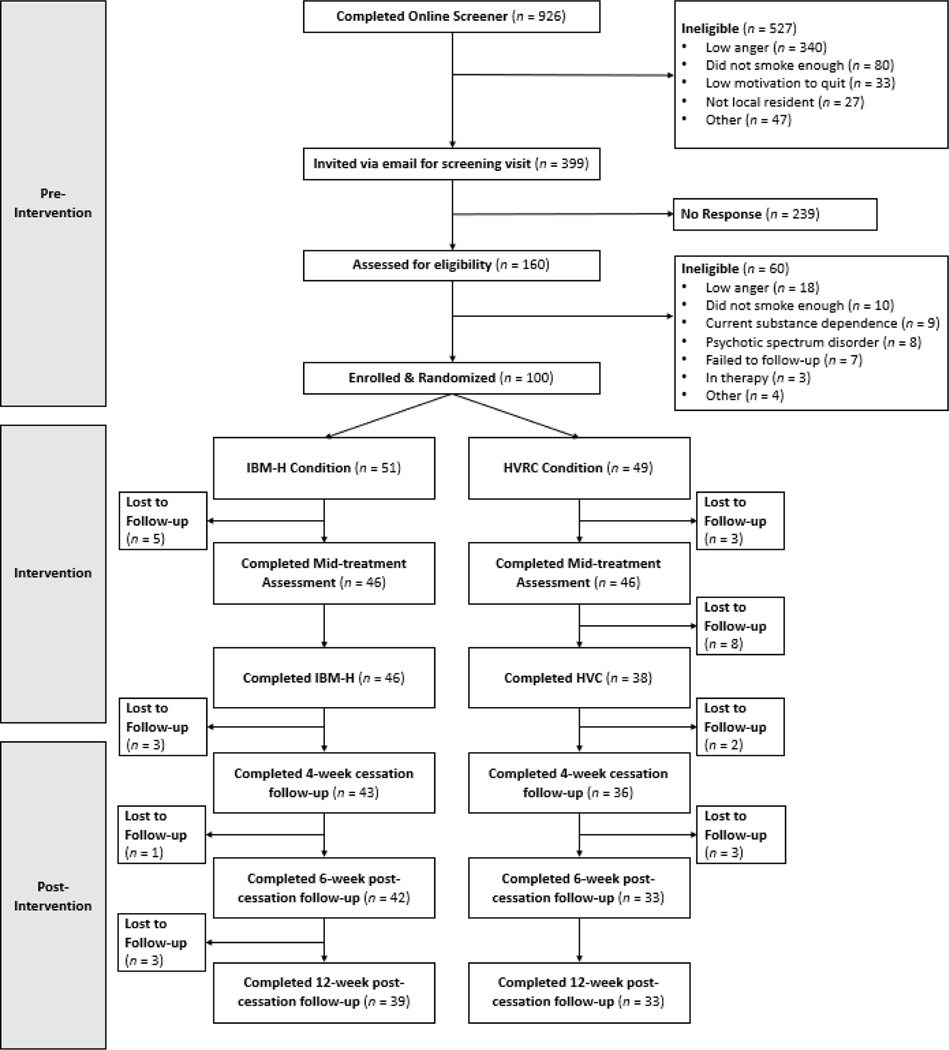
Problematic anger is linked with multiple adverse smoking outcomes, including cigarette dependence, heavy smoking, and cessation failure. A smoking cessation intervention that directly targets anger and its maintenance factors may increase rates of smoking cessation. We examined the efficacy of an interpretation bias modification for hostility (IBM-H) to facilitate smoking cessation in smokers with elevated trait anger. Participants were 100 daily smokers (mean age = 38, 62% female, 55% white) with elevated anger were randomly assigned to eight computerized sessions of either IBM-H or a health and relaxation video control condition (HRVC). Participants in both conditions attempted to quit at mid-treatment. Measures of hostility, anger, and smoking were administered at pre-, mid-, post-treatment, as well as at up to three-month follow-up. Compared to HRVC, IBM-H led to greater reductions in hostile interpretation bias, both at posttreatment and follow-up. IBM-H also led to statistically significant reductions in hostility only at posttreatment, and trait anger only at three-month follow-up. Both conditions experienced reductions in smoking, although they did not differ in quit success. We discuss these findings in the context of literature on anger and smoking cessation and provide directions for future research.
Keywords: Anger; Cognitive bias; Hostility; Nicotine; Smoking.
Copyright © 2024 Elsevier Ltd. All rights reserved.
Conflict of interest statement
Declaration of competing interest None.
Figures
References
Publication types
MeSH terms
Grants and funding
LinkOut - more resources
Full Text Sources
Medical
