


Exposure to school-based tobacco prevention interventions in low-income and middle-income countries and its association with psychosocial predictors of smoking among adolescents: a pooled cross-sectional analysis of Global Youth Tobacco Survey data from 38 countries
- PMID: 38413149
- PMCID: PMC10900417
- DOI: 10.1136/bmjopen-2022-070749
Exposure to school-based tobacco prevention interventions in low-income and middle-income countries and its association with psychosocial predictors of smoking among adolescents: a pooled cross-sectional analysis of Global Youth Tobacco Survey data from 38 countries
Abstract
Objectives: To describe the prevalence of school-based tobacco prevention programme exposure among adolescents in low-income and middle-income countries (LMICs) and its association with psychosocial predictors of smoking.
Design: Analysis of pooled cross-sectional data.
Setting: Global Youth Tobacco Survey (GYTS), conducted in 38 LMICs.
Participants: This was a pooled analysis of data involving a total of 132 755 adolescent respondents to GYTS in 38 LMICs across Africa, Europe and Central/South America between 2014 and 2017.
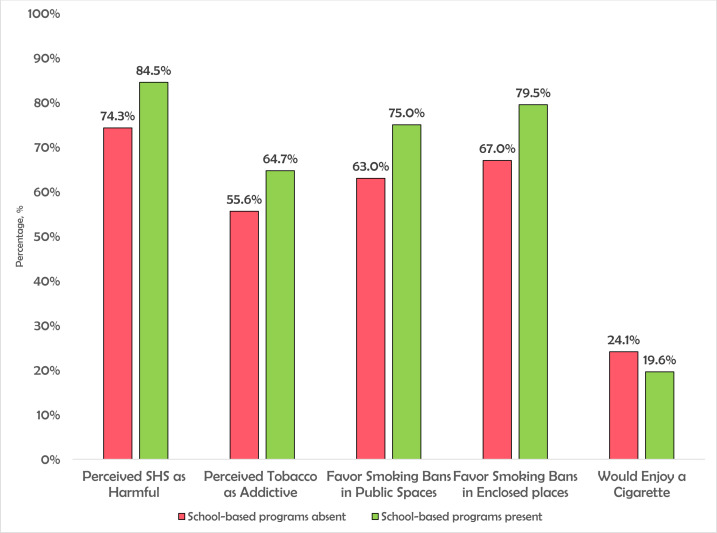
Exposure and outcome measures: The primary independent variable for this study was self-reported exposure to school-based tobacco prevention programmes in the past year. Five psychosocial determinants of smoking were explored as outcomes: perceived addictiveness of nicotine, perceived harm of secondhand smoke exposure, support for restricting cigarette smoking at public indoor locations, support for restricting cigarette smoking at public outdoor areas and self-reported prediction of enjoying cigarette smoking. Multivariable logistic regression models were used to examine the relationship between exposure to school-based tobacco prevention programmes and study outcomes, controlling for sociodemographic and smoking-related characteristics of respondents.
Results: Overall, 59.1% of adolescents in LMICs self-reported exposure to school-based tobacco prevention programmes. The country-specific prevalence of adolescent exposure to school-based tobacco interventions ranged from 24.9% in the Comoros to 99.3% in Turkmenistan. Exposure to school-based tobacco interventions was significantly associated with greater secondhand smoke harm perceptions (adjusted OR (AOR): 1.69; 95% CI: 1.69 to 1.70), perceptions of addictiveness (AOR: 1.37; 95% CI: 1.36 to 1.37) and supporting tobacco use restrictions indoors (AOR: 1.70; 95% CI: 1.69 to 1.70) and outdoors (AOR: 1.59; 95% CI: 1.59 to 1.60). Exposure to school-based tobacco interventions was associated with lower odds of anticipating enjoying cigarette smoking (AOR: 0.76; 95% CI: 0.76 to 0.76).
Conclusion: Exposure to tobacco prevention programmes in schools is suboptimal in LMICs. Given the protective associations described in this study from school-based tobacco prevention programme exposure, it is imperative that national governments implement school-based programmes into ongoing tobacco control measures.
Keywords: EPIDEMIOLOGY; Health policy; PUBLIC HEALTH.
© Author(s) (or their employer(s)) 2024. Re-use permitted under CC BY-NC. No commercial re-use. See rights and permissions. Published by BMJ.
Conflict of interest statement
Competing interests: None declared.
Figures
References
-
- Forouzanfar MH, Afshin A, Alexander LT, et al. Global, regional, and national comparative risk assessment of 79 behavioural, environmental and occupational, and metabolic risks or clusters of risks, 1990–2015: a systematic analysis for the global burden of disease study 2015. Lancet (British Edition) 2016;388:1659–724. 10.1016/S0140-6736(16)31679-8 - DOI - PMC - PubMed
-
- World Health Organization . Guidelines for implementation of article 13 of the WHO framework convention on tobacco control (Tobacco advertising, promotion and sponsorship). Geneva, Switzerland: World Health Organization, 2008.
MeSH terms
Substances
LinkOut - more resources
Full Text Sources
Medical
Miscellaneous
