Association between disease-modifying antirheumatic drugs for rheumatoid arthritis and risk of incident dementia: a systematic review with meta-analysis
- PMID: 38413170
- PMCID: PMC10900342
- DOI: 10.1136/rmdopen-2023-004016
Association between disease-modifying antirheumatic drugs for rheumatoid arthritis and risk of incident dementia: a systematic review with meta-analysis
Abstract
Background: Dysregulation of several inflammatory cytokines including tumour necrosis factor (TNF) in dementia patients has also been identified as a key factor in the pathogenesis of rheumatoid arthritis (RA). We aimed to investigate the association of disease-modifying antirheumatic drugs (DMARDs) therapy for RA with risk of incident dementia.
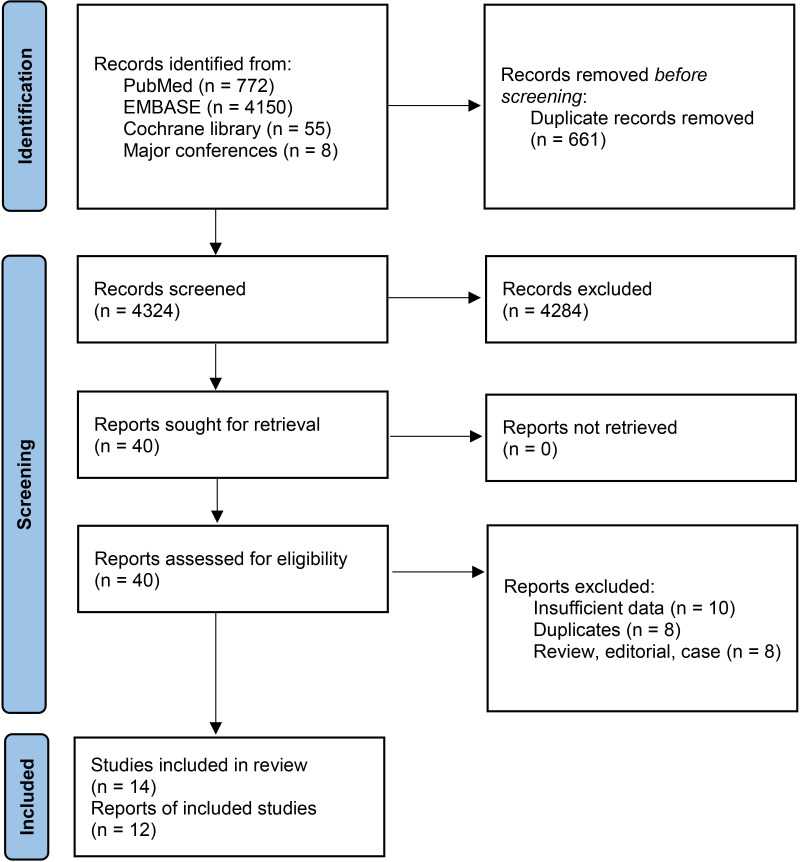
Methods: Electronic database searches of PubMed, EMBASE and Cochrane Library were performed. Observational studies that assessed the association of dementia with DMARDs in RA were included. Pooled risk ratios (RRs) with 95% CIs were used as summary statistic. The certainty of evidence was judged by using the Grading of Recommendations Assessment, Development and Evaluation system.
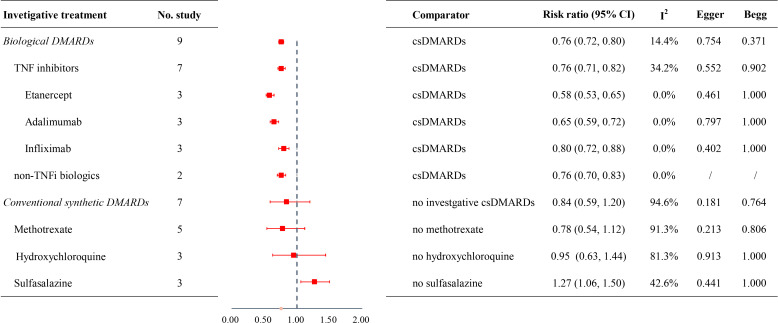
Results: Overall, 14 studies involving 940 442 patients with RA were included. Pooled RR for developing dementia was 0.76 (95% CI 0.72 to 0.80) in patients taking biological DMARDs overall versus those taking conventional synthetic DMARDs, with 24% for TNF inhibitors (RR 0.76, 95% CI 0.71 to 0.82), 24% for non-TNF biologics (RR 0.76, 95% CI 0.70 to 0.83), separately. There was a significant subgroup effect among different types of TNF inhibitors (RR 0.58 [95%CI 0.53 to 0.65], 0.65 [95% CI 0.59 to 0.72], 0.80 [95% CI 0.72 to 0.88] for etanercept, adalimumab, infliximab, respectively; p value between groups=0.002). However, compared with non-users of DMARDs or investigative treatment, no significant effect on dementia incidence was observed in those receiving conventional synthetic DMARDs overall (RR 0.84, 95% CI 0.59 to 1.20), methotrexate (RR 0.78, 95% CI 0.54 to 1.12), hydroxychloroquine (RR 0.95, 95% CI 0.63 to 1.44), except for sulfasalazine (RR 1.27, 95% CI 1.06 to 1.50).
Conclusions: Biological DMARDs for RA are associated with decreased dementia risk, while protective effect is not observed in conventional synthetic DMARDs. Controlled clinical trials on TNF inhibitors are necessary to test their neuroprotective potentials.
Keywords: Biological Therapy; Methotrexate; Rheumatoid Arthritis.
© Author(s) (or their employer(s)) 2024. Re-use permitted under CC BY-NC. No commercial re-use. See rights and permissions. Published by BMJ.
Conflict of interest statement
Competing interests: None declared.
Figures
References
-
- Nichols E, Steinmetz JD, Vollset SE, et al. . Dementia forecasting collaborators. estimation of the global prevalence of dementia in 2019 and forecasted prevalence in 2050: an analysis for the global burden of disease study 2019. The Lancet Public Health 2022;7:e105–25. 10.1016/S2468-2667(21)00249-8 - DOI - PMC - PubMed
-
- Nichols E, Szoeke CEI, Vollset SE, et al. . Dementia collaborators. global, regional, and national burden of Alzheimer’s disease and other Dementias, 1990-2016: a systematic analysis for the global burden of disease study 2016. The Lancet Neurology 2019;18:88–106. 10.1016/S1474-4422(18)30403-4 - DOI - PMC - PubMed
Publication types
MeSH terms
Substances
LinkOut - more resources
Full Text Sources
Medical