Review
. 2024 Feb 27;13(1):12.
doi: 10.1186/s40035-024-00404-1.

Therapeutics for neurodegenerative diseases by targeting the gut microbiome: from bench to bedside

Affiliations
Review

Therapeutics for neurodegenerative diseases by targeting the gut microbiome: from bench to bedside

Yuan-Yuan Ma et al. Transl Neurodegener. .

Abstract

The aetiologies and origins of neurodegenerative diseases, such as Alzheimer's disease (AD), Parkinson's disease (PD), amyotrophic lateral sclerosis (ALS) and Huntington's disease (HD), are complex and multifaceted. A growing body of evidence suggests that the gut microbiome plays crucial roles in the development and progression of neurodegenerative diseases. Clinicians have come to realize that therapeutics targeting the gut microbiome have the potential to halt the progression of neurodegenerative diseases. This narrative review examines the alterations in the gut microbiome in AD, PD, ALS and HD, highlighting the close relationship between the gut microbiome and the brain in neurodegenerative diseases. Processes that mediate the gut microbiome-brain communication in neurodegenerative diseases, including the immunological, vagus nerve and circulatory pathways, are evaluated. Furthermore, we summarize potential therapeutics for neurodegenerative diseases that modify the gut microbiome and its metabolites, including diets, probiotics and prebiotics, microbial metabolites, antibacterials and faecal microbiome transplantation. Finally, current challenges and future directions are discussed.

Keywords: Circulatory system; Gut microbiome; Immune system; Microbiome-targeted therapies; Neurodegenerative disease; Vagus nerve.


Conflict of interest statement

The authors declare that they have no competing interests.

Figures
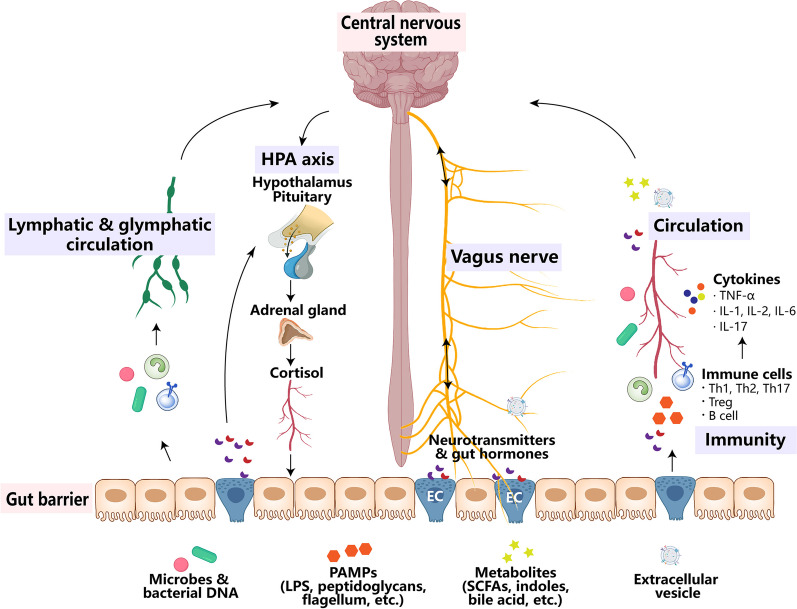
Fig. 1
Fig. 1
Overview of the gut microbiome-brain axis. Communications between the gut microbiome and the central nervous system (CNS) involve circulatory, immunological, vagus nerve, lymphatic and glymphatic, and neuro-endocrine (hypothalamic-pituitary-adrenal [HPA] axis) pathways. Gut microbes, their products (pathogen-associated molecular pattern [PAMPs] and extracellular vesicles) and metabolites, and gut neurotransmitters and hormones secreted by enteroendocrine cells, can transport to the CNS via peripheral circulation and impaired blood-brain barrier; they also interact with the host immune system and affect the CNS via blood circulation or lymphatic and glymphatic system. In addition, microbes and bacterial DNA can also translocate into the mesenteric lymphatic nodes. The vagus nerve transmits neural signals from the CNS to the gut, and also transports gut signals (activated by metabolites or neurotransmitters and hormones secreted by enteroendocrine cells) or gut microbiome-derived products like extracellular vesicles to the CNS. The HPA axis is a major neuro-endocrine system responding to stress by the release of cortisol from the adrenal cortex, which subsequently regulates the gut immune system and influences the gut microbiome composition. In turn, the gut microbiome can activate the HPA axis. EC enteroendocrine cell, IL interleukin, LPS lipopolysaccharide, SCFAs short-chain fatty acids, Th T helper cell, TNF-α tumour necrosis factor-α
Fig. 2
Fig. 2
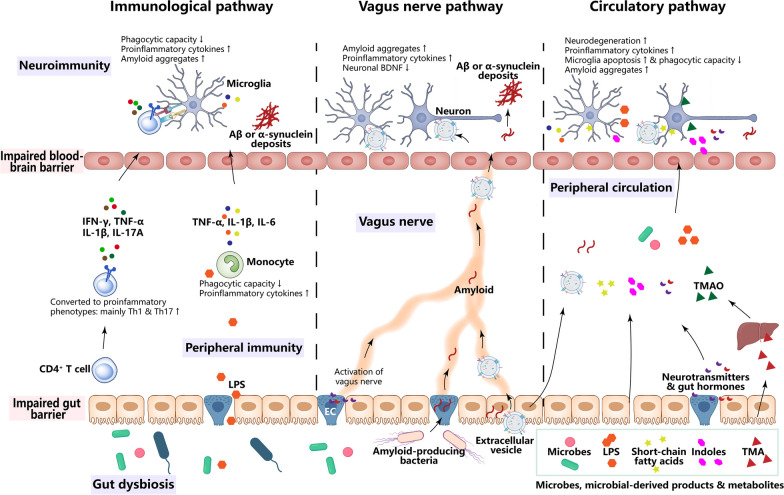
Routes by which microbes modulate neurodegenerative diseases. In the immunological pathway, gut microbe-derived products or metabolites (e.g., LPS) pass through the gut barrier and activate innate immune cells, primarily monocytes, and subsequently increase secretion of proinflammatory cytokines (TNF-α, IL-1β, IL-6, etc.) and reduce the phagocytic capacity of monocytes for amyloid proteins, leading to elevated neuroinflammation and amyloid aggregates in the brain. Gut dysbiosis also promotes the conversion of CD4+ T cells into proinflammatory phenotypes (Th1 and Th17), which secrete proinflammatory cytokines (IFN-γ, TNF-α, IL-1β, IL-17 A, etc.). These microbes can traverse the impaired blood-brain barrier and interact with microglia in the brain, exacerbating neuroinflammation. In the vagus nerve pathway, neurotransmitters and hormones secreted by enteroendocrine cells upon stimulation by the gut microbiome and its products can activate the vagus nerve. Amyloid-producing bacteria trigger gut amyloid accumulation, which is retrogradely transported to the brain via the vagus nerve. Gut microbe-derived extracellular vesicles can penetrate the brain through the vagus nerve and bloodstream, reducing BNDF expression in neurons and exacerbating neuroinflammation. In the circulatory pathway, microbes, their products, and neurotransmitters and hormones secreted by enteroendocrine cells can enter the peripheral circulation and cross the blood-brain barrier, leading to damage to neurons and microglia, reduced microglial phagocytic capacity, and increased neuroinflammation and amyloid aggregates in the brain. BDNF brain-derived neurotrophic factor, EC enteroendocrine cell, IFN-γ interferon-γ, IL interleukin, LPS lipopolysaccharide, Th T helper cell, TMA trimethylamine, TMAO trimethylamine-N‐oxide, TNF-α tumour necrosis factor-α
Fig. 3
Fig. 3
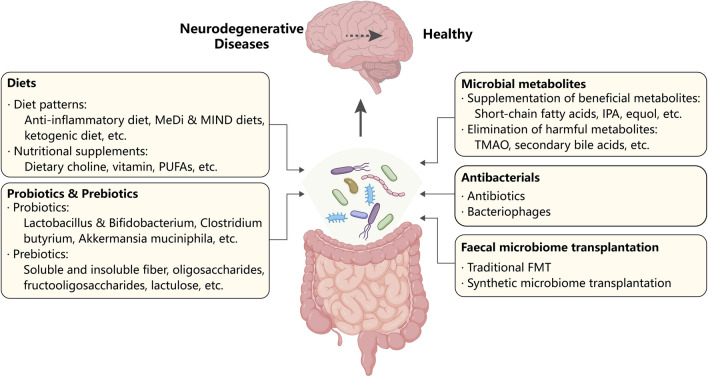
Potential strategies of gut microbiome-targeting therapies for neurodegenerative diseases. Diet (diet patterns and nutritional supplements), probiotics and prebiotics, microbial metabolites (supplementation of beneficial metabolites and elimination of harmful metabolites), antibacterials (antibiotics and bacteriophages) and faecal microbiome transplantation (traditional and synthetic microbiome transplantation) can all make the gut microbiome “healthy”, which prevents and alleviates neurodegenerative diseases. FMT faecal microbiome transplantation, IPA indole-3-propionic acid, MeDi Mediterranean, MIND Mediterranean-DASH Diet Intervention for Neurodegenerative Delay, PUFA polyunsaturated fatty acid, TMAO trimethylamine-N-oxide

References

    1. Ramanan VK, Saykin AJ. Pathways to neurodegeneration: mechanistic insights from GWAS in Alzheimer’s disease, Parkinson’s disease, and related disorders. Am J Neurodegener Dis. 2013;2(3):145–75. - PMC - PubMed
    1. Zhu Z, Yang Z, Yu L, Xu L, Wu Y, Zhang X, et al. Residential greenness, air pollution and incident neurodegenerative disease: a cohort study in China. Sci Total Environ. 2023;878:163173. - PubMed
    1. Wang J, Gu BJ, Masters CL, Wang Y-J. A systemic view of Alzheimer disease—insights from amyloid-β metabolism beyond the brain. Nat Rev Neurol. 2017;13(11):612–23. - PubMed
    1. Farrow SL, Cooper AA, O’Sullivan JM. Redefining the hypotheses driving Parkinson’s diseases research. NPJ Parkinsons Dis. 2022;8(1):45. - PMC - PubMed
    1. Ritz NL, Brocka M, Butler MI, Cowan CSM, Barrera-Bugueño C, Turkington CJR, et al. Social anxiety disorder-associated gut microbiota increases social fear. Proc Natl Acad Sci USA. 2023;121(1):e2308706120. - PMC - PubMed