


Association between filaggrin gene mutations and the clinical features of molluscum contagiosum: The Yamanashi Adjunct Study of the Japan Environment and Children's Study
- PMID: 38414183
- PMCID: PMC11484127
- DOI: 10.1111/1346-8138.17157
Association between filaggrin gene mutations and the clinical features of molluscum contagiosum: The Yamanashi Adjunct Study of the Japan Environment and Children's Study
Abstract
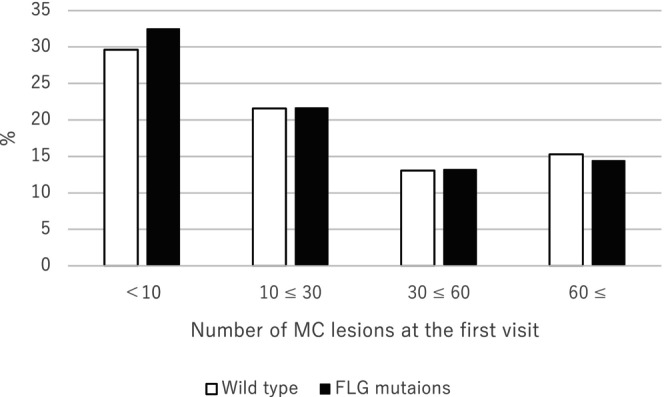
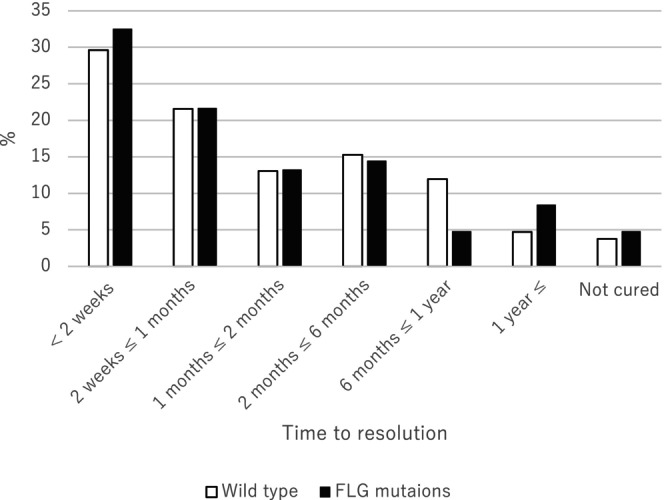
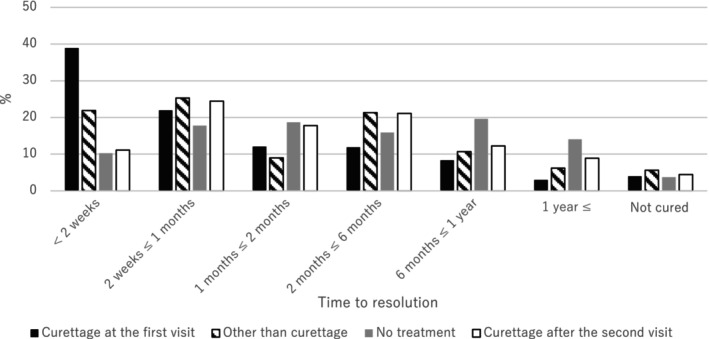
Previous studies have reported swimming, atopic dermatitis, and filaggrin (FLG) gene mutations as risk factors for molluscum contagiosum (MC) infection. FLG gene mutations impair skin barrier function. The aim of this study was to determine the impact of FLG mutations on the incidence and clinical features of MC. We used data from 2036 children who participated in the Yamanashi Adjunct Study of the Japan Environment and Children's Study, a prospective, birth cohort study. A questionnaire for caregivers (when children were 4 and 8 years of age) asked about clinical features including previous MC incidence and treatment, number of MC lesions at first visit, and time to resolution. Participants underwent genotyping to detect six FLG mutations that are common in the Japanese population. A logistic regression model was used to analyze the association between MC incidence and FLG mutations, adjusted for potential confounders. The cumulative incidence of MC at age 8 years was 47.1%. Among participants with a history of MC, 67.6% had undergone curettage. FLG mutation was a significant risk factor for MC incidence (adjusted odds ratio [aOR] 1.69, 95% confidence interval [CI] 1.18-2.42). Swimming and atopic dermatitis were also significant risk factors for MC. There was no significant association between FLG mutation and the number of MC lesions at the first visit or the time to resolution of lesions. FLG mutation is a risk factor for MC incidence; however, FLG mutations do not affect the number of MC lesions at presentation or the time to resolution.
Keywords: atopic dermatitis; filaggrin gene mutations; molluscum contagiosum; time to resolution; treatment modalities.
© 2024 The Authors. The Journal of Dermatology published by John Wiley & Sons Australia, Ltd on behalf of Japanese Dermatological Association.
Conflict of interest statement
None declared.
Figures
References
-
- Chen X, Anstey AV, Bugert JJ. Molluscum contagiosum virus infection. Lancet Infect Dis. 2013;13:877–888. - PubMed
-
- Berger EM, Orlow SJ, Patel RR, Schaffer JV. Experience with molluscum contagiosum and associated inflammatory reactions in a pediatric dermatology practice: the bump that rashes. Arch Dermatol. 2012;148:1257–1264. - PubMed
-
- Olsen JR, Gallacher J, Finlay AY, Piguet V, Francis NA. Time to resolution and effect on quality of life of molluscum contagiosum in children in the UK: a prospective community cohort study. Lancet Infect Dis. 2015;15:190–195. - PubMed
MeSH terms
Substances
Grants and funding
LinkOut - more resources
Full Text Sources
Molecular Biology Databases
Miscellaneous
